
Reviewed · GREEK THEATRE TOURS
Syracuse: Greek Theater and Neapolis Guided Private Tour
Syracuse’s ancient Neapolis Archaeological Park packs Greek drama, tyrants, stone quarries, Roman games, and a fine harbor view into a short walk. The Ear of Dionysus and the huge Greek theater are the stars, but the tour also reaches the Altar of Hieron II and Roman Amphitheater.
I like the private format, especially for a group that wants to ask questions or set its own pace within the two-hour schedule. I also like the range of languages and the chance to hear local stories from guides such as Rita and Cristina. The main drawback is time: two hours moves quickly through a large archaeological area.
In This Review
- Key points
- Why Neapolis is the right place to start in Syracuse
- The Latomie, where Syracuse cut its stone
- The Ear of Dionysus and its famous sound
- Cordari Cave and the changing use of the quarries
- The Greek theater, the tour’s main event
- The Altar of Hieron II and a ruler’s statement in stone
- The Roman Amphitheater and Syracuse after the Greeks
- The guide makes the difference in a two-hour visit
- Is $283.21 good value for your group?
- Who will enjoy this Syracuse tour?
- Should you book the Neapolis private tour?
- FAQ
- Where does the Syracuse Neapolis tour start?
- How long does the tour last?
- Is this a private tour?
- How much does the tour cost?
- Which languages are available?
- What monuments are included?
- Is a guide included?
- Does the Italian tour include anything extra?
- What happens if the weather is bad?
Key points
- The Ear of Dionysus: Hear the story of the cave’s name, its unusual shape, and its famous acoustics.
- A major Greek theater: See one of the largest Greek theaters in the Mediterranean from its upper terrace.
- Four major periods in one visit: The route covers Syracuse’s Greek, Hieronian, and Roman remains, along with the later use of the quarries.
- Private group up to 15: The $283.21 rate is per group, so the value improves when shared by several people.
- A five-language choice: Tours are offered in English, German, Italian, Spanish, and French.
- An Italian-only extra: If you choose an Italian tour, you can attend Il mito di Aretusa.
Why Neapolis is the right place to start in Syracuse
Syracuse was one of the important centers of the ancient Mediterranean, and Neapolis gives you a direct look at why. This is not a single monument surrounded by empty space. It is a broad archaeological area where quarries, theaters, religious buildings, and Roman remains tell different chapters of the same city.
Your guide meets you at the entrance, gives a short briefing, and explains the origins of Syracuse before you enter. That opening matters. Without some context, the park can feel like a collection of impressive stones. With the basic story in place, each stop has a clearer purpose.
I would choose this tour if you want a guided introduction rather than a long museum visit. The route focuses on outdoor monuments and the physical setting of the ancient city. You will spend most of the two hours moving between major sites, listening to explanations, and looking across the old quarry spaces and the harbor.
The private arrangement is useful here. A group of up to 15 people shares one booking, and you do not have to join a large mixed group. At $283.21 per group, the price is harder to justify for one or two people, but it can be reasonable for a family or larger party. For 10 people, it works out to about $28 per person. For the full 15-person group, it is about $19 per person, before any separate admission costs.
More Greek theatre visits around Syracuse:
- Syracuse: Neapolis and Greek Theater guided tour
★ 4.5 · 160 reviews - Greek Theater – Ortigia walking tour
★ 3.5 · 7 reviews - Syracuse: Greek Theater and Neapolis sunset tour
★ 5.0 · 4 reviews
The Latomie, where Syracuse cut its stone
The first major part of the park is the Latomie, the ancient stone quarries. Syracuse extracted building material here for centuries. These spaces also served as places of forced labor and imprisonment, giving the quarries a darker role than their peaceful appearance suggests today.
Over time, the quarry walls became covered with greenery. The result is a curious mix of raw cut stone and plant life. Your guide can help you read the walls as evidence of work, punishment, and city building rather than simply treating them as a scenic stop.
This is one reason a guide adds value. The shape of the quarries is easy to admire, but the human story is less obvious. The explanations connect the site to the growth of Syracuse and to the political power of its rulers.
The Latomie are also a good reminder that ancient cities were built through hard physical work. The grand theater and temples depended on stone being cut, moved, and shaped. You see the finished monuments later in the walk, but here you see part of the cost.
The Ear of Dionysus and its famous sound
Inside the Latomie, you reach the Ear of Dionysus, a cave known for its tall, curved form and unusual acoustics. Its name refers to the shape, while the story around it is tied to the tyrant Dionysius.
The guide explains both the legend and the history connected with the cave. This is a stop where the story can be as memorable as the stone itself. The cave’s shape gives it a strong visual identity, and its acoustics make it easy to understand why it has attracted so much attention.
Do not expect a long standalone visit here. It is one part of a larger route, and the guide then leads you toward the Cordari Cave. Still, the Ear of Dionysus is likely to be one of the stops you remember most clearly, especially if you enjoy places where physical features and old stories overlap.
The name can also create confusion, since it sounds like a mythological monument rather than a quarry cave. Your introductory explanation helps put it in context. You are seeing a space connected to Syracuse’s ancient quarry system, with later legends adding another layer to its identity.
Cordari Cave and the changing use of the quarries
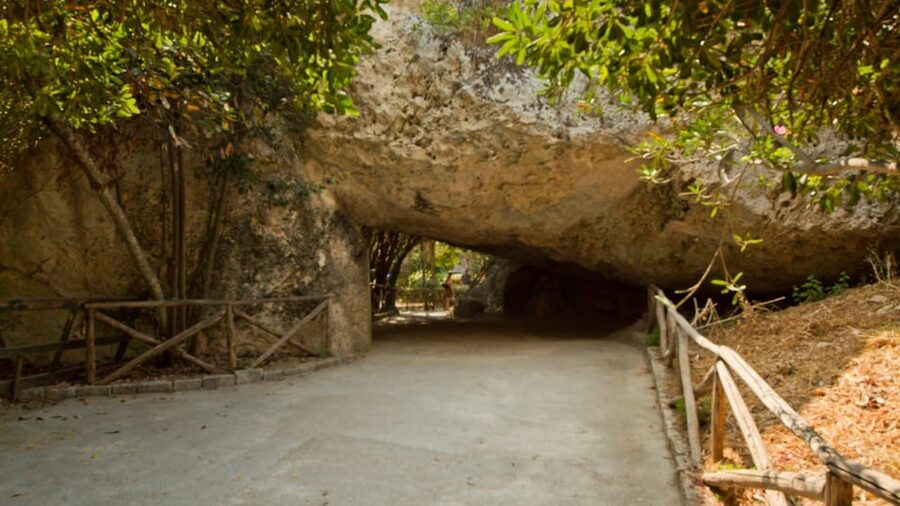
The route continues to the Grotta dei Cordari, or Cordari Cave. The supplied details do not promise a separate activity inside the cave, so think of this as a viewpoint and interpretation stop within the quarry area rather than a caving experience.
The Cordari name points to the working life associated with the space. Along with the Latomie, it shows how the area changed over time. These were not only ancient extraction sites. They were also places shaped by labor and later by new uses.
This part of the walk may appeal most to travelers who like the less obvious pieces of an archaeological site. The Greek theater gets the attention, but the quarries explain how the city functioned below the level of its grand public monuments.
A few more Syracuse tours and experiences worth weighing up
- Syracuse: Ortigia and Neapolis Guided Walking Tour
★ 4.7 · 205 reviews - From Syracuse: Mount Etna Guided Morning Hike & Food Tasting
★ 4.8 · 173 reviews - Syracuse: Highlights of Ortigia Guided Walking Tour
★ 4.2 · 136 reviews - Siracuse: Guided Velobike Tour
★ 4.5 · 116 reviews
The Greek theater, the tour’s main event
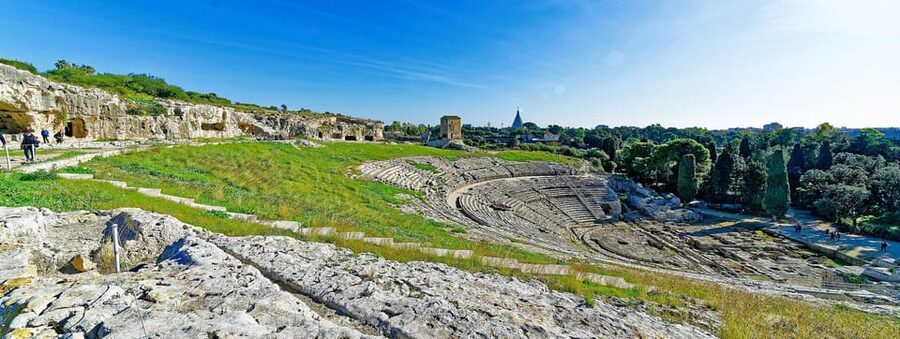
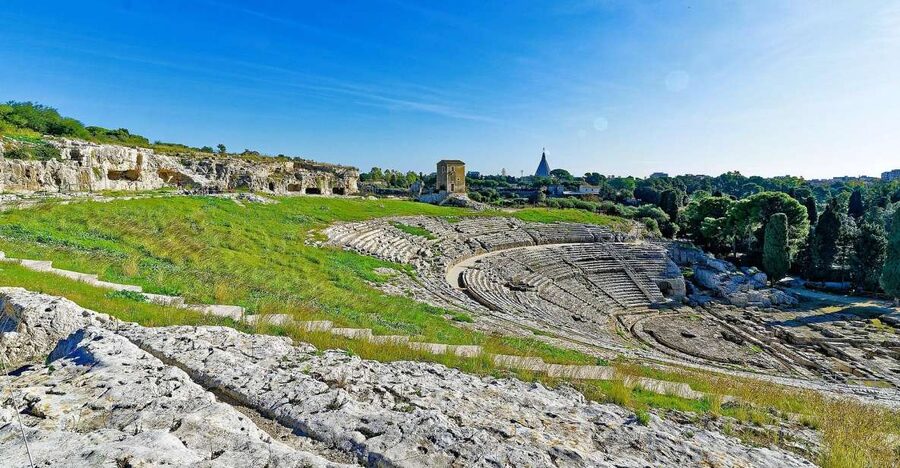
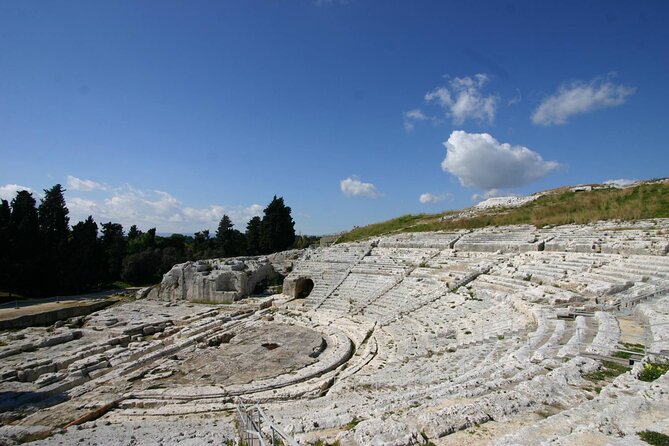
The Greek theater of Syracuse is the central attraction. It is described as one of the largest Greek theaters in the Mediterranean, and the scale becomes clear as you look across its broad seating area and stage setting.
The guide explains the theater within the story of the ancient polis of Syracuse. That context helps you see it as more than a large semicircle cut into stone. It was a public place tied to performance, civic life, and the identity of the city.
You approach the theater after the quarry stops, so the contrast is effective. The Latomie show the labor behind the city. The theater shows how Syracuse presented itself in public.
From the upper terrace, you can admire the Fountain of the Nymphaeum and the view toward the large port. This is one of the best moments for stepping back from the stones and seeing the connection between the archaeological park and the wider city.
The upper terrace is also a practical reason to keep your camera ready. The route offers more than close views of masonry. You get a broader view across the theater area and toward the harbor, which helps explain Syracuse’s position as a major Mediterranean center.
A two-hour visit does not leave unlimited time to sit and study every part of the theater. If you want a slow, highly detailed examination of the seating, stage, and surrounding remains, you may find the schedule brisk. The advantage is that you see the theater along with several other major monuments instead of spending the entire visit in one location.
The Altar of Hieron II and a ruler’s statement in stone
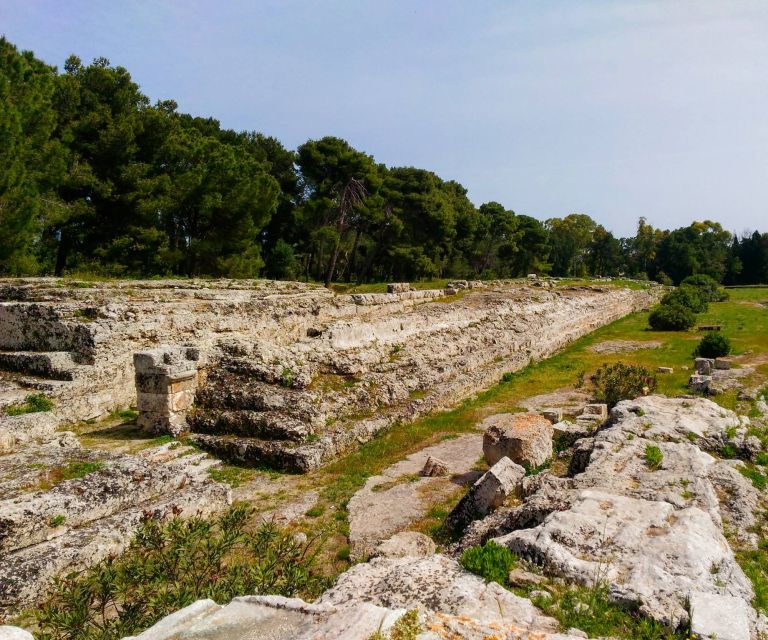
After leaving the theater, the tour moves to the Altar of Hieron II. It is described as the largest stone altar built in the Greek world, so this is another stop where scale is the point.
An altar of this size tells you something about public ceremony and royal ambition. Hieron II was not making a private religious offering. A monument on this scale required resources, planning, and a public setting.
The stop also gives your guide a chance to place Syracuse within the political story of the ancient Mediterranean. The tour is not limited to architecture. It follows how rulers, religious customs, and civic life shaped the city.
At this point, you have moved from quarries to theater to altar. The sequence works well because each monument shows a different side of Syracuse: labor, entertainment, ceremony, and power.
The Roman Amphitheater and Syracuse after the Greeks
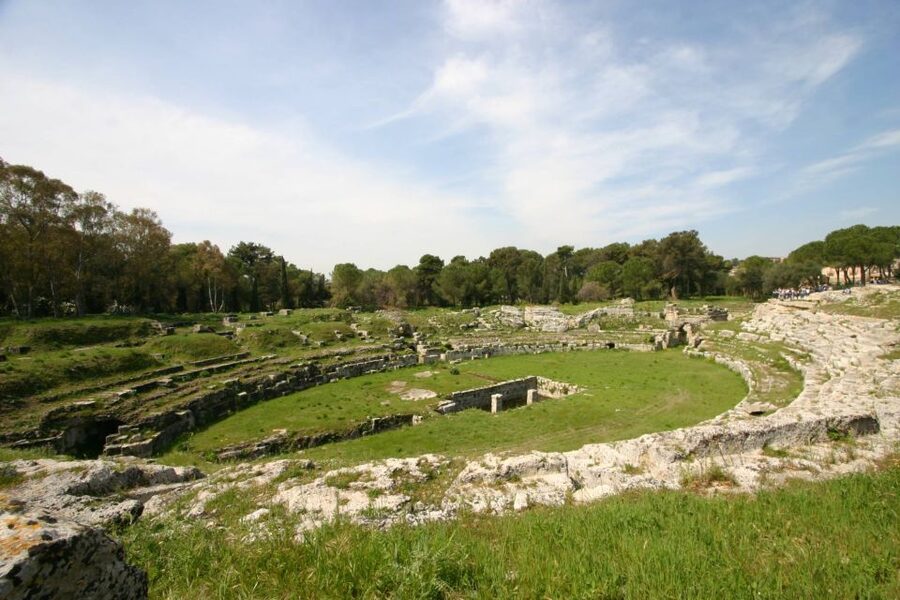
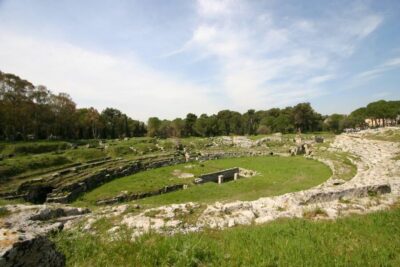
The final monument is the Roman Amphitheater, where the guide explains the Roman phase of Syracuse. You will learn about the building’s features and the gladiatorial games held there.
This is an important change of tone. The Greek theater reflects Greek public culture, while the amphitheater introduces the Roman world and its taste for staged combat. Seeing both buildings in one visit makes it easier to understand that Syracuse did not stop developing after its Greek period.
The amphitheater also keeps the tour from becoming a single-period history lesson. You begin with the origins of the city and Greek monuments, then move through Hieronian construction and finish with Roman use of the site.
As with the theater, the value comes from seeing the structure while hearing how it worked. The surviving stone does not automatically explain the audience, the games, or the building’s role. A guide’s account gives the remains a practical meaning.
The guide makes the difference in a two-hour visit
This experience depends heavily on the guide. In two hours, you need someone who can explain the main points without burying you in dates and names. Rita is specifically praised for her strong grasp of the history and for making the tour enjoyable for her group. Cristina is also highlighted for explaining details clearly and for helping bring out the beauty of the park and its natural setting.
Those two names are useful when you book, although guide assignment is not stated as guaranteed. The available languages are English, German, Italian, Spanish, and French, so you can choose the language that lets you follow the myths and historical details most easily.
The private format should suit families, friends, and groups with mixed interests. You can ask about the Ear of Dionysus, the Roman games, or the history of Syracuse without waiting for a large group to catch up. It also gives you a better chance to clarify what you are looking at when several monuments appear close together.
The trade-off is that a private tour is not automatically a slow tour. The duration remains two hours, and the park contains more than the listed highlights. I would arrive ready to walk from one major stop to the next and save any extended independent exploration for another visit.
Is $283.21 good value for your group?
The price is $283.21 for a private group of up to 15 people. That is a group rate, not a per-person rate, so the value changes sharply depending on how many people join.
For a small party, the cost is a significant outlay for a two-hour activity. You are paying for a certified guide and private attention, not for a full-day excursion, transportation, or a broad city tour. The listed inclusions do not mention entrance tickets, transport, food, or any other extras, so check the selected option carefully before booking.
For a larger group, the calculation looks better. Families and friend groups can split the price while keeping the advantages of a private guide. The language choice is another practical benefit if your group is more comfortable in Spanish, French, German, or Italian than in English.
The tour includes free cancellation up to 24 hours before the start time, and you can reserve now and pay later. Bad weather can lead to a modified or canceled reservation, so keep that possibility in mind when planning a tightly packed Syracuse itinerary.
Who will enjoy this Syracuse tour?
I would recommend it most strongly to you if:
- You want the main monuments of Neapolis explained in one organized visit.
- You prefer a private guide to a large shared group.
- Your party has enough people to share the group price.
- You want to connect the Greek and Roman periods of Syracuse.
- You enjoy myths and stories alongside archaeology.
- You need a choice of English, German, Italian, Spanish, or French.
It is less suitable if you want to explore every corner at a slow pace. The two-hour duration is efficient, but it leaves limited time for lingering. It may also feel expensive for one or two people, especially since only a certified guide is specifically included.
The Italian option has one extra attraction: attendance at Il mito di Aretusa. If that show is important to you, confirm the exact option and timing before paying, since it is tied to the Italian-language tour.
Should you book the Neapolis private tour?
Book it if you want a focused introduction to Syracuse’s ancient center and can share the price across a group. The route gives you the Ear of Dionysus, Latomie, Cordari Cave, Greek theater, Fountain of the Nymphaeum viewpoint, Altar of Hieron II, and Roman Amphitheater in a logical two-hour circuit.
I especially like the way the tour moves from quarry labor to Greek public life, royal ceremony, and Roman entertainment. Rita and Cristina are names worth noting when you make your request, though the specific guide is not guaranteed.
Skip it if you want a very slow archaeological study or if you are traveling alone and trying to keep costs low. For a family or private party seeking clear explanations and the major sights without a full-day commitment, this is a strong way to get your bearings in Neapolis.
FAQ
Where does the Syracuse Neapolis tour start?
You meet the guide at the entrance of the Neapolis Archaeological Park in Syracuse. The exact meeting point may vary depending on the option booked.
How long does the tour last?
The tour lasts two hours. Starting times depend on availability.
Is this a private tour?
Yes. It is offered as a private group experience for up to 15 people.
How much does the tour cost?
The listed price is $283.21 per group of up to 15 people.
Which languages are available?
The live guide can conduct the tour in English, German, Italian, Spanish, or French.
What monuments are included?
The route includes the Latomie, Ear of Dionysus, Cordari Cave, Greek theater, Fountain of the Nymphaeum viewpoint, Altar of Hieron II, and Roman Amphitheater.
Is a guide included?
Yes. A certified guide is included.
Does the Italian tour include anything extra?
If you choose the Italian-language tour, you can attend Il mito di Aretusa.
What happens if the weather is bad?
In bad weather, the reservation may be modified or canceled. You can cancel up to 24 hours in advance for a full refund, and the reserve-now, pay-later option lets you keep your plans flexible.
Just added around Syracuse
- Sicily Boats Avola: Plemmirio boat tour 4 people 4 hours★ 5.0 · 3 reviews
- From Syracuse: Private Taormina and Castelmola tour with lunch★ 5.0 · 3 reviews
- Siracusa Iris Photography Experience★ 5.0 · 3 reviews
- Siracusa E-bike rental service★ 5.0 · 3 reviews
- Tour Ragusa Ibla, Modica and Noto, from Syracuse★ 5.0 · 3 reviews
- Cyclops Tour★ 4.5 · 3 reviews
- Archaeological Syracuse: Neapolis Park private tour★ 5.0 · 3 reviews
- Tour of Syracuse by Ape Calessino★ 3.0 · 3 reviews
Greek Theatre Tours, compared.
Guided tour of the Greek Theater and the Neapolis of Syracuse
Read our review →
Skip-the-Line Taormina Half Day Greek Theater and Historic Center
Read our review →
Excursion HALF DAY- Syracuse Greek Theatre and the island of Ortigia.
Read our review →
Browse the lists this tour appears in