
Reviewed · WALKING TOURS
3-hour walking tour Discovering Ragusa Baroque
Ragusa’s best feature is its split personality: the newer upper town sits above old Ibla, and this tour walks you between them by way of churches, stairways, balconies, and sweeping views. Guide Serena fills the route with stories about the 1693 earthquake, local saints, architecture, and the rivalry between the two parts of town.
I like the small groups of no more than 10 and the smart downhill route, which makes the walk easier than climbing from Ibla to Ragusa Superiore. I also like that Serena is praised for clear English, patient answers, restaurant advice, and an easy way of bringing church facades to life. The main drawback is simple: this is a step-heavy walk, with roughly 300 steps, and some people may find the many church stops a little long.
In This Review
- Key points before you book
- Why this Ragusa route works so well
- San Giovanni Battista Cathedral sets the story
- Santa Maria delle Scale and the first view of Ibla
- Baroque balconies turn a walk into a close-up lesson
- Santa Maria dell’Itria and Palazzo Cosentini
- San Giorgio brings you into the center of Ibla
- Conversation Club, Benedictine church, and the old Saint George portal
- Iblean Gardens provide a gentle finish
- What Serena adds to the experience
- Steps, timing, and what to wear
- Who will get the most from the $78.44 price
- Should you book Discovering Ragusa Baroque?
- FAQ
- Where does the tour begin?
- Where does the tour end?
- How long does the walking tour last?
- Is the tour offered in English?
- How many people can join the tour?
- Is the tour suitable for people with reduced mobility?
- Can I cancel for a full refund?
Key points before you book
- Start high and walk down: The route begins at San Giovanni Battista’s Cathedral in Ragusa Superiore and finishes near the Iblean Gardens in Ibla.
- See more than the headline churches: The walk includes Baroque palaces, carved balconies, old portals, the Conversation Club, and several churches that are easy to miss alone.
- Serena leads in clear English: Her approach combines architecture, local stories, Sicilian history, and practical tips for the rest of your stay.
- Expect about 300 steps: Comfortable sneakers are essential, and the tour is not suited to people with reduced mobility.
- The views are part of the reward: The descent toward Ibla opens up a memorable panorama of Ragusa’s lower town.
- Small-group value: With a maximum of 10 people, it should feel more like a guided walk than a crowded procession.
Why this Ragusa route works so well
I like walking tours that use a city’s shape as part of the story. This one does exactly that. You begin at Piazza San Giovanni in Ragusa Superiore, then descend toward Ragusa Ibla, the older quarter, through a string of churches and Baroque streets.
That route gives you more than a checklist of monuments. You see how Ragusa developed into two connected but distinct towns, and you feel the change under your feet. The stairways are not just a way to get from one stop to the next. They explain why the upper and lower sections of Ragusa feel so different.
The experience lasts about three hours, including walking and time between sites. That is enough time to get a useful introduction without giving up an entire day. Serena’s style appears to be story-led rather than rushed. She explains the history of each place, answers questions, and adds details about art, architecture, food, and nearby places to visit.
The tour is offered in English and costs about $78.44 per person. That is not a bargain-priced orientation walk, but the value depends on what you want. If you only need directions and a few dates, it is expensive. If you want the churches opened when possible, a clear explanation of Ragusa’s Baroque character, and help understanding the relationship between upper Ragusa and Ibla, the price is easier to justify.
More walking tours in Ragusa:
- Ragusa Ibla: Walking Tour with Local Guide
★ 4.4 · 8 reviews - Scicli: Guided Walking Tour in Baroque City Center
★ 4.3 · 3 reviews - Palermo: NO Mafia Walking Tour
★ 4.8 · 2,431 reviews
San Giovanni Battista Cathedral sets the story
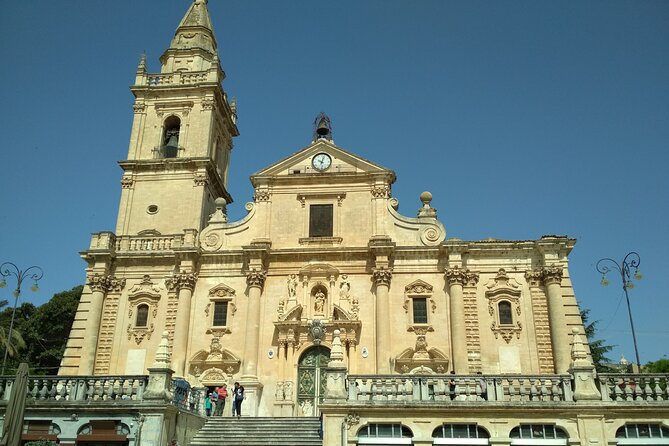
The tour begins at San Giovanni Battista’s Cathedral, at Piazza San Giovanni 41/45. This is a useful starting point because the cathedral immediately introduces Ragusa’s late Baroque style.
You first see the exterior, including its broad facade, terrace, balustrade, and side gardens. Serena explains the church’s history and the feast of Ragusa’s patron saint before taking you inside. Admission is included, so you do not need to budget a separate entrance fee for this stop.
Give yourself a moment to look at the cathedral’s position in the square. The staircase and formal facade create the kind of grand urban setting that makes Baroque architecture feel theatrical. The building is also part of the UNESCO-listed Baroque heritage of southeastern Sicily, so this is not a minor opening stop.
The interior visit depends on the time of day and season. That qualification matters throughout the tour. You should expect Serena to explain the church even if the interior is not available, but you should not book this walk assuming every church will be open for a full visit.
Santa Maria delle Scale and the first view of Ibla
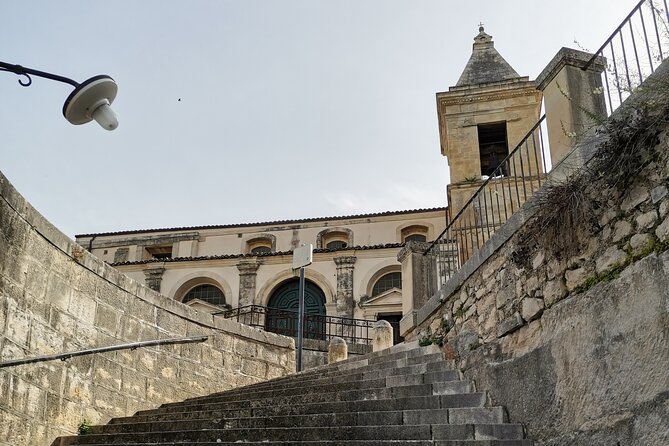
From the cathedral, the route heads downhill toward Santa Maria delle Scale. This is where the walk begins to feel like a journey through Ragusa rather than a series of isolated buildings.
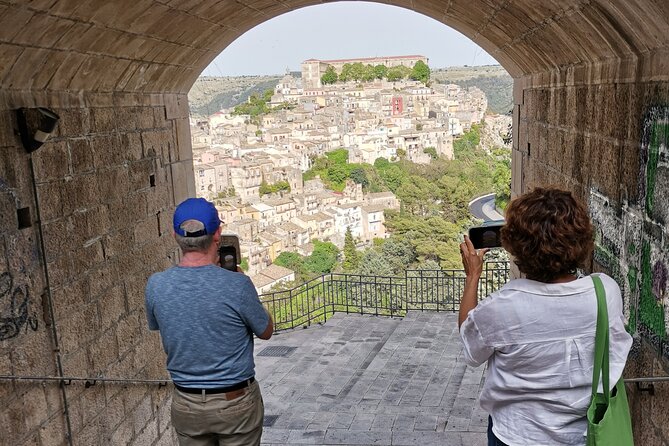
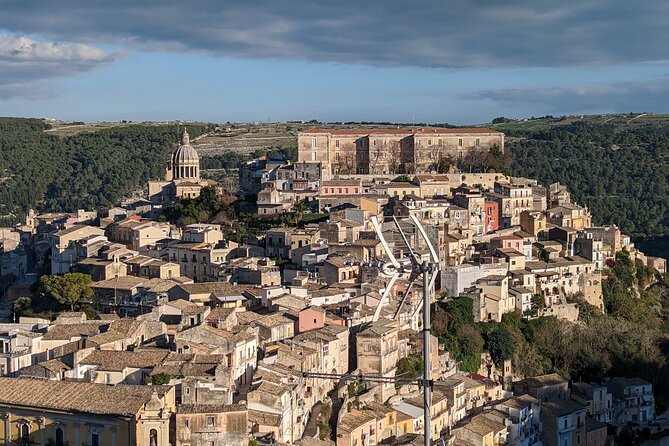
The church is another UNESCO-recognized site, but the stairs around it are just as important. As you descend, you reach a panoramic viewpoint over Ibla. Depending on the season and time of day, you may also go inside Santa Maria delle Scale.
The church is especially useful for understanding Ragusa before the earthquake. Its interior can offer a glimpse of an earlier architectural style, before much of the city was rebuilt or reshaped in the late Baroque period. Serena uses the building to connect the older city with the grander style that follows.
This is also one of the places where the physical effort pays off. The view gives you a strong sense of Ibla’s position below, and the route makes the two sections of Ragusa feel like parts of one story. Bring water, especially in warm weather, and avoid slick shoes. The steps are a real part of the experience, not a minor inconvenience.
Baroque balconies turn a walk into a close-up lesson
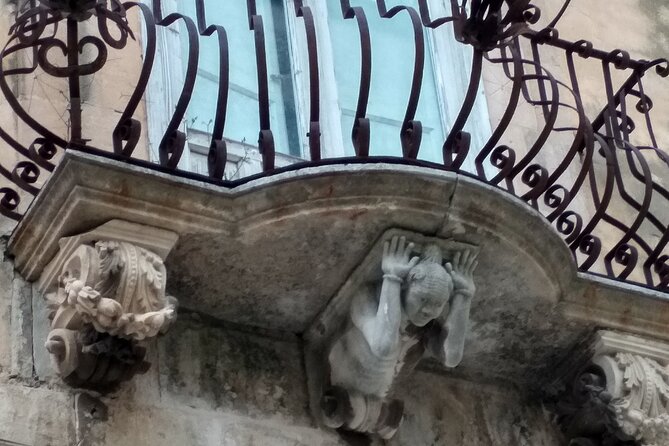
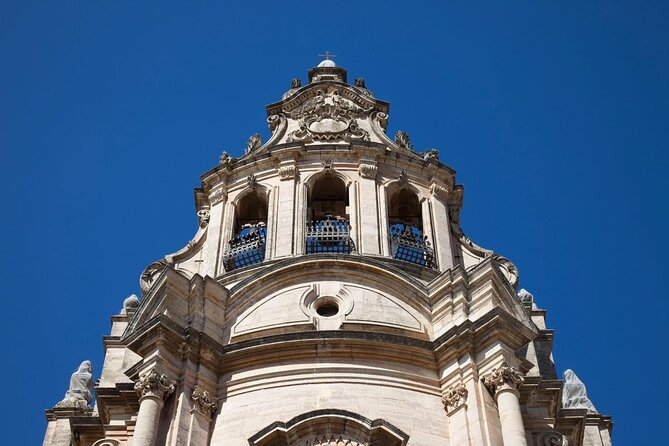
Several short stops focus on Ragusa’s Baroque palaces and their balconies. The most memorable details are the grotesque masks carved into the stone.
One building has six balconies decorated with these expressive faces. Other facades feature richly ornamented balconies and more grotesque figures. From a distance, Ragusa’s Baroque architecture can look grand and uniform. Up close, the masks give it personality, humor, and a slightly strange edge.
This is where a guide earns the walking-tour fee. Alone, you might photograph the balconies and move on. Serena points out the decorative details and explains how they fit the local style. She also draws your attention to the way balconies project from the facades and how the stonework changes from one palace to another.
Do not expect each palace stop to be a formal interior visit. These are primarily exterior viewing points, woven into the walk between churches. That is a strength if you enjoy street-level detail, but someone who wants only major interiors may find the number of facade stops excessive.
A few more Ragusa tours and experiences worth weighing up
- Discover Palermo in 3 hours. Art, history, markets and street food
★ 5.0 · 352 reviews - Discover the Charm of Palermo: A 3-Hour UNESCO Sites Walking Tour
★ 5.0 · 264 reviews - Boat excursion in Cefalù and snorkeling 3 hours fruit and drink
★ 4.5 · 85 reviews - 3-Hour Dolphin watching at sunset with aperitif
★ 5.0 · 67 reviews
Santa Maria dell’Itria and Palazzo Cosentini
The next major church is Santa Maria dell’Itria. Serena explains the church’s story and its connection with Palazzo Cosentini, whose late Baroque facade is one of the route’s architectural highlights.
The palace was once connected internally to the church. That detail gives the stop more depth than a simple look at a decorated building. You get a sense of how religious and private spaces were once linked, and how the town’s buildings worked together rather than existing as separate attractions.
Palazzo Cosentini is particularly good for seeing the theatrical side of Ragusa’s architecture. Its facade and balconies carry the same local taste for ornate stonework and grotesque figures, but the details are easier to appreciate when someone tells you where to look.
The interior of Santa Maria dell’Itria may be available depending on the time of day and the period of the year. Again, treat the inside visit as a possible bonus rather than the fixed heart of the stop. The exterior and the story connecting the church to the palace remain worthwhile.
San Giorgio brings you into the center of Ibla
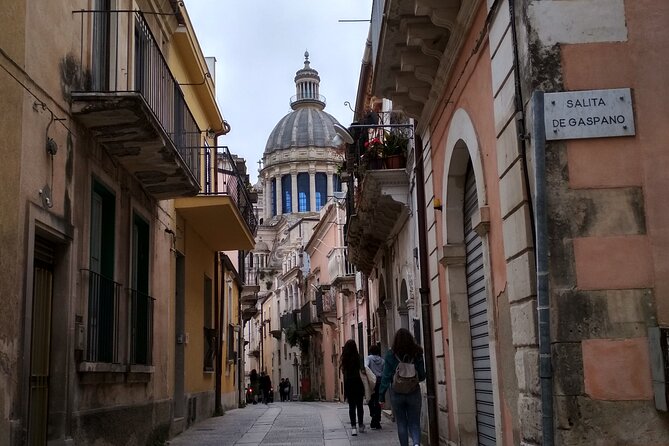
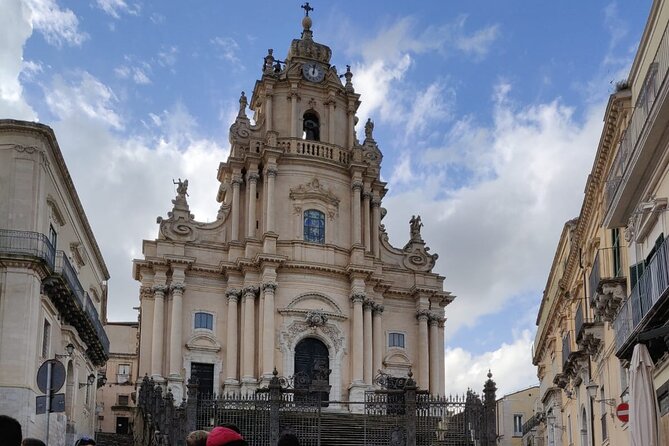
The route continues to the Duomo di San Giorgio, the dominant church of Ragusa Ibla. Serena covers the church’s story, its saint, and the feast associated with him, then draws attention to the facade and its grand staircase.
This is one of the tour’s major visual moments. The stairs create a long approach, and the facade rises above them with the confident scale you expect from late Baroque Ragusa. After the smaller details of masks and balconies, San Giorgio gives you a grand public monument.
The interior visit depends on opening conditions, just as it does at the other churches. If you are particularly interested in seeing inside, ask Serena at the start about the likely timing. The tour schedule may need to adapt to church hours, and the supplied information makes clear that seasonal and daily access can vary.
The route’s order is sensible. By the time you reach San Giorgio, you have already seen earlier architectural traces, smaller churches, and residential decoration. The duomo then feels like a high point in the story, not simply another church on a long list.
Conversation Club, Benedictine church, and the old Saint George portal
Near San Giorgio, the walk pauses at the Conversation Club, also called the Café of the Knights. It is known as a filming location for scenes from the Inspector Montalbano fiction.
This will appeal to fans of the series, but the stop has value even if you have never watched it. It adds a social and civic note to a route otherwise centered on religious buildings and palaces. You see how Ragusa’s historic spaces have continued to serve as settings for public life and popular culture.
The tour then takes in the late Baroque facade of a Benedictine church. If open, you may visit its precious oval-shaped interior. The oval plan gives this church a different visual character from the larger cathedral spaces, and it is the kind of architectural feature that can be easy to miss without guidance.
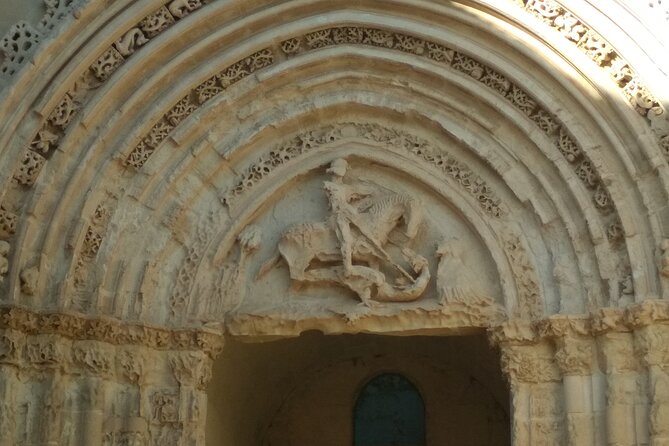
Another stop is the ancient portal of Saint George church. This surviving portal is important because it preserves a style from before the earthquake. It helps you compare the older architectural language with the Baroque rebuilding seen across Ibla.
These shorter stops make the route feel broad. You are not limited to the two best-known churches. You also see fragments, civic buildings, and smaller architectural clues that explain how the town changed over time.
Iblean Gardens provide a gentle finish
The walk ends at the Giardini Iblei, or Iblean Gardens, near Via Giardino in Ragusa Ibla. The gardens are described as Ibla’s green lung and include three churches.
Depending on the season and time of day, the tour may include visits to the churches of St. James and St. Agata. As with the other interiors, access can vary. The garden itself provides a pleasant change after the stone steps, crowded facades, and formal church interiors.
This is a practical ending point. The tour finishes near an urban bus stop and taxi stop, so you can continue exploring Ibla, return to upper Ragusa, or head onward without retracing the full route. If you are staying in the lower town, you can simply continue on foot from here.
I would leave room in your schedule after the tour. The route may take the full three hours and can run longer if the group has questions or if Serena takes extra time at a church. That relaxed pace is part of the appeal, but it is worth knowing if you have a tightly timed dinner, bus, or train.
What Serena adds to the experience
The guide makes a major difference here. Serena is repeatedly praised for clear English, detailed explanations, patience, warmth, and positive energy. She covers Sicilian history, local architecture, art, church traditions, and the relationship between upper and lower Ragusa.
I especially like the practical side of her approach. She has helped with directions before the tour, stayed in touch through WhatsApp, adapted to a group’s needs, and offered suggestions for restaurants and places to visit elsewhere in the area. That kind of help can be useful in Ragusa, where the steep layout and divided town centers can make planning less obvious than a map suggests.
Her calm, focused manner should suit people who want plenty of information without being hurried. She also appears comfortable answering questions, which matters on a tour with many historic sites. The only caution is that her detailed approach can make the walk feel long for anyone who prefers a quick overview.
With a maximum of 10 people, you should have a better chance of hearing explanations and asking questions than on a large city tour. Group discounts are available, but the exact saving is not specified, so check the price for your party before booking.
Steps, timing, and what to wear
This is not a flat stroll. The route includes many steps, with roughly 300 steps noted by one participant, and descends from Ragusa Superiore to Ibla.
Wear comfortable sneakers. That is the most useful piece of advice for this experience. You should also plan your day so you arrive at the starting cathedral with time to spare, particularly if you are staying in lower Ragusa and need to reach the upper town by bus or taxi.
The tour is not recommended for people with reduced mobility. Most people can participate, and service animals are allowed, but the stairways and uneven walking route make this a poor choice if you need a step-free itinerary.
The tour requires good weather. If conditions force cancellation, you can choose another date or receive a full refund. You can also cancel for a full refund up to 24 hours before the start time. Changes or cancellations made later are not accepted for a refund.
Who will get the most from the $78.44 price
I would recommend this tour to you if Ragusa is a priority and you want to understand more than its pretty streets. It is particularly useful for a first visit, a short stay, or a day when you want a local guide to organize the route between the upper town and Ibla.
The price makes the most sense for people who value context. You are paying for three hours with a guide who explains why the buildings look as they do, points out details you could walk past, and connects churches, earthquake history, local customs, and urban design.
It is less suitable if you prefer to explore at your own pace, spend long stretches inside one church, or avoid stairs. You can see many of the exteriors without a guide, and the tour includes several short facade stops rather than lengthy visits at every building.
The strongest value comes from the combination of route and interpretation. You start at a major cathedral, descend through older and newer layers of Ragusa, pause for views, and end in the gardens of Ibla. That is a well-shaped introduction to the city, not just a collection of addresses.
Should you book Discovering Ragusa Baroque?
Book it if you want a well-organized walk through both Ragusa Superiore and Ragusa Ibla, and if churches, Baroque stonework, local stories, and scenic viewpoints interest you. Serena’s clear English, patient style, and practical advice add real value, especially if you are new to the city.
Skip it if 300 steps sounds daunting, if you want a short and casual look at Ragusa, or if your schedule cannot handle a tour that may run beyond three hours. For everyone else, this is one of the better ways to see how Ragusa’s two towns fit together, with enough history to make the architecture meaningful and enough walking to keep the experience grounded in the city itself.
FAQ
Where does the tour begin?
The tour begins at San Giovanni Battista’s Cathedral, Piazza San Giovanni 41/45, in Ragusa Superiore.
Where does the tour end?
It ends near the Iblean Gardens in Ragusa Ibla, close to an urban bus stop and taxi stop.
How long does the walking tour last?
The tour lasts approximately three hours, including the walking time between attractions.
Is the tour offered in English?
Yes. The tour is offered in English and is led by Serena.
How many people can join the tour?
The group has a maximum of 10 travelers.
Is the tour suitable for people with reduced mobility?
No. The route includes many steps and is not recommended for people with reduced mobility.
Can I cancel for a full refund?
Yes. You can cancel at least 24 hours before the local start time for a full refund. Cancellations or changes made less than 24 hours before the start time are not refunded.
Just added around Ragusa
- Modica private tour: the chocolate town in Sicily★ 5.0 · 3 reviews
- Scicli: Guided Walking Tour in Baroque City Center★ 4.3 · 3 reviews
- Tour in the heady scents of our garden in Ragusa★ 5.0 · 4 reviews
- Scicli – Bonelli Patané Palace: exclusive private tour★ 4.6 · 4 reviews
- Private tour of the Baroque cities of Eastern Sicily★ 4.5 · 5 reviews
- Ragusa Countryside Home Cooking Class & Meal★ 4.8 · 6 reviews
- Radici: IImmerse yourself in the heady scents of our garden★ 4.7 · 7 reviews
- Ragusa Ibla: Walking Tour with Local Guide★ 4.4 · 8 reviews
Walking Tours, compared.
Palermo Original Street Food Walking Tour by Streaty
Read our review →
Palermo No Mafia walking tour: discover the Anti-mafia culture in Sicily
Read our review →
Street Food Walking Tour with Local Guide & Tasting
Read our review →
Browse the lists this tour appears in