
Reviewed · WALKING TOURS
Discover the Charm of Palermo: A 3-Hour UNESCO Sites Walking Tour
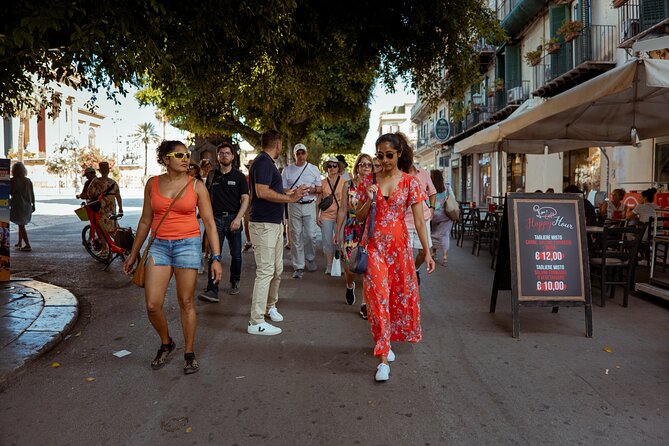
Palermo’s great attraction is its collision of cultures. In three hours, this walk takes you from the grand Teatro Massimo through noisy market lanes and Baroque squares to Norman churches, the cathedral, and the Royal Palace. You get a useful first look at a city that can feel confusing until someone explains how its Greek, Roman, Arab, Norman, Spanish, and modern Sicilian layers fit together.
I like two things here: the wide sweep of the route and the chance to see ordinary streets and markets between the famous monuments. I also like the practical finish, a Sicilian cannolo or granita, plus restaurant and pastry tips from guides such as Valeria, Renata, Fabio, Debbie, and Giada. The main limitation is important: the Palatine Chapel is viewed from outside, and admission to the Norman Palace is not included.
In This Review
- Key points to know before booking
- Why this is a smart first morning in Palermo
- Teatro Massimo begins the city story
- Markets show Palermo beyond the monuments
- San Domenico and Palermo’s public memory
- La Martorana brings Byzantine and Arab-Norman art together
- Piazza Pretoria and Quattro Canti are Palermo’s Baroque stage
- Palermo Cathedral rewards a closer look
- Villa Bonanno gives the route breathing room
- The Norman Palace and Palatine Chapel are the major limitation
- Pace, group size, and comfort
- The guides make the difference
- Who should book this Palermo walk?
- Should you book the UNESCO sites walking tour?
- FAQ
- How long does the Palermo UNESCO sites walking tour last?
- Where does the tour begin?
- Where does the tour end?
- Is the Palatine Chapel included?
- Is admission to Palermo Cathedral included?
- What food is included?
Key points to know before booking
- Three hours covers Palermo’s historic center at a brisk but manageable pace, with stops at the city’s best-known monuments.
- The Cathedral entrance is included, but the Royal Palace and Palatine Chapel are not part of the admission package.
- Markets add local life to the sightseeing, especially around Via Bandiera and Piazza Caracciolo.
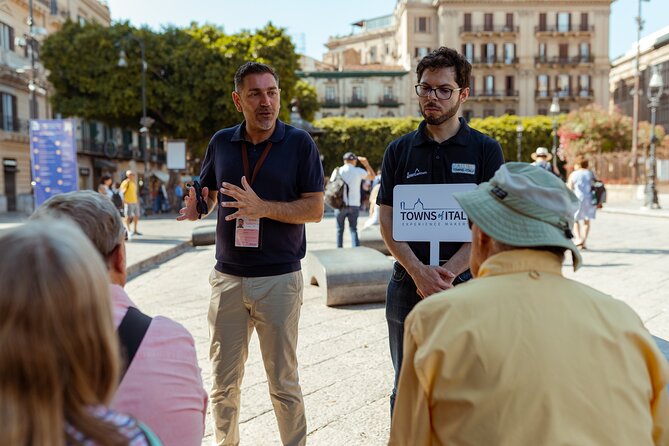
- The English-speaking guides shape the experience, with past guides including Valeria, Renata, Fabio, Laura, Peter, Simone, Debbie, Giada, and Lara.
- A Sicilian cannolo or lemon granita is included, a small but welcome reward at the end.
- Groups can reach 20 people, and the tour runs in rain or shine.
Why this is a smart first morning in Palermo
Palermo is not a city I recommend meeting with a checklist alone. Its major sights are close together, yet their stories overlap in complicated ways. A church may occupy the site of a mosque, which replaced a Christian basilica. A Baroque fountain may have begun life in Florence. A street name may preserve the memory of judges who lived there centuries ago.
This tour gives you that framework before you set off on your own. You see the main center in one concentrated walk, then return later to the places that caught your interest. Several guides also offer suggestions for food and further exploring, which can make the rest of your stay easier.
The price, about $31.88 per person, is fair for a licensed English-speaking guide, three hours of sightseeing, Cathedral admission, and a cannolo or granita. It is particularly good value if you are new to Palermo or have only a short visit. It is less attractive if you already know the center well or want long interior visits at every monument.
The walk is designed to cover ground. One account describes a warm day, shade breaks, and a quick pace, while another found the amount of information occasionally hard to absorb. I would wear sturdy shoes, bring water, and avoid scheduling an important activity immediately afterward.
More Walking Tours in Palermo
- Palermo: NO Mafia Walking Tour
★ 4.8 · 2,431 reviews - Palermo Original Street Food Walking Tour by Streaty
★ 5.0 · 2,105 reviews - Palermo: Street Food and History Walking Tour
★ 4.9 · 1,294 reviews
Teatro Massimo begins the city story
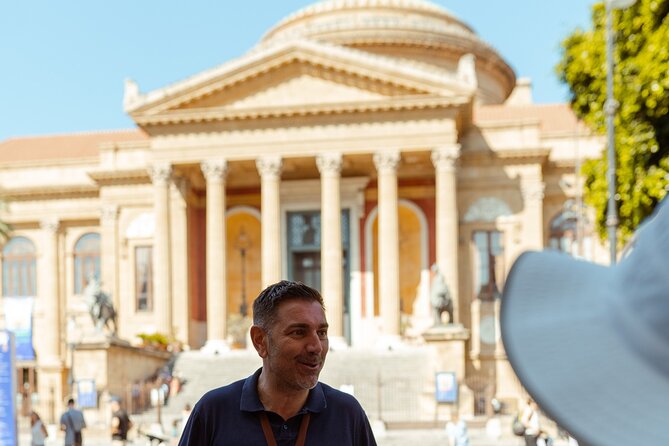
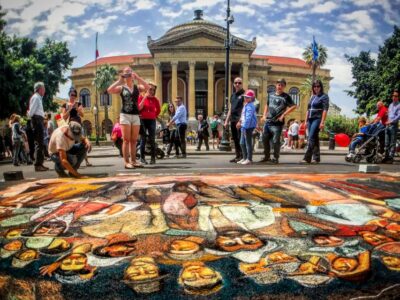
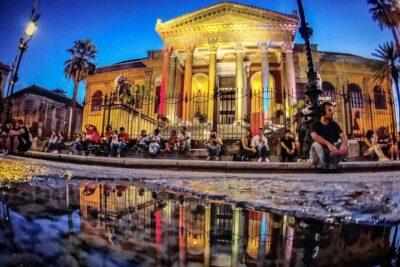
The meeting point is Via Volturno 44, near Teatro Massimo. The opera house sits on Piazza Verdi and is one of Palermo’s most recognizable buildings. It is Italy’s largest opera house and was among Europe’s largest when it opened.
Your stop here is brief, about five minutes, and admission is not included. That is enough time to admire the enormous exterior and hear why its acoustics are famous. You should not expect a performance or an extended interior visit. The point is orientation: this is the grand civic face of modern Palermo, and a useful contrast to the medieval and religious buildings ahead.
From here, the route moves toward Via Maqueda and the Galleria delle Vittorie. This former commercial mall, with its entrance at 301 Via Maqueda, has deteriorated over time despite restoration efforts. It is not a polished attraction, and that is precisely why it earns a glance. Palermo’s center includes grand restoration projects, worn facades, lively commerce, and half-forgotten spaces all within a few steps.
Markets show Palermo beyond the monuments
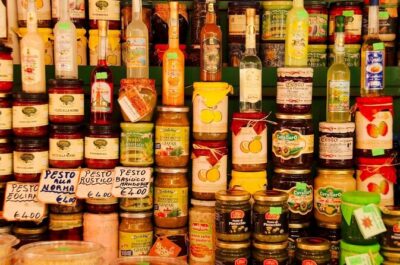
Crossing Via Bandiera brings you near a typical open-air market. Later, the walk reaches Piazza Caracciolo, where market lanes and nearby streets reveal a more everyday side of the center.
Piazza Caracciolo’s market area was once called La Bucceria, from the French word boucherie, because it began as a place for selling meat. Today, the narrow lanes carry the energy of Palermo’s food culture, with street food and low-cost places to eat. You will not have much time to shop. The group keeps moving so the tour can reach the major sights, and one account specifically wished for more time in the market.
That is a useful distinction. This is a market introduction, not a food tour. You get a sense of where to return, what the streets feel like, and how local life fits into the historic center. If you see something tempting, make a mental note and come back later with time to browse.
San Domenico and Palermo’s public memory
The Chiesa di San Domenico occupies a commanding position on its namesake square. After the Cathedral, it is one of Palermo’s most important churches in size and cultural weight.
The visit here lasts about ten minutes and admission is free. San Domenico is known as a pantheon for important Sicilians, and it also carries a modern civic meaning as a symbol in the fight against the Mafia. That combination gives the stop more force than a quick architectural glance. Your guide can connect the church to Palermo’s religious life, public memory, and long struggle with organized crime.
The route also passes the Garraffo Fountain, a Baroque work in Piazza Marina, and the former Palermo Stock Exchange. The exchange traded from 1845 and remained active until 1997, when Italian stock market institutions were unified. Palermo’s exchange was the most important in Sicily, though Messina, Catania, and Agrigento also had exchanges.
These stops are easy to overlook if you walk only from church to church. They show Palermo as a commercial capital, not merely a museum of old buildings.
Same island, a completely different day out:
- Palermo: Hop-on Hop-off Bus Tour 24-hour Ticket
★ 3.9 · 2,410 reviews - Segesta, Erice and Salt Pans Full-Day Excursion from Palermo
★ 4.2 · 1,791 reviews - Palermo: Teatro Massimo Opera House Guided Tour
★ 4.5 · 1,573 reviews - From Palermo: Monreale and Cefalù Half-Day Trip
★ 4.2 · 1,354 reviews
La Martorana brings Byzantine and Arab-Norman art together
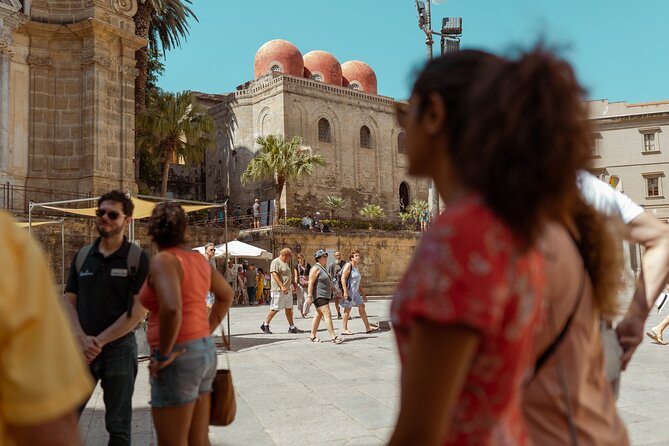
One of the most rewarding exterior stops is Santa Maria dell’Ammiraglio, better known as La Martorana. It faces Piazza Bellini and was built between 1143 and 1185 by George of Antioch, a Greek admiral who credited the Virgin Mary with protecting him.
The church still belongs to the Italo-Albanian Catholic tradition connected with the Eparchy of Piana degli Albanesi. Ceremonies may be held in ancient Greek or Albanian. That detail captures Palermo’s unusual mix of languages and religious traditions better than a simple list of architectural styles.
The route passes along the descent of the Judges, which runs from Piazza Sant’Anna to Piazza Bellini. Its name recalls judges of the Praetorian Court who once lived in the monastery of Santa Caterina. Small details like this make the walk feel connected to the city’s streets rather than limited to famous facades.
Piazza Pretoria and Quattro Canti are Palermo’s Baroque stage
Piazza Pretoria is one of the tour’s longer stops, with about 20 minutes to take in the fountain and surrounding buildings. The fountain was designed for a garden belonging to Don Luigi de Toledo in Florence, then brought to Palermo. Francesco Camilliani, a student of Baccio Bandinelli, created it.
The fountain’s crowded sculptural design has long given the square a dramatic character. It also illustrates Palermo’s habit of borrowing, adapting, and enlarging outside ideas. Your guide can help you see the square as more than a photo stop.
A short walk leads to Quattro Canti, officially Piazza Vigliena. Four buildings frame the intersection, built between 1608 and 1620, with their sculptures and decoration completed in 1663. The four corners mark the meeting point of Palermo’s old quarters and form one of the city’s clearest urban designs.
The tour allows roughly 20 minutes here. Look up at the layered facades, statues, and curved corners, but also notice the traffic and foot movement around the intersection. Quattro Canti is not a quiet plaza. It is a working crossroads, and its position makes it an excellent place to understand the shape of central Palermo.
Palermo Cathedral rewards a closer look
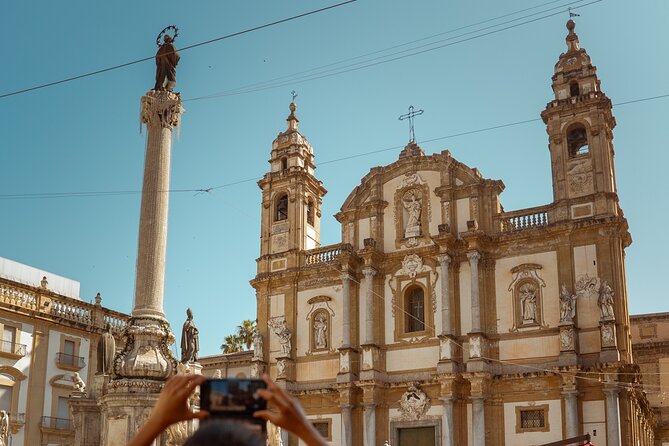
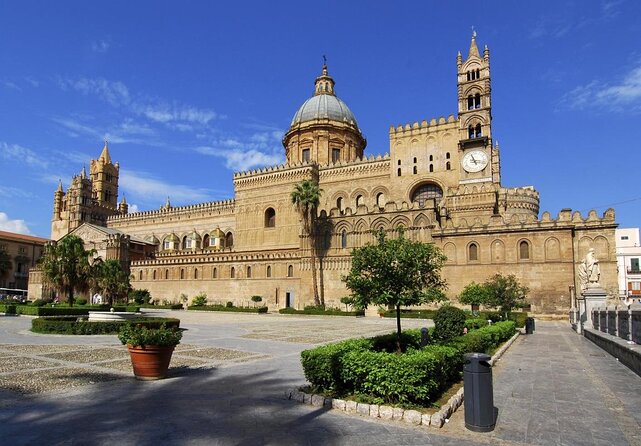
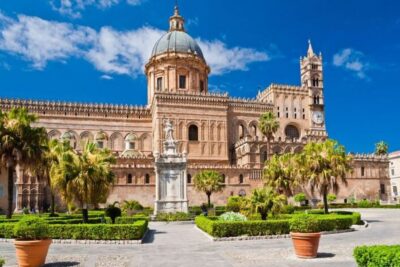
The Cathedral receives the longest included interior visit, about 30 minutes. It began in 1184 under the Normans on the site of an earlier Muslim mosque, itself built over a Christian basilica. The building you see today reflects additions and changes from several periods, including Gothic, medieval, Arabic, and Neoclassical work.
One especially striking detail is a passage from the Koran engraved on one of the columns. The cathedral’s story is not a simple Christian replacement of an earlier building. It is a record of changing rulers, faiths, artistic ideas, and political ambition.
The Normans also wanted a cathedral grander than Monreale’s, adding a touch of competition to the story. A guide makes these details easier to grasp because the exterior can otherwise feel like a collection of unrelated styles.
The Cathedral is included, but the exact scope of the admission should be understood. This is not described as a full tour of every chapel, rooftop area, or treasury. You get a guided introduction and time to appreciate the main interior. If you want to explore every paid section, plan a separate visit.
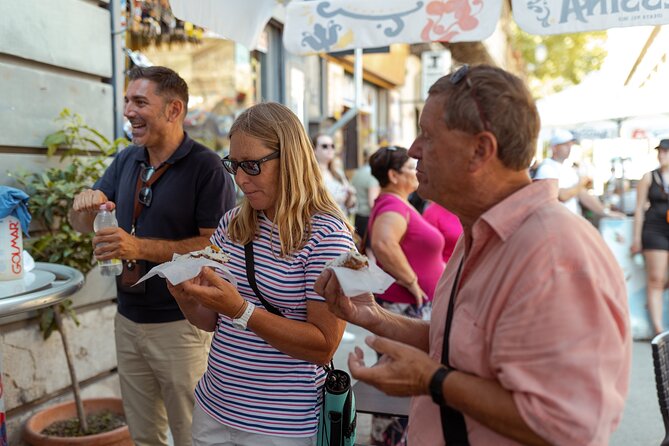
At the end, you receive a typical Sicilian cannolo or granita. A cannolo suits anyone who wants a crisp shell filled with sweet ricotta, while a lemon granita offers a cooler choice on a hot day. Some guides also arrange a coffee stop during the walk, though the listed inclusion is the cannolo or granita. The treat is modest, but it gives the group a pleasant Sicilian pause after several hours on foot.
Villa Bonanno gives the route breathing room
Villa Bonanno is a garden in Victory Square behind the Norman Palace. Built in 1905 by Mayor Bonanno, it contains palms, statues, and busts of notable Palermo figures.
The garden also marks an important archaeological discovery. Roman patrician houses with mosaics were found here, including mosaics depicting the seasons and Orpheus. Those mosaics are now held in the National Archaeological Museum, so you should not expect to see the originals in the park.
The stop lasts about ten minutes, and admission is not included. It offers a little open space after the tight streets and crowded intersections. Nearby is a fountain with a monument to Philip V, designed in the seventeenth century and later realized as a nineteenth-century work by Nuncio Morello.
The Norman Palace and Palatine Chapel are the major limitation
The tour ends at the Palazzo dei Normanni, also called the Royal Palace or Norman Palace. It is one of Sicily’s most important buildings, with a story reaching from early Punic settlement through the present day.
Inside the palace is the Palatine Chapel, the famous Arab-Norman masterpiece covered with glittering mosaics. Its decoration is a major reason this part of Palermo received UNESCO recognition. The palace also contains the Torre Pisana, home to the Palermo Astronomical Observatory and Specola Museum, while the Duke of Montalto rooms may host temporary exhibitions.
Here you need to read the fine print carefully. The tour stops at the palace for about 30 minutes, but admission is not included. The advertised experience specifically emphasizes learning about the Palatine Chapel from outside rather than entering to see its mosaics. If the chapel is high on your list, you will need a separate ticket and enough time for a dedicated visit.
There was also a reported occasion when a last-minute change to the Royal Palace’s final admission time caused a tour to finish about ten minutes early. That appears to have been an unusual scheduling problem, not the standard plan, but it is another reason not to place a tight connection immediately after the walk.
Pace, group size, and comfort
The maximum group size is 20 people. That is large enough for a social tour but still workable in the narrow streets, especially if the guide uses an audio amplification system. One account praised the headsets because every word remained clear, while another noted that the amount of information could sometimes be a lot to absorb.
Expect a walking tour rather than a gentle stroll. You will cross busy streets, pass through market lanes, and stop repeatedly at squares and churches. Guides have adapted to conditions by taking shade breaks when possible, but Palermo can be hot, and the tour continues in poor weather.
The experience operates rain or shine. Bring water, sun protection, and a light layer for a cool or wet day. Public restrooms can be hard to find in central Palermo, so use facilities when you have the chance.
Most people can participate, and service animals are allowed. Pets are not permitted. If you have limited mobility or another special need, tell the operator in advance so the guide can try to help. Hotel pickup and drop-off are not included. The meeting point is Via Volturno 44, and the stated finish is back at that meeting point, so confirm the exact return arrangement if you are visiting from a cruise ship or have a fixed departure.
The guides make the difference
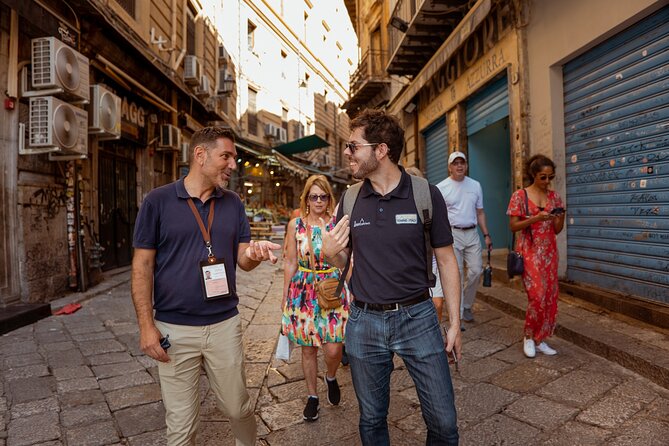
The strongest part of this experience is the human explanation. Guides named in the supplied material include Valeria, Renata, Fabio, Laura, Peter, Simone, Debbie, Giada, and Lara. Their approaches differ, but the best reports describe clear English, strong local knowledge, patience with questions, and personal insight into life in Palermo.
Valeria is associated with historical explanations, food advice, and a welcome treat. Renata is praised for bringing together the UNESCO sights and for answering questions in a polished way. Fabio is described as informal and easy to understand, with useful advice on where to eat and what to do next.
The Mafia and modern Sicilian politics may come up as part of the city’s story. A good guide should place those subjects in context rather than use them as cheap drama. You will also hear about poverty, limited public support in southern Italy, corruption, transport, and the way cars and motorcycles still move through areas that feel almost pedestrian-only.
Guide quality can vary on any group tour. One poor experience described a disorganized timeline, repeated points, unusual jokes, and a finish before the full three hours. The operator explained that a late palace admission change contributed to an early finish on that date. I would book this tour for its overall structure, while remembering that the guide is a major part of what you are paying for.
Who should book this Palermo walk?
Book it if you are arriving in Palermo for the first time, want a solid overview in one morning, or prefer history explained as you walk rather than read from a guidebook. It also suits anyone with three or four days in the city who wants food suggestions and a map in their head before exploring alone.
It is a good fit for cruise passengers only if your shore time allows for the full meeting and return schedule. The tour does not provide hotel or port pickup, and the route’s fixed timing may not suit a tight ship departure.
You may want something else if your priority is entering the Palatine Chapel, spending an hour shopping in the markets, or examining each church in detail. This is a highlights walk. It gives you the story and the setting, then leaves you to return to the places you want to see properly.
Should you book the UNESCO sites walking tour?
At $31.88, I consider this a useful buy for a first day in Palermo. You see major architecture, local markets, public squares, the Cathedral, and the exterior of the Norman Palace without giving up a whole day. The cannolo or granita is a nice extra, and the best guides add the local context that makes Palermo easier to enjoy.
Book it early if your schedule is fixed, since it is commonly reserved well ahead of time. Go in knowing that the Palatine Chapel is not an included interior visit, keep your pace steady, and save time afterward for the market or palace areas that interest you most.
FAQ
How long does the Palermo UNESCO sites walking tour last?
The tour lasts approximately three hours.
Where does the tour begin?
It begins at Via Volturno 44, 90138 Palermo PA, Italy.
Where does the tour end?
The stated end point is back at the meeting point.
Is the Palatine Chapel included?
The tour includes an outside stop at the Royal Palace and information about the Palatine Chapel. Admission to the Norman Palace and Palatine Chapel is not included.
Is admission to Palermo Cathedral included?
Yes. Entrance to the Cathedral is included.
What food is included?
You receive a typical Sicilian cannolo or granita. Hotel pickup and drop-off are not included.
More 3-Hour Experiences in Palermo
- Discover Palermo in 3 hours. Art, history, markets and street food
★ 5.0 · 352 reviews - Palermo: three-hour private city tour
★ 4.9 · 8 reviews - Boat excursion in Cefalù and snorkeling 3 hours fruit and drink
★ 4.5 · 85 reviews - 3-Hour Dolphin watching at sunset with aperitif
★ 5.0 · 67 reviews
Just added around Palermo
- Anti-Mafia Heroes (Cool Hours) Morning Walking Tour★ 5.0 · 3 reviews
- The art of the Italian Aperitivo with a local: Learn & Enjoy in Palermo★ 5.0 · 3 reviews
- Private transfer from Palermo airport to Mercure Palermo Centro or vice versa★ 5.0 · 3 reviews
- ERICE and SEGESTA Private Exclusive Tour starts from Palermo with Guide Driver★ 4.0 · 3 reviews
- Private 10 hour tour to Agrigento (Valley of the Temples) from Palermo★ 5.0 · 3 reviews
- Palermo Private MINITOUR of WEST SICILY 4 Days with Guide Driver★ 5.0 · 3 reviews
- The Best Of Sicily and Sorrento & Culinary Experiences, Deluxe★ 5.0 · 3 reviews
- Transfer from Palermo Airport to Scopello and Tonnara di Scopello★ 5.0 · 3 reviews
Walking Tours, compared.
Palermo Original Street Food Walking Tour by Streaty
Read our review →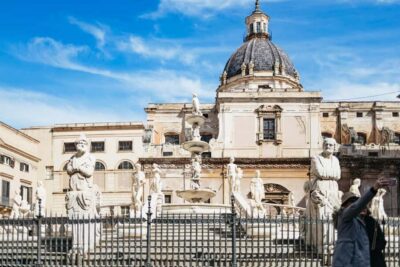
Palermo No Mafia walking tour: discover the Anti-mafia culture in Sicily
Read our review →
Street Food Walking Tour with Local Guide & Tasting
Read our review →
Browse the lists this tour appears in