
Reviewed · WALKING TOURS
Noto: Sicilian Baroque Architecture Guided Walking Tour
Noto’s beauty is not shy. Honey-colored churches, theatrical stairways, carved masks, winged figures, and stone animals line the main streets, creating the effect of a city built as one grand Baroque stage. This private walking tour gives you a clear route through that spectacle, beginning at Porta Reale and ending at the Fountain of Hercules.
I like two things here. First, the route gathers Noto’s major sights into a compact two-hour walk, so you can get your bearings before exploring on your own. Second, a private guide can shape the pace for your group. One guide named Elia has received especially warm praise, and another guide adjusted the timing and sought shade on a hot day. The main consideration is price: $346.65 per group, which can be good value for a large party but steep for two people.
In This Review
- Key points to know before booking
- Why Noto’s Baroque feels like theater
- Starting at Porta Reale and San Francesco
- Santa Chiara and the art of the church interior
- Piazza del Duomo and Palazzo Ducezio
- San Nicolò Cathedral and three collapses
- Via Nicolaci and Palazzo Nicolaci’s carved balconies
- Loggia del Mercato and the city’s everyday side
- Tina di Lorenzo Theater and the Fountain of Hercules
- The guide and private pace
- Is $346.65 good value for two hours?
- Timing, clothing, and practical planning
- Who should book this Noto walking tour?
- Final verdict: a focused introduction to Noto
- FAQ
- Where does the Noto walking tour start?
- Where does the tour end?
- How long does the tour last?
- What languages does the guide speak?
- Is this a private tour?
- What is included in the price?
- Does the tour visit San Nicolò Cathedral?
- Does the tour visit Palazzo Nicolaci?
- Can I cancel for a full refund?
Key points to know before booking
- Porta Reale begins the story: Enter Noto’s old center beneath the grand gate and walk directly into its Baroque core.
- San Nicolò Cathedral is the centerpiece: The famous honey-colored church has been rebuilt after three collapses and is visited inside.
- Palazzo Nicolaci rewards a slow look: Its balconies carry carved masks, animals, statues, and other playful stone details.
- The route covers more than churches: You also see the Town Hall, market loggia, theater, flower-street setting, and Fountain of Hercules.
- The private format helps in hot weather: Your guide can adjust the pace and make shade stops when needed.
- Two hours is efficient, not leisurely: You will see a great deal, but some stops are viewed from outside and the walk does not include a long pause for coffee or shopping.
Why Noto’s Baroque feels like theater
Noto was rebuilt in the Baroque style after the devastating earthquake of 1693. You do not need a long lecture to understand the result. Walk a few blocks and the city presents churches with layered façades, broad stairways, decorative balconies, and statues that seem ready to act out a scene.
The local limestone gives the city a warm color that changes with the sun. At sunset, the Cathedral of San Nicolò takes on a particularly soft, golden tone. A guide helps you notice how the buildings work together, rather than treating each church as an isolated stop.
This is a walking tour of the historic center, not a day trip through southeastern Sicily. You are not riding between scattered sights or waiting for transport. The route keeps you on the main streets and nearby lanes, making it a useful introduction if Noto is new to you.
The group is private, with a maximum of 25 people. That upper limit is large, but the private arrangement means the booking belongs to your party rather than being mixed with strangers. For a couple or small family, the cost may feel high. For a bigger family, wedding party, or group of friends, the flat group price becomes easier to justify.
More Walking Tours in Syracuse
- Syracuse: Street Food Walking Tour in Ortigia with Tastings
★ 4.9 · 293 reviews - Syracuse: Ortigia and Neapolis Guided Walking Tour
★ 4.7 · 205 reviews - Syracuse: Ortigia Private Walking Tour
★ 4.8 · 181 reviews
Starting at Porta Reale and San Francesco
Meet your guide under Porta Reale, also called Porta Ferdinandea, at the entrance to Noto’s historic center. Look for the guide’s clearly visible license badge. This simple meeting point is useful because the gate is an obvious landmark and puts you at the correct edge of the old city.
The first stop is the Church of St. Francis of Assisi, reached by a broad staircase beside the former Convent of the Holy Savior. The climb is part of the experience. Noto’s Baroque architects used steps to create drama, placing churches above the street so that you approach them with a sense of ceremony.
Inside, you can expect frescoes and decorative work. The stairs may be easy for some people and tiring for others, especially in summer heat, so wear shoes with good support. Comfortable clothing also helps, since the tour is on foot and includes several churches and open streets.
This opening section gives the tour a good rhythm. You begin with the city gate, move into a church interior, then continue along the main street toward more famous civic and religious buildings.
Santa Chiara and the art of the church interior
A short walk brings you to the Church of Santa Chiara, beside a former Benedictine monastery. From the outside, it fits Noto’s grand style. Inside, the decoration becomes more detailed, with stucco-covered columns, statues of apostles, and small figures of putti.
This is one of the places where a guide adds real value. A quick glance can reduce the church to white columns and ornament. With an explanation, you can better understand how the decoration directs your eyes upward and gives the interior a carefully staged appearance.
The visit also offers a useful contrast with San Francesco. Instead of seeing one church after another as a blur of pale stone and painted decoration, you can compare how each building handles stairs, columns, statues, and interior space.
The tour schedule does not promise a long visit inside every church, so keep your expectations in check. You will see the important details, but this is not a specialist architecture seminar or a sketching session. If one interior captures your imagination, you may want to return later at your own pace.
Piazza del Duomo and Palazzo Ducezio
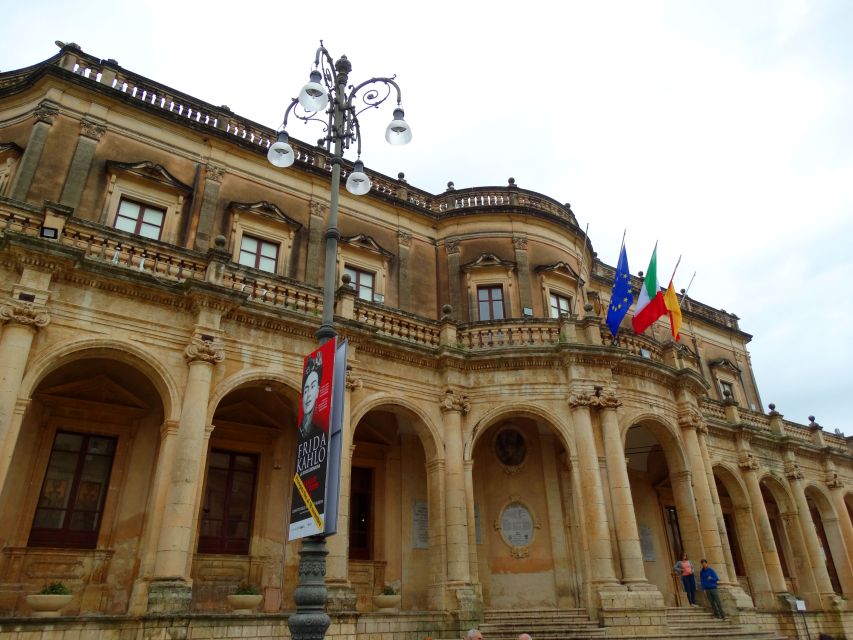
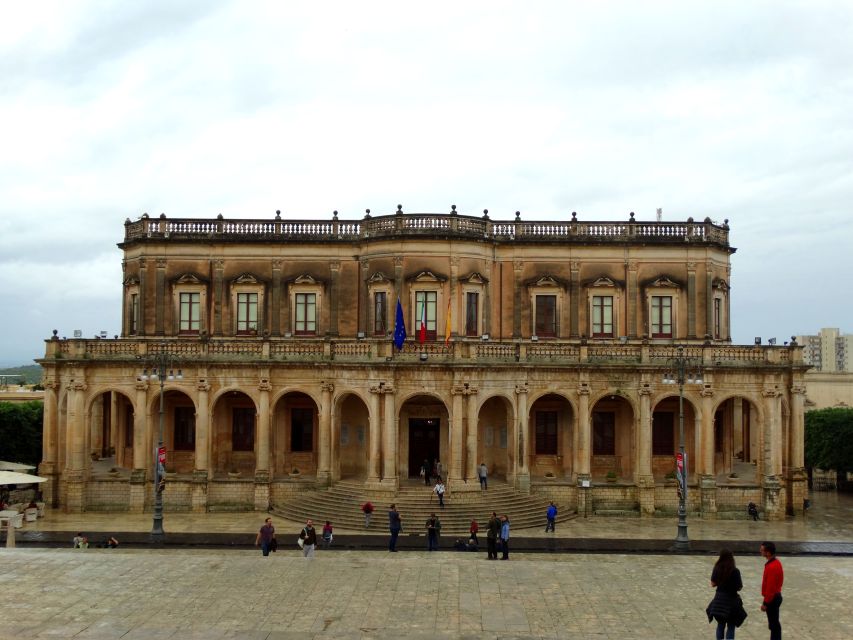
The route continues to Piazza del Duomo, Noto’s grand civic and religious square. Here, Palazzo Ducezio houses the Town Hall and faces the monumental staircase of San Nicolò Cathedral.
Palazzo Ducezio was built between the 18th and 19th centuries. Its interior includes a frescoed ceiling and rooms with mirrors designed to create visual illusions, making the spaces appear larger. That detail is easy to miss if you only admire the façade, so it is worth listening closely when your guide explains how the rooms were designed.
The building also shows that Noto’s Baroque identity is not limited to churches. Civic power received its own formal setting, with decorated rooms intended to impress visitors and officials. You get a sense of how the city wanted to present itself, not just how it worshipped.
The square is one of the strongest portions of the walk because several major sights gather in one view. Palazzo Ducezio, the cathedral staircase, and the cathedral façade create a tightly framed architectural scene. Your guide can also help you find a good position for photographs without turning the stop into a rushed photo break.
More Noto, Modica and Scicli days from Syracuse:
- Baroque tour: Ragusa, Modica and Noto
★ 5.0 · 81 reviews - From Syracuse: Car/Minivan Tour to Noto, Ragusa and Modica
★ 4.6 · 50 reviews - From Taormina: Siracusa & Noto Small-Group Tour
★ 4.6 · 44 reviews - Wine Tasting and Typical Tastings in the Val di Noto
★ 4.4 · 20 reviews
San Nicolò Cathedral and three collapses
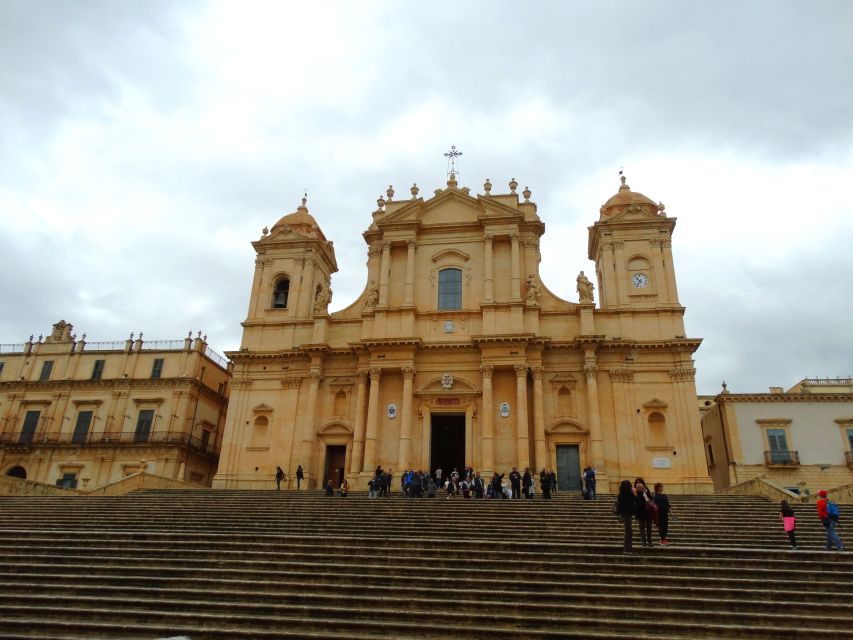
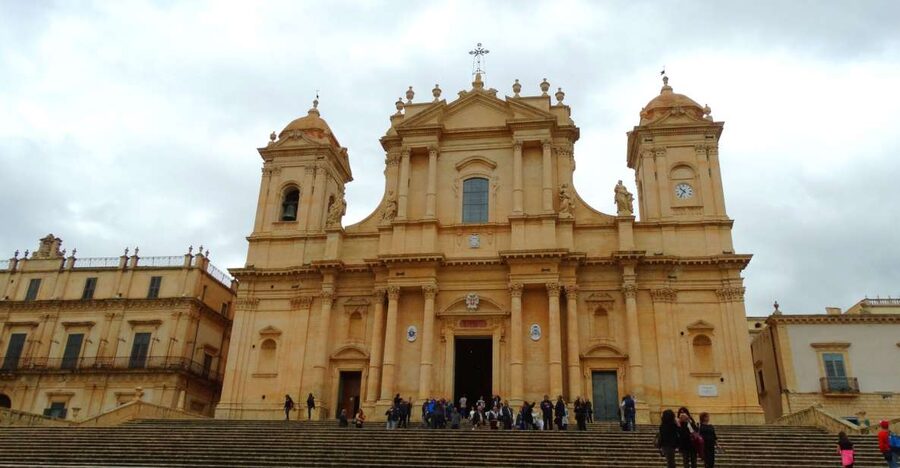
The Cathedral of San Nicolò is Noto’s best-known building and the visual anchor of the tour. Its pale limestone façade has two bell towers, one with a bell and the other with a clock. The grand staircase gives the church a formal approach and makes the building feel larger than it might from a narrow street.
You visit the cathedral interior. It was built in the 18th century but has collapsed three times over the years and been rebuilt. Some frescoes were lost, which gives the current interior a different character from a church that has survived unchanged.
That rebuilding is important to understand. The cathedral is not simply an old structure preserved in perfect condition. It is also a record of damage, repair, and changing approaches to restoration. A guide can help you separate original Baroque work from later rebuilding, though the tour description does not promise a technical conservation lecture.
Allow time to look at the façade before going inside. The color is especially attractive in late light, but the tour’s starting times vary, so you should check availability rather than assume you will see sunset. The exact timing is one of the details to confirm when booking.
Via Nicolaci and Palazzo Nicolaci’s carved balconies
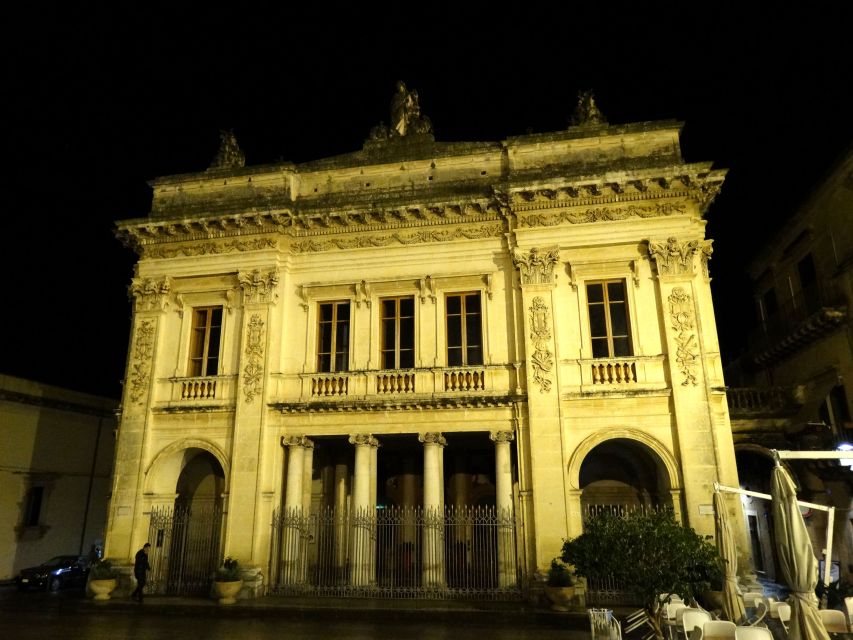
From the cathedral area, the walk reaches Via Nicolaci, the street famous for Noto’s Infiorata. During the flower festival, artists arrange flowers on the road to create a large temporary carpet. The street itself remains an important Baroque setting even when the flower display is not being installed.
The tour includes a visit to the area and exterior views of several notable buildings. Palazzo Nicolaci is the main prize. Its balconies are decorated beneath with carved limestone masks, animals, statues, and other figures. The designs are playful, sometimes odd, and far more expressive than a quick pass along the street would suggest.
This is a good place to slow down and look up. The lower parts of the balconies carry much of the visual interest, while the upper façades can seem more restrained. You may find that the most memorable details are small ones: a face, a creature, or a figure supporting the balcony.
Palazzo Nicolaci is viewed externally on this route. If entering the palace is a priority, confirm what is open separately, because this activity does not promise an interior palace visit. That distinction matters. You are booking a guided city walk with selected interiors, not a full palace-access tour.
Loggia del Mercato and the city’s everyday side
The tour leaves the grand ceremonial streets for the Loggia del Mercato. This wrought-iron loggia once served Noto’s market and is now used for cultural events.
It is a useful change of mood. Churches, palaces, and civic buildings show Noto presenting its finest face. The market loggia points toward ordinary exchange and public life. Even if the structure is not as ornate as the cathedral or Palazzo Nicolaci, it helps you picture how the city functioned beyond formal squares.
The loggia also shows why a guided route is better than a simple checklist of famous façades. Noto’s appeal is not only in its largest monuments. Smaller public structures help connect the grand architecture to daily life.
Tina di Lorenzo Theater and the Fountain of Hercules
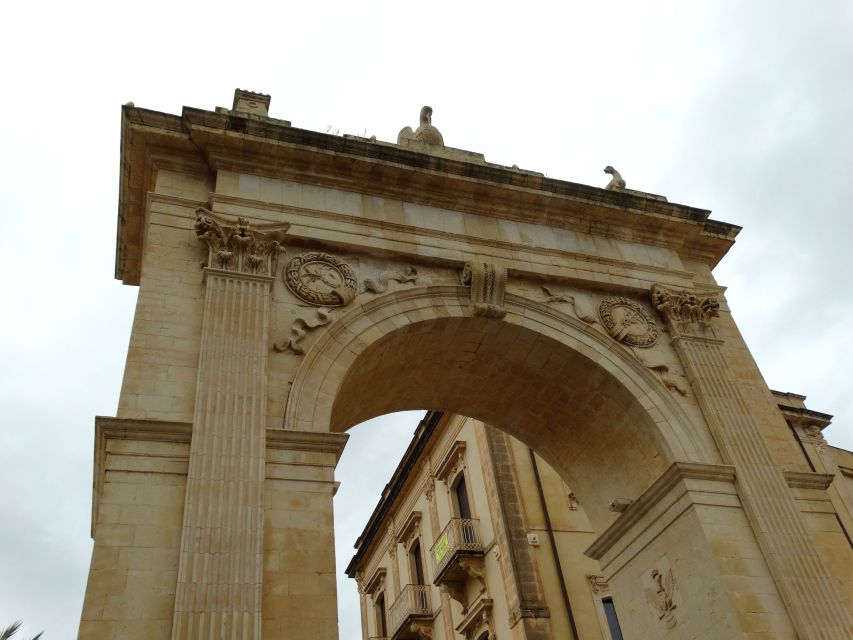
The final part of the walk brings you to the elegant building that houses the Tina di Lorenzo Theater. Its style is neoclassical, giving you a visual contrast after so much Baroque decoration. The theater is seen as part of the street walk, and the change in style helps you identify different design priorities within Noto.
The tour ends at the marble Fountain of Hercules, built in the 1700s. It is a modest but fitting final stop after the heavy façades and elaborate church interiors. You finish with a public monument rather than another grand palace, then return to the original meeting point.
Ending where you started makes the activity easy to fit into a day. You can continue exploring Noto, find lunch, return to a hotel, or use the historic center as a base for further sightseeing. The tour does not leave you at a distant location or require a separate ride back.
The guide and private pace
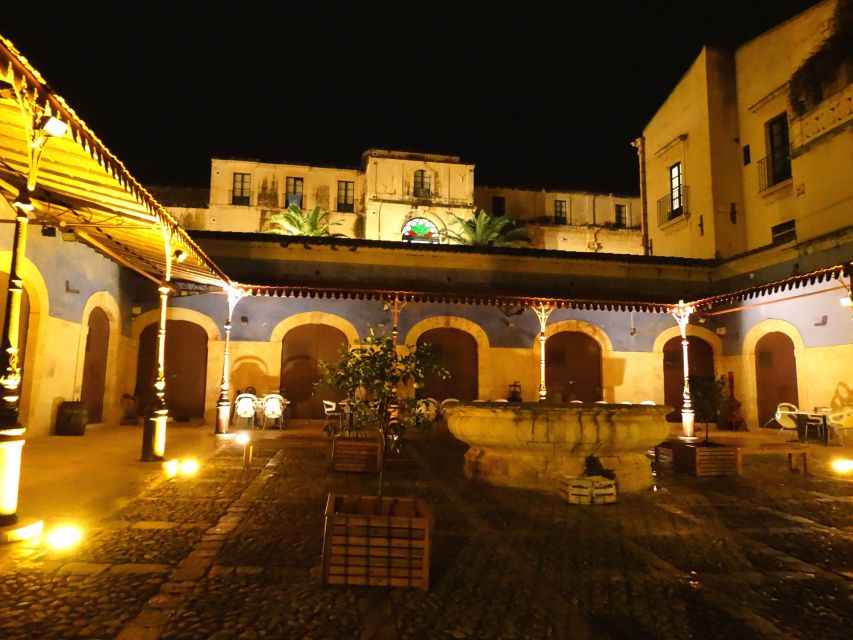
The tour is led by a licensed guide in English or Italian. One named guide, Elia, has been singled out for making the experience enjoyable and easy to follow. Another guide was praised for tailoring the timing and making an effort to find shade on a warm day.
That last detail matters in Noto. The main streets can feel exposed, and limestone reflects sunlight. A private guide cannot change the weather, but can help your group pause, adjust the pace, and avoid turning a pleasant walk into a sweaty march.
The private format is also useful for mixed groups. Children, older relatives, and architecture fans rarely want exactly the same pace. Here, you can ask questions, spend a little longer at a detail, or move on without waiting for a large public group.
The available languages are Italian and English. If your group needs another language, this activity does not list it as an option.
Is $346.65 good value for two hours?
The price is $346.65 for the entire group, with up to 25 people. That flat rate changes the calculation.
For one or two people, it is an expensive two-hour walk. You are paying for a licensed private guide and a focused route through Noto, but not for transportation, meals, or a long list of included admissions. If you are mainly looking for inexpensive orientation, a self-guided walk may be enough.
For a larger party, the cost can make more sense. Split among 10 people, it is about $34.67 each. Split among 20, it is about $17.33 each. The value improves sharply as your group grows.
You also pay for structure. Noto is compact, but its churches and palaces can blend together without context. The guide links the buildings, explains the Baroque details, and keeps the route moving. That is particularly useful if you have only one afternoon in town.
The tour includes the licensed guide. Check the current booking details for any entrance arrangements connected with the churches or public buildings, since the supplied information does not list separate admission inclusions.
Timing, clothing, and practical planning
The duration is two hours, with starting times dependent on availability. Choose a time that suits your heat tolerance and photography plans. The cathedral’s honey-colored stone is especially attractive in late light, but you should not assume every departure is timed for sunset.
Wear comfortable shoes. The route includes stairs, sidewalks, church interiors, and several streets, so thin sandals or hard city shoes may become unpleasant. Comfortable clothing is also recommended.
The meeting point is under Porta Reale or Porta Ferdinandea. Look for the guide with a visible license badge. The activity returns to this same meeting point, which keeps your wider plans simple.
Free cancellation is available up to 24 hours before the start for a full refund. You can also reserve now and pay later, useful if your Sicily plans are still shifting.
Who should book this Noto walking tour?
I would choose this tour if you want a strong first look at Noto without spending half a day on a formal architecture program. It suits first-time visitors, families who want a private pace, and groups that prefer an English-speaking guide to explain what they are seeing.
It is also a good choice for architecture fans who want the major Baroque highlights in a logical order. You see churches, a cathedral, civic rooms, ornate balconies, a former market structure, a theater, and a fountain in one compact circuit.
I would hesitate if you are traveling alone or as a couple on a tight budget. The flat group price is hard to defend for a very small party unless personal guidance and efficient sightseeing are especially important to you.
Final verdict: a focused introduction to Noto
Book this tour if you want Noto’s main Baroque sights explained by a licensed guide, with the freedom of a private group and a route that returns to its starting point. The best parts are the cathedral, Palazzo Nicolaci’s expressive balconies, and the chance to compare grand churches with civic buildings and the old market loggia.
Skip it if you want extensive palace interiors, long time at each monument, or the lowest-cost way to walk Noto. For a larger group, though, the price becomes far more reasonable, and the two-hour format gives you a useful foundation for exploring the city on your own.
FAQ
Where does the Noto walking tour start?
The tour starts under the Porta Reale or Porta Ferdinandea gate, near the Church of St. Francis of Assisi.
Where does the tour end?
The activity ends back at the original meeting point under Porta Reale.
How long does the tour last?
The walking tour lasts two hours.
What languages does the guide speak?
The tour is available with a live guide in English or Italian.
Is this a private tour?
Yes. It is a private group activity for up to 25 people.
What is included in the price?
A licensed tour guide is included.
Does the tour visit San Nicolò Cathedral?
Yes. The route reaches the Cathedral of San Nicolò and includes a visit inside.
Does the tour visit Palazzo Nicolaci?
The tour includes external views of Palazzo Nicolaci and its decorated Baroque balconies.
Can I cancel for a full refund?
Yes. You can cancel up to 24 hours in advance for a full refund.
Just added around Syracuse
- Sicily Boats Avola: Plemmirio boat tour 4 people 4 hours★ 5.0 · 3 reviews
- From Syracuse: Private Taormina and Castelmola tour with lunch★ 5.0 · 3 reviews
- Siracusa Iris Photography Experience★ 5.0 · 3 reviews
- Siracusa E-bike rental service★ 5.0 · 3 reviews
- Tour Ragusa Ibla, Modica and Noto, from Syracuse★ 5.0 · 3 reviews
- Cyclops Tour★ 4.5 · 3 reviews
- Archaeological Syracuse: Neapolis Park private tour★ 5.0 · 3 reviews
- Tour of Syracuse by Ape Calessino★ 3.0 · 3 reviews
Walking Tours, compared.

Palermo Original Street Food Walking Tour by Streaty
Read our review →
Palermo No Mafia walking tour: discover the Anti-mafia culture in Sicily
Read our review →

Street Food Walking Tour with Local Guide & Tasting
Read our review →
Browse the lists this tour appears in