
Reviewed · SICILIAN SALT PAN TOURS
Guided tour of the salt pans of Trapani and the Salt Museum
Trapani’s salt pans are not simply scenic pools beside the sea. They are working farms where sunlight, wind, shallow water, and patient labor turn seawater into the salt on your table. The changing colors are the surprise: white salt, gray clay, blue water, and pink-tinted tanks sit side by side. You also see the old Archimedes screw and follow the process from sea water to finished salt.
I like the mix of outdoor scenery and human history. The walk gives you a clear look at salt production, while the small museum and old mill show how families kept the work going across generations. At $21.77 per person, the 75-minute visit offers good value, especially if you are already exploring the Trapani coast.
The main catch is getting there. The salt pans are about a 15-minute drive from central Trapani, and public transportation is not provided by the city. You need to arrange your own taxi or car, and a taxi can cost far more than the tour itself.
In This Review
- Key points at a glance
- Why Trapani’s salt pans are worth your time
- A 50-minute walk through the Culcasi salt pans
- What the colors and water reveal
- Inside the Salt Museum and the old mill
- The small salt tasting
- A private tour with English guidance
- The real price: $21.77, plus getting there
- How long you need and when to go
- Who will enjoy this experience most
- Should you book the Trapani salt pan tour?
- FAQ
- Where does the tour start?
- Where does the tour end?
- Where do I redeem my ticket?
- How long does the experience last?
- Is the tour offered in English?
- Is transportation from Trapani included?
- Is this a private tour?
- What does the ticket include?
- Are service animals allowed?
- What happens if the weather is poor?
- Can I cancel for a full refund?
Key points at a glance
- Working salt pans: Watch sea water pass through shallow tanks and become usable salt.
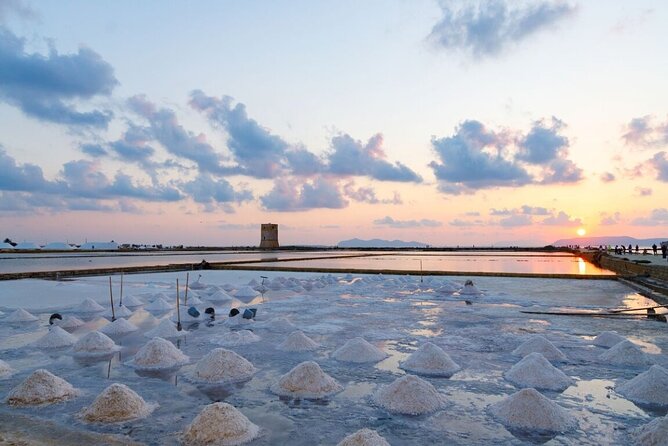
- Strong visual setting: White salt, pink pools, gray clay, blue sea, and sky reflections make this a fine stop for photographers.
- Two-part visit: Spend about 50 minutes outdoors, then 25 minutes in the Salt Museum and ancient mill.
- English guidance: The experience is offered in English, though English time slots may be limited.
- Small-group format: This is a private activity, with only your group taking part.
- Best timing: A late-afternoon visit can lead into a memorable sunset over the salt pans.
Why Trapani’s salt pans are worth your time
The salt pans of Trapani and Paceco give you something many historic Sicilian sights cannot: a look at work that is still being done in an old-fashioned way. Instead of seeing salt as a finished product in a shop, you watch the stages that make it possible.
The Culcasi salt pans sit inside the Riserva Naturale Saline di Trapani e Paceco, a protected area managed with attention to plants and birds. The setting has a calm, open feel. Water fills shallow tanks, the sea sits nearby, and the salt forms in layers as the water evaporates.
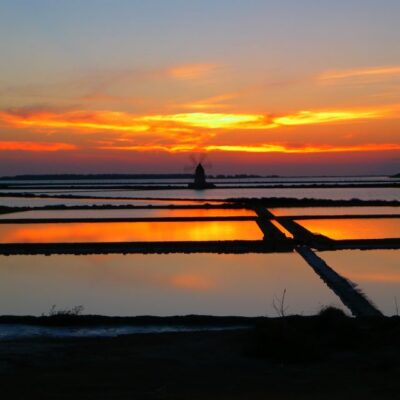
The appeal is partly visual. Salt is not just white here. Depending on the tank and stage of evaporation, you can see white crusts, gray mud, pale blue water, and pink tones. When the pools reflect the sky, the scene looks almost painted, though the work around them remains very practical and physical.
I also like that the tour does not treat the salt pans as a decorative stop. You learn how sea water moves through the tanks and can see the salt that forms there. The experience connects the view in front of you with the salt used in everyday cooking.
More salt pan visits near Sicily:
- Segesta, Erice and Salt Pans Full-Day Excursion from Palermo
★ 4.2 · 1,791 reviews - Guided tour of the Trapani Salt Pans and Salt Museum
★ 4.7 · 423 reviews - Trapani: Salt Pans Sunset Tour and Flamingo Way
★ 4.4 · 252 reviews
A 50-minute walk through the Culcasi salt pans

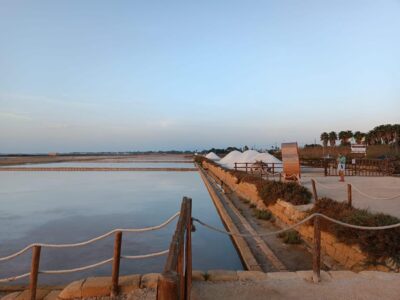
The outdoor section lasts about 50 minutes and follows the perimeter of the salt pan. You walk toward the banks and shallow pools, where the water can reflect the sky like a mirror.
The route is described as relaxing and suitable for all age groups. It is not presented as a strenuous outing, and most people can take part. Still, you are outdoors in an open working area, so sensible shoes, sun protection, and water are useful choices, particularly during Sicily’s hotter months.
Your guide explains the production process step by step. You see how sea water is collected, moved through the salt pans, and gradually concentrated. The tour also lets you collect salt with your hands, giving you a simple physical connection to the process rather than leaving it as a lecture.
One particularly interesting feature is the Archimedes screw. This old-style device helps move water between levels and shows how engineering has long been part of salt farming. It is the sort of detail that makes the visit more memorable than a basic nature walk.
The guides are a major part of the experience. The English-speaking guides are described as friendly, clear, and engaging, with strong explanations of the production stages and local traditions. The English is generally good, though one account found one guide’s Italian accent harder to follow. If you have difficulty hearing or understanding, stand close to the guide and ask questions as you go.
The salt pan portion is likely to be the stronger half for anyone who enjoys seeing a process in action. You are not only looking at pools. You are tracing the full chain from sea water to salt, with the equipment and working environment in front of you.
What the colors and water reveal
The salt pans reward slow looking. The white surfaces are the most obvious feature, but the blue, gray, and pink tones give the site much of its character.
The white is the salt itself, gathering in the tanks as water evaporates. The gray comes from the clay and earth around the pools. Pink tones appear in some tanks, adding contrast to the otherwise pale setting. The water reflects the sky, shifting the appearance of the pans with the light.
This is also why timing matters. Several people found sunset especially appealing, describing the light as one of the finest parts of the visit. A tour around 6 p.m. can work well if the schedule lines up, since you may be able to remain nearby afterward and watch the sunset.
Do not assume every departure will give you sunset. The tour lasts about 75 minutes, and the best light depends on the season and start time. If photography or evening light matters to you, check the available English departure before booking.
The scenery is quiet rather than crowded or theatrical. That makes the salt pans a useful change of pace after busy streets, churches, or archaeological sites. You get open space, sea air, and a close look at a trade that shaped this part of western Sicily.
Inside the Salt Museum and the old mill

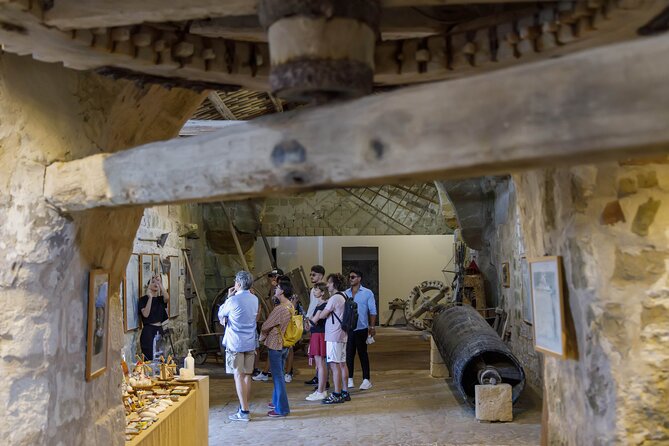
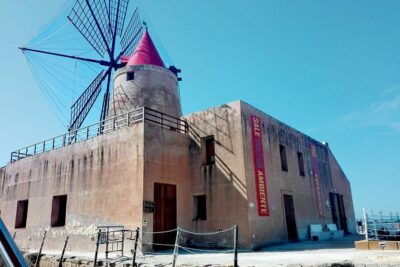
The second part lasts about 25 minutes and takes place in the Salt Museum. The museum occupies an old baglio, a traditional Sicilian rural courtyard complex, and includes an ancient mill dating from the 1400s.
Here, the focus shifts from nature and machinery to people. You learn about the hard work involved in salt farming and the family that has managed the site for generations. Old tools preserve the working methods of earlier salt producers, helping you picture the labor behind the salt pans outside.
The museum is included in the ticket, which makes the visit feel more complete. Without it, you would see a striking setting but miss much of the local story. The museum explains why salt and sea have been closely linked in Trapani for so long.
The museum section is smaller and less visually dramatic than the outdoor walk. One account found it difficult to hear the second guide when more people were present, so this is the part where paying attention to the guide’s position matters most. If the room feels crowded, move closer rather than staying at the back.
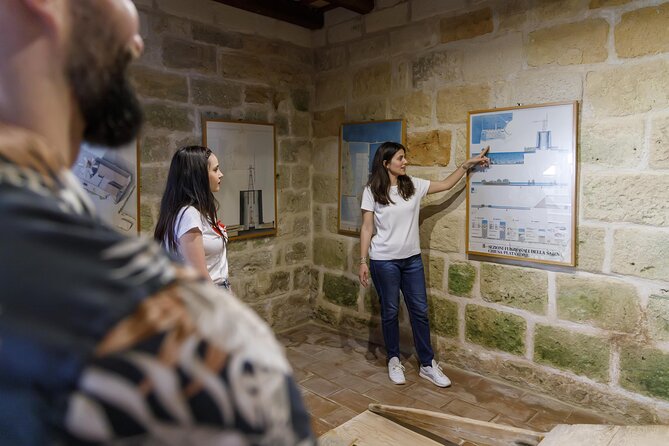
The guide-led explanation is important because the museum appears to be a modest, working collection rather than a large formal institution. Its value comes from the tools, the mill, and the family connection. You are there to understand the work, not to spend hours reading exhibit panels.
More museums in Sicily:
- Tile Museum – Majolica Museum – Rooms at the Genius
★ 5.0 · 85 reviews - Enchanted Castle of Sciacca – Museum Tickets
★ 3.5 · 63 reviews - Syracuse: Museum Guided Tour with Sicilian Puppet show
★ 4.1 · 27 reviews - Tecnoparco Archimede Museum Exhibition Ticket
★ 4.8 · 14 reviews
The small salt tasting
A salt tasting is included in the experience. It is a small detail, but it neatly finishes the production story.
After seeing salt form in the tanks and learning how it is gathered, you get to taste the product. This helps you understand that the salt pans are not only preserved for display. They remain tied to a living local business and regional food culture.
The tasting should not be the main reason to book. The walk, working machinery, and museum carry the experience. Still, it gives the tour a pleasant final touch and makes the subject easier to remember.
A private tour with English guidance
This is a private activity, so only your group participates. That format can make it easier to ask about the salt process, the machinery, or the family history without waiting for a large group to move along.
The experience is offered in English, but English departures may not run as often as Italian ones. Check the language and time carefully when booking. One visitor accidentally booked the Italian option and was able to change tours, but it is better to avoid that problem before arrival.
The supplied information does not name the individual guides, so you should not expect a particular person by name. What you can expect is a guided outdoor explanation followed by a museum guide, with the staff focused on the work and traditions of the salt pans.
Most people can participate, and service animals are allowed. Since this is an outdoor walk in a working salt area, anyone with specific mobility needs should confirm the conditions directly before booking. The general participation policy is broad, but it does not provide detailed information about surfaces or step-free access.
The real price: $21.77, plus getting there
At $21.77 per person, the tour itself is reasonably priced. You receive a guided walk, admission to the protected salt pan area, entry to the museum, a look at the old mill, and a small tasting. For a short activity, that is a solid bundle.
The cost becomes less attractive if you must pay a large taxi fare. The meeting point is at Via Salina Chiusa in Paceco, with the ticket redemption point listed as Via Chiusa in Nubia. The site is roughly a 15-minute drive from downtown Trapani.
Trapani does not provide public transportation to the location, and transport is not organized as part of the activity. If you have a car, this is simple. If you are staying in central Trapani without one, check taxi prices before committing. A round trip can cost about €60, according to one experience, which is much more than the admission price.
That does not make the tour a poor value. It means you must calculate the full outing, not just the ticket. The best value comes when you already have a car, can share a taxi with your group, or are combining the visit with other plans in the salt pan area.
The meeting point is also where the activity ends, so there is no separate drop-off in Trapani. Plan your return before the tour begins, especially if you are visiting in the evening.
How long you need and when to go
The stated duration is about one hour and 15 minutes. The salt pan walk takes approximately 50 minutes, and the museum takes about 25 minutes.
That makes this an easy addition to a day in western Sicily. You do not need to reserve half a day, although transport can add time. It works as a focused stop before or after other sights around Trapani, Paceco, or the coast.
Late afternoon is the most appealing time if you care about light. The pools can look particularly good at sunset, and the open setting gives you a wide view of the changing sky. Earlier visits may be more practical in hot weather, but the exact comfort depends on the season.
The tour requires good weather. If poor weather forces cancellation, you will be offered another date or a full refund. You can cancel for a full refund up to 24 hours before the start time, but changes or cancellations within 24 hours are not refunded.
Who will enjoy this experience most
I would recommend this tour to you if you like local industries, food traditions, quiet scenery, and guided visits with a clear subject. It is also a good choice for families because the walk is described as suitable for all age groups and the salt-making process is easy to follow.
It suits curious adults who want more than another church or museum. The salt pans show how geography, weather, machinery, and labor work together. You leave with a better sense of why this corner of Sicily produces salt and how the trade shaped local life.
Photographers should consider the light and colors. The white salt, pink tanks, gray clay, and blue reflections offer plenty to notice, especially near sunset.
You may want to skip it if you have no practical way to reach Paceco. Spending €60 or more on a taxi can change the value calculation. You should also think twice if you want a long, highly polished museum visit. The museum is interesting because it is compact and connected to a working family business, but it is not a major national collection.
Should you book the Trapani salt pan tour?
Book it if you can solve the transport and want a short, well-explained look at one of Sicily’s distinctive working traditions. The strongest reasons are the outdoor walk, the hands-on look at salt production, the Archimedes screw, the old mill, and the chance to see the pools in evening light.
I would choose an English departure late in the day, confirm the meeting point, and arrange the return before arriving. At $21.77, the activity is good value on its own. With expensive transport, it becomes a worthwhile but less economical private outing.
If those practical details work for you, the salt pans offer a memorable change from standard sightseeing. You see a real product being made, meet the history of a family trade, and experience a side of Trapani that is easy to miss from the city center.
FAQ
Where does the tour start?
The tour starts at Via Salina Chiusa, 1, 91027 Paceco TP, Italy.
Where does the tour end?
The activity ends back at the meeting point.
Where do I redeem my ticket?
The ticket redemption point is listed as VIA CHIUSA, Nubia, 91027 Paceco TP, Italy.
How long does the experience last?
The total duration is approximately one hour and 15 minutes. The salt pan walk takes about 50 minutes, followed by a 25-minute museum visit.
Is the tour offered in English?
Yes. The experience is offered in English, though English time slots may be infrequent.
Is transportation from Trapani included?
No. Transportation is not included, and public transportation from Trapani to the location is not provided.
Is this a private tour?
Yes. Only your group participates in the private activity.
What does the ticket include?
Admission to the salt pans and the Salt Museum is included. The experience also includes the guided explanations and a small salt tasting.
Are service animals allowed?
Yes. Service animals are allowed.
What happens if the weather is poor?
The experience requires good weather. If it is canceled because of poor weather, you will be offered a different date or a full refund.
Can I cancel for a full refund?
Yes. You must cancel at least 24 hours before the experience start time to receive a full refund. Cancellations or changes made less than 24 hours before the start time are not refunded.
Just added around Sicily
- Anti-Mafia Heroes (Cool Hours) Morning Walking Tour★ 5.0 · 3 reviews
- Nicolosi: Excursion Etna Craters at 3000 mt.★ 4.2 · 3 reviews
- DISCOVER THE SECRET OF PALERMO Walking Tour Combining Art and best street food★ 5.0 · 3 reviews
- The art of the Italian Aperitivo with a local: Learn & Enjoy in Palermo★ 5.0 · 3 reviews
- Taormina PRIVATE EAST COAST EXCURSIONS 2 Exclusive Days with Guide Driver★ 5.0 · 3 reviews
- Monti Rossi Adventure Park Entry Ticket Full★ 5.0 · 3 reviews
- Guided kayak tour inside the Stagnone of Marsala★ 5.0 · 3 reviews
- Catania : Diving for patented divers★ 5.0 · 3 reviews
Sicilian Salt Pan Tours, compared.
Segesta, Erice and Salt Pans Full-Day Excursion from Palermo
Read our review →
Guided tour of the Marsala Salt Pans and salt harvesting
Read our review →
Browse the lists this tour appears in