
Reviewed · ORTIGIA TOURS
Syracuse: Ortygia & Neapolis Archaeological Park Guided Tour
Syracuse packs Greek, Roman, medieval, and Baroque Sicily into one compact outing. This tour links Ortygia’s waterfront sights with the major ruins at Neapolis, so you can move from the Temple of Apollo and a freshwater spring to a Greek theater carved into stone.
I like the clear route and the private format. A guide such as Giuseppe can keep the story lively for adults and younger members of a group, while the walk through Ortygia gives you real streets, squares, churches, and sea views instead of ruins in isolation. The main drawback is time: two hours is tight, especially since tickets and transport to Neapolis are not included.
In This Review
- Key points to know before booking
- Starting on Umbertino Bridge in Ortygia
- Ortygia’s squares, cathedral, and Baroque stonework
- The freshwater Fonte Aretusa and the Alfeo waterfront
- Getting from Ortygia to Neapolis
- The Roman Pool and amphitheater at Neapolis
- Hieron’s altar and the Latomie del Paradiso
- Ending at Syracuse’s Greek theater
- What the two-hour length really means
- Price, flexibility, and who gets the best value
- Should you book this Syracuse tour?
- FAQ
- Where does the Syracuse tour begin?
- Where does the activity end?
- How long does the guided tour last?
- Are entrance tickets included?
- Is transport between Ortygia and Neapolis included?
- What languages are available?
- How many people can join the private group?
Key points to know before booking
- The tour begins on Umbertino Bridge, by the statue of Archimedes, and returns to the meeting point.
- Ortygia combines ancient and Baroque Syracuse, including the Temple of Apollo, Diana Fountain, cathedral, and Fonte Aretusa.
- The Cathedral of Syracuse incorporates parts of an ancient Temple of Athena, with columns still visible inside and outside.
- Neapolis includes major Greek and Roman sites, such as the Greek theater, Roman amphitheater, Ara of Hieron, and Ear of Dionysus.
- Tickets are extra, including the cathedral and Neapolis Archaeological Park, and you arrange transport between Ortygia and Neapolis yourself.
- The private group can include up to 30 people, with guiding available in English, Italian, French, German, and Spanish.
Starting on Umbertino Bridge in Ortygia
Your guide meets you on Umbertino Bridge, beside the statue of Archimedes. Look for the guide’s visible license badge. This is a useful meeting point because it places you right at the entrance to Ortygia, the small island that forms Syracuse’s historic center.
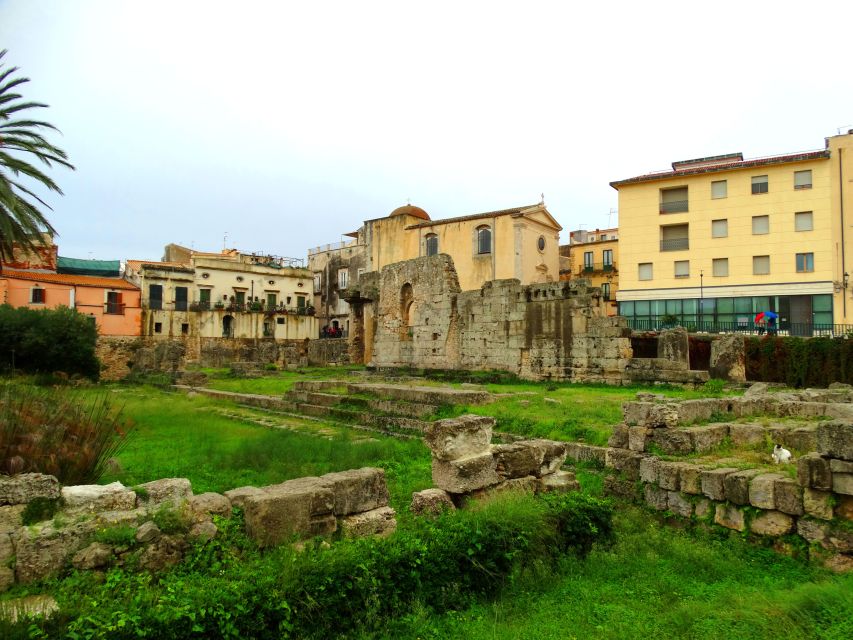
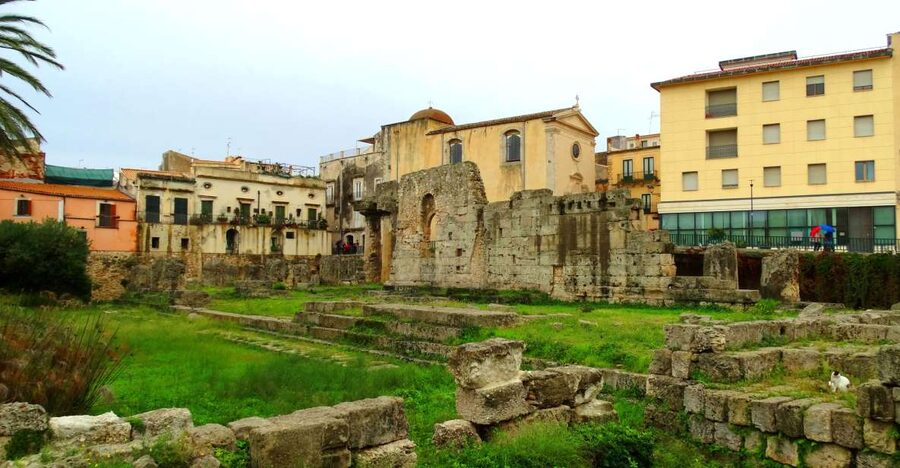
The tour starts with the Temple of Apollo, built around 580 BC. It is described as the oldest Doric temple in Sicily, and even the remaining stones make a strong first impression. The site is not a complete temple you can walk through, so keep your expectations realistic. Its value comes from the age of the remains and the way they introduce Syracuse as one of the Greek world’s major cities.
I like beginning here because the ancient ruins are part of the modern city. You are not yet in a remote archaeological field. Cars, bridges, shops, and daily life surround the old stones. That contrast helps you understand how much of Syracuse was built on top of earlier Syracuse.
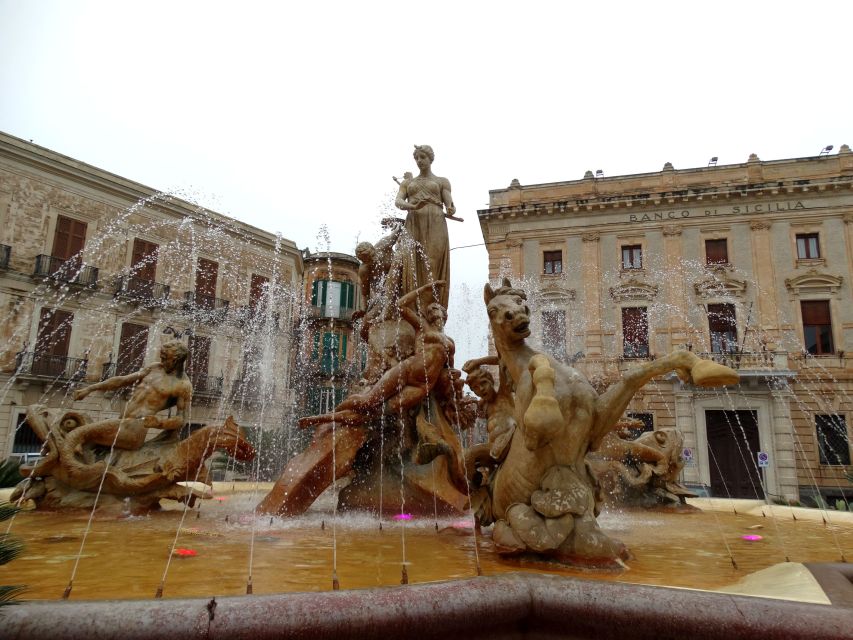
From here, you walk toward Piazza Archimede. The square honors Archimedes, the famous mathematician born in Syracuse, and features the Fountain of Diana. The fountain gives the square a decorative focal point, while the surrounding buildings help shift the mood from Greek antiquity to the more polished urban character of Ortygia.
More Ortigia walks in Syracuse:
- Siracusa: Ortigia Boat Tour with Marine Grotto
★ 4.7 · 617 reviews - Siracusa: Ortigia & Sea Caves Speedboat Tour with Swim Stop
★ 4.9 · 499 reviews - Syracuse: Pillirina, Ortigia, and Sea Caves Tour by Boat
★ 4.6 · 348 reviews
Ortygia’s squares, cathedral, and Baroque stonework
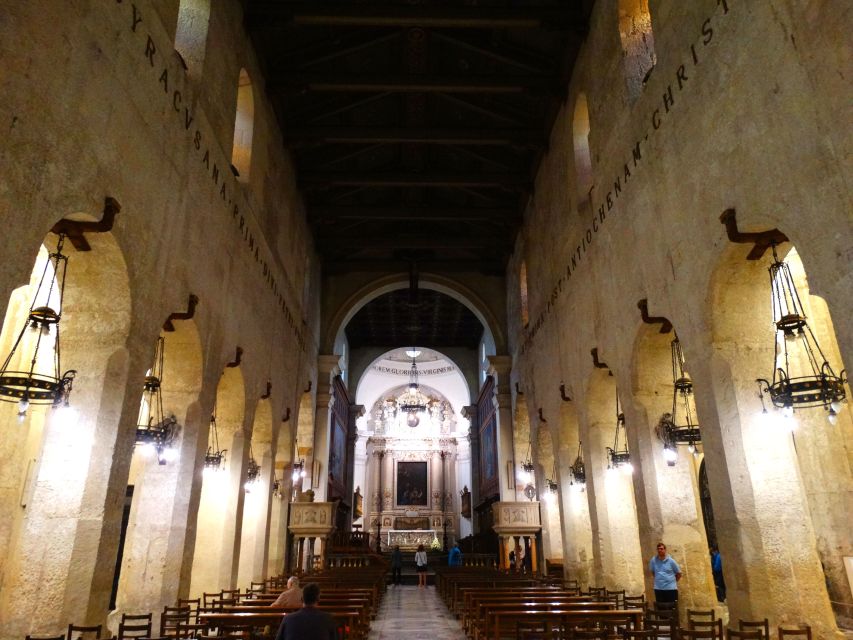
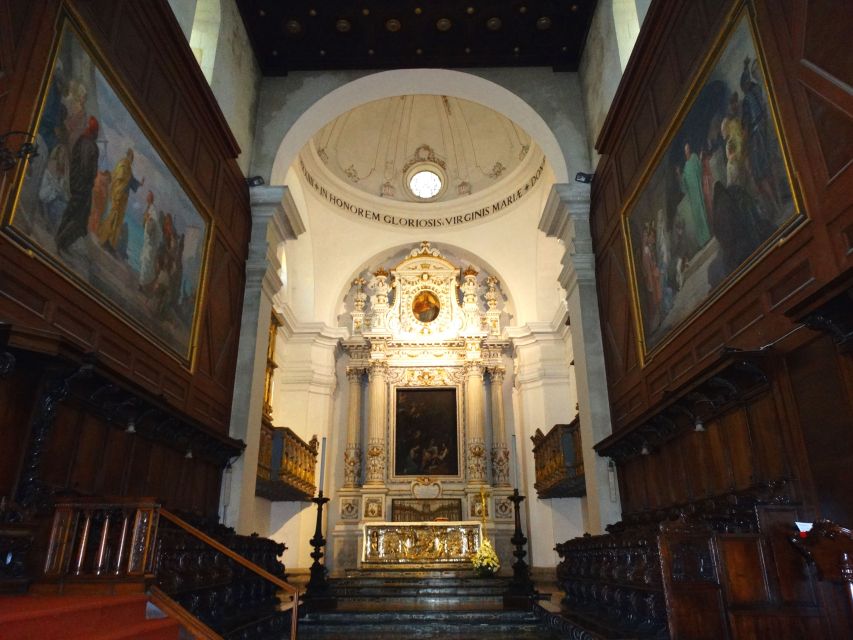
The route continues through narrow streets to Piazza della Minerva, a white limestone square lined with important buildings. The Cathedral of Syracuse takes center stage here. Its exterior mixes Baroque and Rococo design, with a large facade that can feel almost too grand for the square around it.
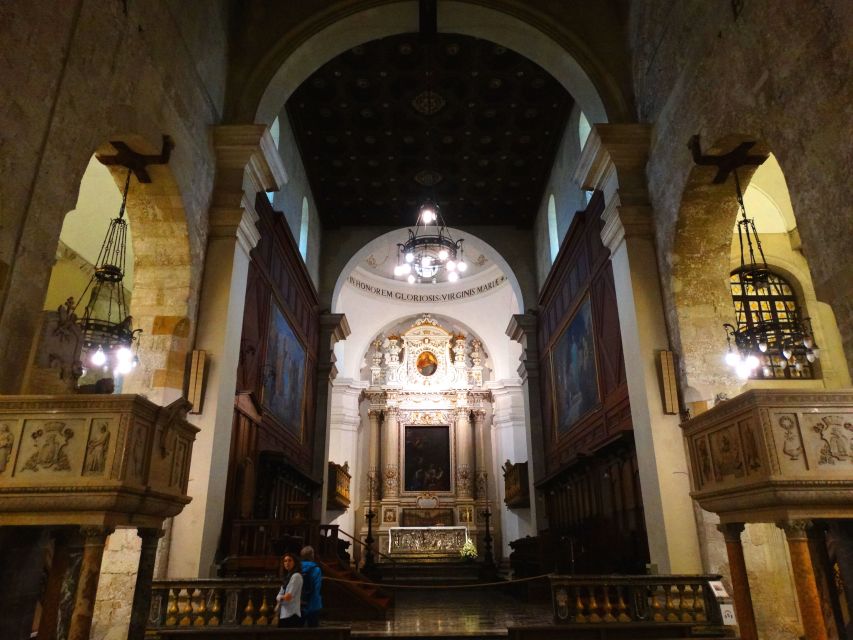
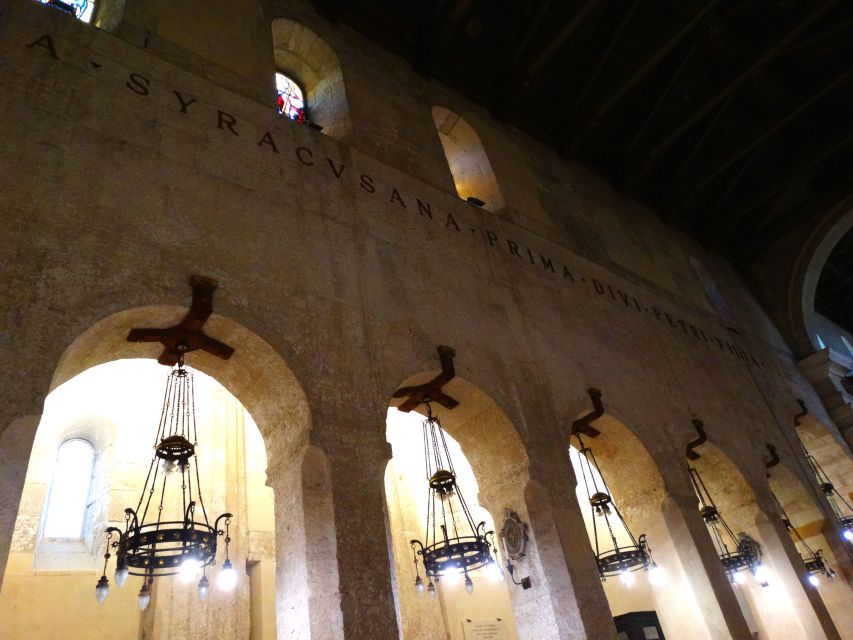
The cathedral is especially interesting because it was built on the remains of the ancient Temple of Athena. Some of the old columns are still visible in the church walls. You can see them from outside, but the interior makes the connection clearer. This is one of the best examples in Syracuse of how later religious buildings absorbed earlier monuments rather than simply replacing them.
The cathedral ticket is not included, so budget for admission separately. Since the tour lasts only two hours, ask your guide how much time is planned inside. The building deserves attention, but a rushed visit can feel more like a quick look than a full church tour.
The square also includes Palazzo del Vermexio, home of the city government, Palazzo Beneventano, and the Church of Santa Lucia alla Badia. The church houses Caravaggio’s Burial of Saint Lucia, an important work that gives the stop extra weight for art lovers. If the church is open during your visit, it is worth taking a quiet moment with the painting rather than treating it as another fast photo stop.
This portion of the tour is where a guide adds real value. The buildings are close together, but the layers are not always easy to read on your own. A guide can connect the cathedral’s ancient columns, the Baroque facade, the civic palace, and the church into one clear view of Syracuse’s changing identity.
The freshwater Fonte Aretusa and the Alfeo waterfront
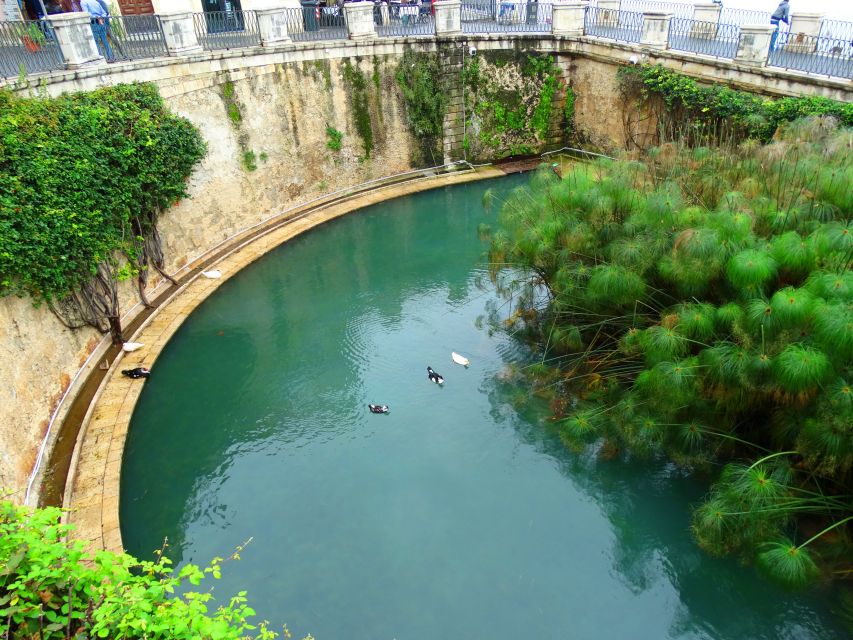
Ortygia’s route then heads toward the sea and the Fonte Aretusa. This spring forms an unusual pool of fresh water beside the Mediterranean. Fish and ducks live in the water, and papyrus plants grow around it.
The spring is more than a pretty stop. It shows the strange mix of natural water and coastal setting that has long shaped Ortygia. The site also carries old mythology linked to the nymph Aretusa, though the supplied tour details focus mainly on what you can see: fresh water, fish, ducks, and papyrus beside the sea.
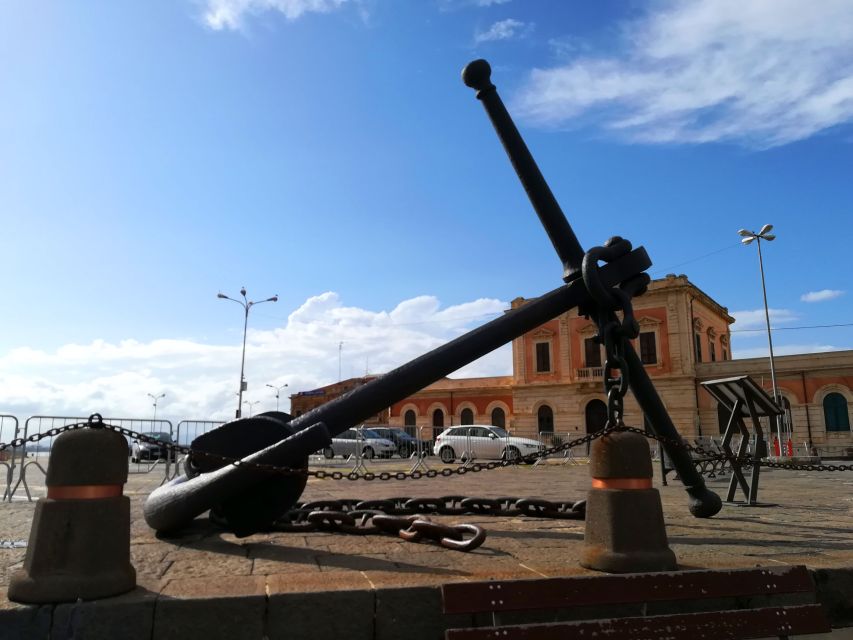
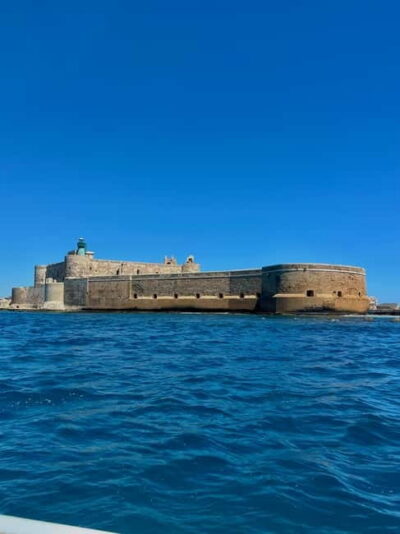
A short walk brings you to the Alfeo waterfront, described as the oldest stretch of seafront on the island. From here, you can look across the water and toward the imposing Maniace Castle. The fortress dates from the Swabian period and later served as a prison and military barracks.
This is a good place to slow down for a minute. The tour is full of dates and monuments, but the waterfront gives you a sense of Syracuse as a real coastal city. You can see why Ortygia works so well as a walking area: the streets lead from ancient ruins to grand churches, then out to open water without long gaps between them.
Getting from Ortygia to Neapolis
The tour’s two parts are separated by transport. You must arrange your own vehicle or public transport from Ortygia to the Neapolis Archaeological Park and back. That cost is not part of the $369.31 group price.
This is the most important practical point in the booking. The stated duration is two hours, and the route includes both the historic center and a sizeable archaeological park. If you lose time getting between sites, you have less time for the monuments themselves. Plan the transfer before the tour begins, and allow enough time to meet the guide again as directed.
The price covers a licensed guide for a private group of up to 30 people, not the entrance fees. A full group would pay about $12.31 per person before adding tickets and transport, which is reasonable for private guiding. A small group will pay much more per person, so the value depends heavily on your group size and how much you want personal guidance.
The private format is helpful if your party includes children, older relatives, or people with different interests. You can ask for more explanation at the cathedral or move past a stop that does not interest you. Still, the group limit is high. A private group of 30 is private in the booking sense, but it will not feel like a close, quiet walk. If possible, keep the group smaller.
A few more Syracuse tours and experiences worth weighing up
- Syracuse: Ortigia and Neapolis Guided Walking Tour
★ 4.7 · 205 reviews - From Syracuse: Mount Etna Guided Morning Hike & Food Tasting
★ 4.8 · 173 reviews - Syracuse: Neapolis and Greek Theater guided tour
★ 4.5 · 160 reviews - Syracuse: Highlights of Ortigia Guided Walking Tour
★ 4.2 · 136 reviews
The Roman Pool and amphitheater at Neapolis
The Neapolis section begins near the Church of San Nicolò ai Cordari, an eleventh-century church. The lower area includes the Roman Pool, large tanks cut into the rock. Pipes once carried water to the Roman amphitheater, where the water was used for nautical games and staged water fights.
This is a useful stop because it adds working infrastructure to the usual story of temples and theaters. You are not only looking at grand monuments. You are seeing how water supported Roman spectacles.
The nearby Roman amphitheater dates to the age of Augustus. It has an elliptical shape, is cut into the rock, and spreads across three levels. Gladiatorial fights were among the shows held here.
The amphitheater is one of the park’s clearest reminders of Roman public entertainment. Its form is easy to understand even if you know little ancient history. Look across the stone seating and arena area, and you can picture how the space separated spectators from the action below.
The drawback is that the park contains many major sites close together, and two hours does not leave much room for lingering. If you want detailed architectural study or long photography stops, you may find this tour too brisk. It works better as a guided introduction that helps you decide which parts deserve a longer return visit.
Hieron’s altar and the Latomie del Paradiso
Next comes the Ara of Hieron, or Altar of Hieron, an immense altar dedicated to Zeus. Bulls were sacrificed here, and the scale of the remains gives you a sense of how large public religious ceremonies could become.
The altar is not as visually complete as the Greek theater, but it matters because of its size and civic role. Ask your guide to help you read the remains. Without context, it can look like a broad stretch of ancient stone. With explanation, it becomes part of the public and religious machinery of Greek Syracuse.
The route then reaches the Latomie del Paradiso, quarries cut into the rock for stone extraction. The most famous cave here is the Ear of Dionysus. It rises about 23 meters and is known for its striking echo.
The cave is a highlight for many people because it gives you something to experience, not just inspect. The height and sound make the space memorable. The name may suggest a dramatic legend, but the essential point is simple: this is a huge rock-cut chamber with unusual acoustics.
Stay close to your group and listen for the guide’s explanation. The cave’s echo is the sort of feature you can appreciate in seconds, but its purpose and place within the quarries benefit from a little context. This stop also breaks up the sequence of open-air ruins with a darker, enclosed space.
Ending at Syracuse’s Greek theater
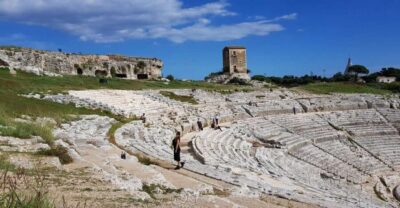
The final major stop is the Greek theater, the most famous monument in Neapolis. It was carved into the stone by the Greeks and later renovated by the Romans.
The theater’s shape is easy to grasp from the seating area. Its wide curve faces the performance space, while the surrounding rock ties the building directly to the hillside. It is a fitting ending because the site brings together the park’s main themes: Greek planning, Roman changes, local stone, public gatherings, and Syracuse’s long importance.
I like ending here rather than at a minor ruin. The Greek theater gives the park a clear final image, and the guide can connect it to the Roman amphitheater you saw earlier. One space centered on Greek drama and another on Roman spectacles show how public life changed under different rulers.
You should also know that the Neapolis Archaeological Park ticket is not included. Check the admission cost and opening arrangements when you book. The guide fee and entry fee are separate, and the guide does not provide the transfer from Ortygia.
What the two-hour length really means
Two hours is enough for a focused overview, not a slow archaeological study. The route covers a lot: Ortygia’s ancient temple, squares, cathedral, Caravaggio connection, spring, waterfront, castle view, and then the main monuments at Neapolis.
That pace can work well if you want orientation before exploring Syracuse on your own. It is also useful if your group has limited time and wants to see the essential sites with a clear narrative. The tour gives you a framework, then you can return to the cathedral, waterfront, or archaeological park with more time.
I would be cautious about booking it if you dislike quick transitions or want long visits inside each monument. The transfer between Ortygia and Neapolis is on you, and admission procedures can also use part of your available time.
The tour is available in English, Italian, French, German, and Spanish. A live licensed guide is included, and Giuseppe is one guide associated with the experience. His approach is described as entertaining enough to hold the attention of younger members of a group, which is useful for families facing a dense ancient-history itinerary.
Price, flexibility, and who gets the best value
The listed price is $369.31 for a private group of up to 30 people. For a large party, that can be good value because the guide cost is spread across the group. For one or two people, the price is harder to justify unless you place a high value on a private guide and a tightly organized overview.
You also need to add the Duomo ticket, Neapolis Archaeological Park ticket, and your own transport between the two areas. These extra costs do not make the tour a poor choice, but they should be included in your real budget.
Free cancellation is available up to 24 hours before the tour for a full refund, and you can reserve now and pay later. Those terms help if your Syracuse plans are still shifting. The listed rating is 4.7 from three reviews, so I would treat it as encouraging but based on a small sample. The strongest specific praise concerns Giuseppe’s entertaining delivery and his ability to keep younger participants interested.
Should you book this Syracuse tour?
Book it if you want a private, guide-led introduction to Syracuse and you value seeing both Ortygia and Neapolis in one plan. It suits families, mixed-age groups, and first-time visitors who want the major sights explained rather than simply photographed.
Think twice if you want a relaxed pace, dislike arranging your own transfer, or plan to study every monument in detail. Two hours is short for this much ground, and the separate tickets add to the total.
For a large group, the price can work well. For a small party, book only if the personal guide and combined itinerary matter more to you than keeping costs low. Prepare the Ortygia to Neapolis transfer in advance, confirm ticket arrangements, and you will get the most from this concentrated look at Syracuse.
FAQ
Where does the Syracuse tour begin?
The tour begins on Umbertino Bridge, beside the statue of Archimedes in Ortygia. The guide wears a clearly visible license badge.
Where does the activity end?
The activity ends back at the meeting point on Umbertino Bridge.
How long does the guided tour last?
The tour lasts two hours. Starting times depend on availability.
Are entrance tickets included?
No. The ticket for the Cathedral of Syracuse and the ticket for the Neapolis Archaeological Park are not included.
Is transport between Ortygia and Neapolis included?
No. You arrange transport by your own vehicle or public transport from Ortygia to Neapolis and back.
What languages are available?
Live guiding is available in English, Italian, French, German, and Spanish.
How many people can join the private group?
The private group can include up to 30 people.
Just added around Syracuse
- Sicily Boats Avola: Plemmirio boat tour 4 people 4 hours★ 5.0 · 3 reviews
- From Syracuse: Private Taormina and Castelmola tour with lunch★ 5.0 · 3 reviews
- Siracusa Iris Photography Experience★ 5.0 · 3 reviews
- Siracusa E-bike rental service★ 5.0 · 3 reviews
- Tour Ragusa Ibla, Modica and Noto, from Syracuse★ 5.0 · 3 reviews
- Cyclops Tour★ 4.5 · 3 reviews
- Archaeological Syracuse: Neapolis Park private tour★ 5.0 · 3 reviews
- Tour of Syracuse by Ape Calessino★ 3.0 · 3 reviews
Ortigia Tours, compared.
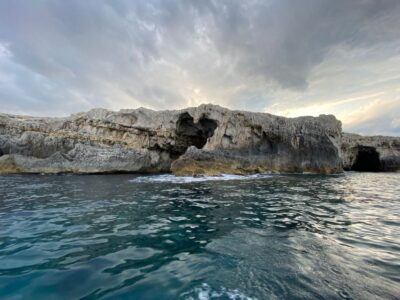
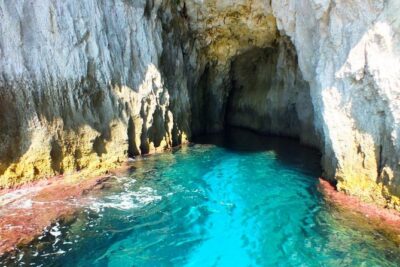
Tour of the island of Ortigia and exploration of sea caves with baths.
Read our review →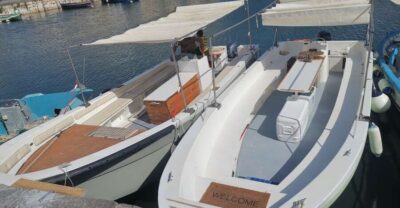
Ortigia & Sea Caves Speedboat Tour with Swim Stop
Read our review →

Ortigia Island and Sea Caves Boat Tour with Drinks
Read our review →Browse the lists this tour appears in