
Reviewed · VILLA ROMANA DEL CASALE TOURS
Piazza Armerina: Roman Villa del Casale Mosaics Tour
The Villa del Casale holds one of the finest Roman mosaic collections anywhere, spread across about 3,500 square meters. In just 1.5 hours, you move through hunting scenes, gymnasts, gods, animals, marble floors, baths, and grand reception rooms that make ancient Roman life feel unusually close.
I like the private-group format, which lets up to 15 people stay with one guide, and I like the clear route through the villa’s 48 rooms. The Great Hunt and the famous bikini mosaic are the big stars. The main drawback is that admission is not included, and the site can feel crowded even when your own tour group is small.
In This Review
- Key points to know before you book
- Why Villa del Casale deserves your time
- Starting at the SP90 entrance
- The peristyle and its procession of animals
- The garden fountain with three pools
- The Great Hall Corridor and imperial symbolism
- The oval triclinium and domestic rooms
- The ten athletes in the famous bikini mosaic
- The Basilica and polished marble floors
- A bedroom with masks and a lovers’ medallion
- The Frigidarium, Tepidarium, and Roman bathing
- Ending in the Circus Hall
- How the price compares with the experience
- Who should book this private villa tour?
- Should you book the Villa del Casale mosaics tour?
- FAQ
- Where does the tour begin?
- Where does the tour end?
- How long does the tour last?
- Is the entrance ticket included?
- Is transportation included?
- How many people can join the private group?
- Which languages are available?
- What mosaics will I see?
- Can I cancel the booking?
Key points to know before you book
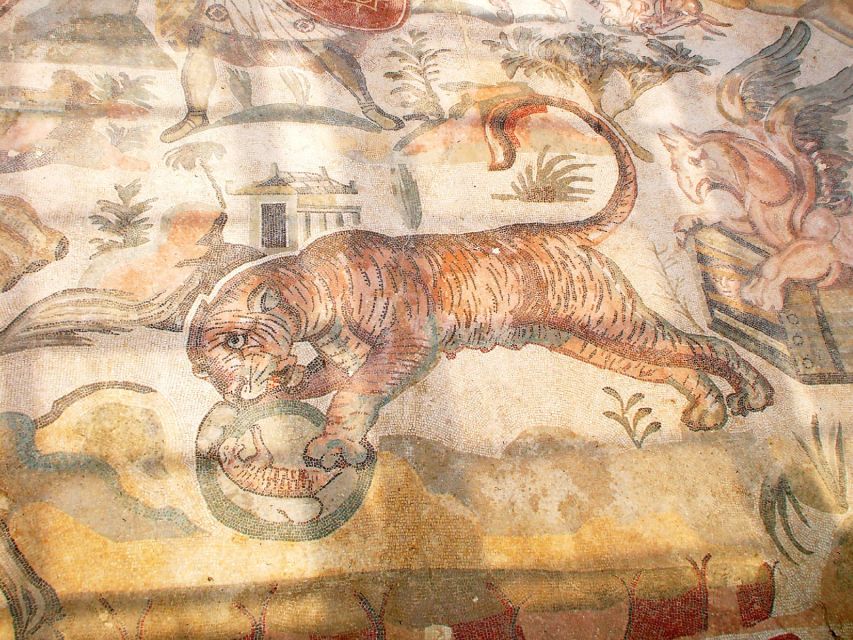
- The Great Hunt mosaic shows animals and capture scenes across a vast floor, giving the villa its most memorable visual centerpiece.
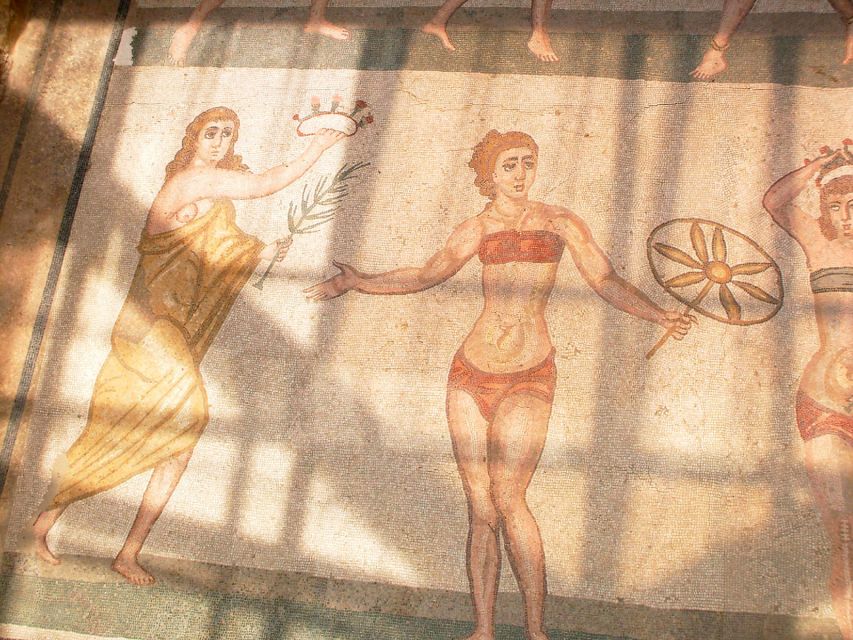
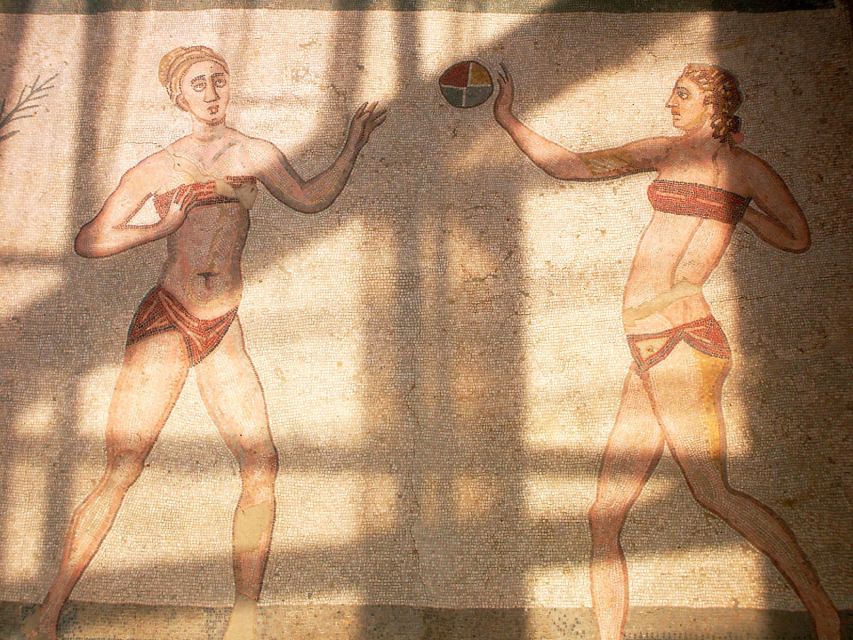
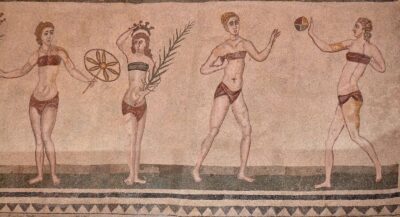
- The famous bikini mosaic depicts ten women exercising, throwing a discus, playing with a ball, lifting weights, and running.
- A private guide leads the visit in English, Italian, Spanish, French, or German.
- The tour lasts 1.5 hours, a useful length for seeing the main rooms without turning the visit into an all-day march.
- The $325.13 price covers a group of up to 15, but you must pay separately for entry to the archaeological site.
- The route ends where it begins, at the entrance on SP90 near Piazza Armerina, with no transportation included.
Why Villa del Casale deserves your time
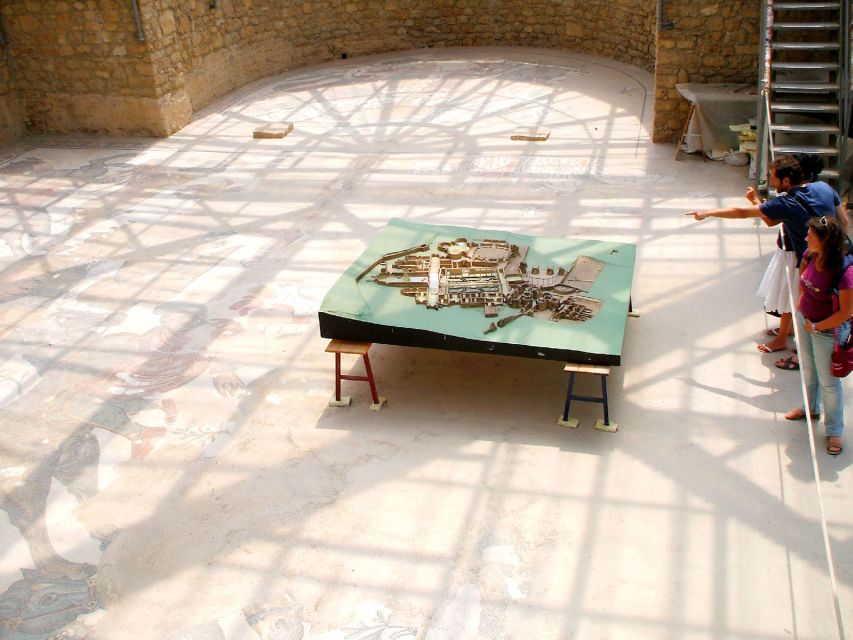
Many ancient sites leave you staring at broken walls and trying to picture the finished building. Villa Romana del Casale gives you a much better chance. Its floors still carry large, detailed mosaics showing animals, athletes, theatrical masks, deities, heroes, hunting scenes, and ordinary activities.
The villa was likely owned by Valerio Massimiano, a powerful Roman patrician. That possible connection helps explain the scale of the place. This was not a modest country home. It was a large domus built for display, comfort, entertaining, and the management of a substantial household.
The mosaics are not small decorative patches tucked into corners. They cover roughly 3,500 square meters, making the floors the main event. Your guide helps you read the scenes rather than simply walk past them as attractive patterns.
I find that especially useful here because the villa contains many rooms and several different styles of space. Without context, it can be hard to tell a reception hall from a private room, or a bath from a garden feature. A good explanation gives each floor a purpose.
The tour is led by a licensed guide, and you can choose English, Italian, Spanish, French, or German. The private format is a real advantage for families, couples, and small groups who want to stay together rather than join a large mixed crowd. Stefania is one guide associated with this experience, and her approach has been praised for putting the villa into its historical setting while pointing out the most important and unusual features.
More Villa Romana del Casale mosaic tours near Sicily:
- From Palermo: Villa Romana and Valley of the Temples Trip
★ 4.6 · 294 reviews - From Catania: Agrigento and Piazza Armerina Full-Day Trip
★ 4.7 · 140 reviews - Valley of the Temples and Villa Romana del Casale Day Trip from Taormina
★ 4.0 · 137 reviews
Starting at the SP90 entrance
You meet your guide at the entrance to the archaeological site on SP90, 94015 Piazza Armerina EN. Transportation and hotel pickup are not included, so you need to arrange your own way to the site.
That detail matters when planning a day in central Sicily. The meeting point is not in the middle of a city square where you can simply wander over from a nearby café. Build enough time into your schedule to arrive at the archaeological entrance before the tour begins.
The tour returns to this same meeting point. You will not be dropped at another part of Piazza Armerina, and the experience does not include a meal, tasting, or onward transport.
Your entry ticket is also separate. The price of $325.13 is for the private guided service for up to 15 people, not for admission to the villa. For a full group, that can be a reasonable way to secure a dedicated guide. For only one or two people, the cost is much harder to justify unless personal attention is a priority.
The peristyle and its procession of animals
The route takes you through the villa’s rooms, beginning with areas that show how carefully the complex was planned. The peristyle floor is made entirely of mosaic, with images of European and African animals.
A peristyle is a courtyard surrounded by columns, so this part of the villa gives you both architecture and decoration at once. Picture Roman household life unfolding around an open central space, with visitors moving through shaded walkways while colorful animals appear beneath their feet.
This is a good place to listen closely to the guide. The animal scenes are not just filler between grander rooms. They help show the villa’s wide visual world, linking local Roman life with animals and places beyond Sicily.
The scale also becomes clear here. You are not viewing a single famous panel and leaving. The villa’s decoration continues from room to room, with changes in subject and setting that reflect the different uses of the domus.
The garden fountain with three pools
After the interior rooms, the route includes a garden enriched by a large fountain. The fountain has three pools, marble on the outside and mosaics on the inside.
This feature offers a welcome change from the long interior sequence. It also shows that the villa’s owners cared about movement, water, and presentation, not only about filling rooms with expensive floors.
The combination of marble and mosaic is worth noting. The outside gives the fountain a formal finish, while the interior decoration rewards anyone looking into the pools. Your guide can help connect this garden feature to the wider design of the villa.
Do not expect a long garden walk. The visit is focused on the archaeological complex and its decorated rooms, with the fountain forming one part of the larger route.
Same island, a completely different day out:
- Catania: Mount Etna Morning or Sunset Day Trip with Tasting
★ 4.8 · 4,028 reviews - Mount Etna: Guided Volcano Summit Hiking Tour with Cable Car
★ 4.7 · 3,784 reviews - Palermo: NO Mafia Walking Tour
★ 4.8 · 2,431 reviews - Palermo: Hop-on Hop-off Bus Tour 24-hour Ticket
★ 3.9 · 2,410 reviews
The Great Hall Corridor and imperial symbolism
One of the key stops is the Great Hall Corridor. Two columns show female figures symbolizing the two peripheral provinces of the empire.
This is a useful reminder that Roman decoration often carried a political message. The villa was not only a comfortable residence. Its imagery could communicate status, power, and a connection to the wider Roman world.
The corridor also prepares you for the villa’s larger reception spaces. You begin to see how the building guided visitors through a series of impressive views, with mosaics underfoot and symbolic decoration around them.
The guide’s role is important here. A quick solo visit might leave you with the impression of a handsome corridor. With explanation, the female figures become part of the owner’s presentation of Roman authority.
The oval triclinium and domestic rooms
Next comes the oval-shaped triclinium, or dining room. Roman dining rooms were made for social display, and an oval plan gives this space a different feel from the rectangular rooms around it.
The villa also includes private rooms reserved for domestic people. These less formal spaces help balance the grand halls. They show that the complex needed more than impressive areas for entertaining an elite owner and his visitors.
This part of the route is helpful if you want to understand the building as a working household rather than a collection of museum panels. The villa had spaces for formal meals, private life, service, movement, and maintenance.
You will not spend equal time in all 48 rooms during a 1.5-hour tour. The guide has to keep the group moving, so the emphasis falls on the most important floors and architectural features. That makes the tour efficient, but anyone who wants to examine every mosaic at leisure should plan extra time at the site if permitted by the admission rules.
The ten athletes in the famous bikini mosaic
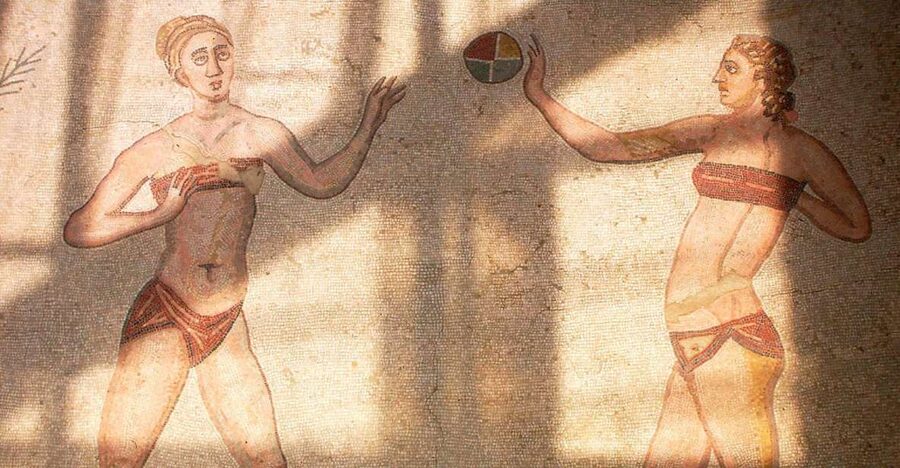
The bikini mosaic is the villa’s most instantly recognizable scene. It shows ten young women taking part in different athletic activities, including discus throwing, ball games, weight exercises, and cross-country running.
The modern nickname catches the eye, but the mosaic is more interesting than its title. It shows women engaged in organized physical activity and gives you a lively picture of ancient sport. The figures are not stiff symbols. Their poses suggest motion, competition, and training.
This is one of the rooms where a guide can add real value. The images are easy to see, but the details can be missed when several people gather around the same floor. The explanation helps you notice what each athlete is doing and how the scene fits into the villa’s wider decoration.
Expect this room to attract attention. It is one of the most popular stops, and crowded conditions are possible. Stay close enough to hear your guide, especially if other groups are moving through the same area.
The Basilica and polished marble floors
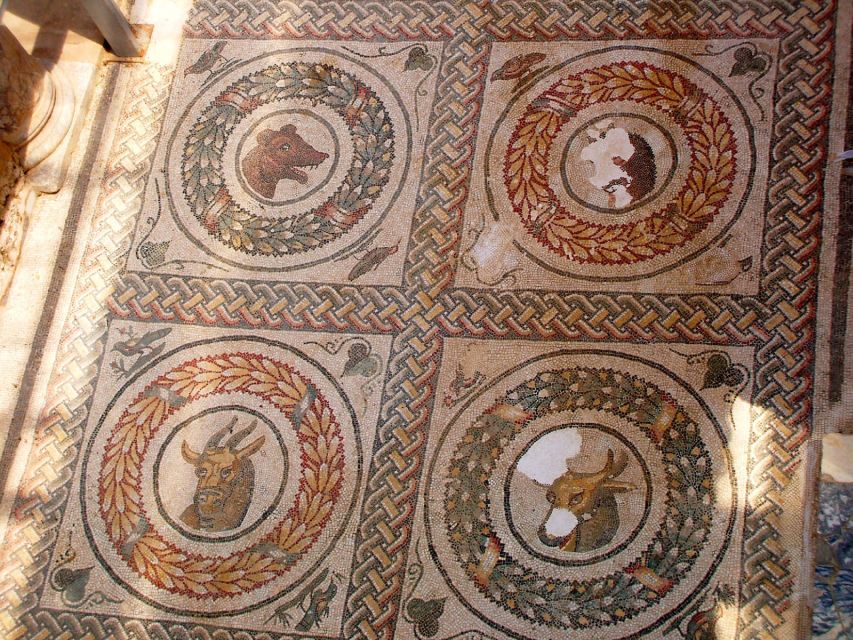
The Basilica brings a more formal note to the visit. Its floor is made from polychrome marble, a sharp contrast to the mosaic scenes in the surrounding rooms.
This is where you can appreciate the villa’s use of different materials. Mosaics supplied pictures and patterns, while colored marble created a more controlled, prestigious surface. Together, they show the range of decoration available to a wealthy Roman household.
The Basilica was an important reception space, so it helps you picture the social hierarchy built into the villa. Some rooms were designed for everyday domestic work. Others were intended to impress people who entered on official or social business.
The marble may appear less playful than the animal and athlete scenes, but it is no less valuable to the overall visit. It gives the villa a sense of ceremony and helps explain why the property was built on such an ambitious scale.
A bedroom with masks and a lovers’ medallion
One bedroom contains a rectangular alcove and mosaic decoration with theatrical masks. At the center is a famous medallion showing lovers.
This room offers a more intimate contrast to the grand corridors and public halls. The theatrical masks bring drama into a private setting, while the central medallion provides a human focus.
It is also a good example of how the villa’s mosaics vary in subject. You move from animals and imperial symbols to athletics, theater, and personal relationships. The variety keeps the tour from becoming a long parade of similar floors.
If you enjoy details, listen for the guide’s explanation of how the room is arranged. The alcove, surrounding decoration, and central image are best understood as parts of one design rather than separate objects.
The Frigidarium, Tepidarium, and Roman bathing
The route then reaches the domus baths, including the Frigidarium and Tepidarium. These names refer to different bathing spaces, with the Frigidarium associated with cool water and the Tepidarium with warm water.
The baths show another side of life at the villa. Roman bathing was not merely a practical wash. It was part of daily routine, comfort, and social life, and the presence of dedicated rooms indicates the level of luxury available here.
You can also see how decoration followed function. The mosaics and carefully arranged spaces made ordinary activities feel ceremonial and refined.
The bath section is not a modern spa experience, of course. It is an archaeological stop within a larger route, and the value comes from seeing how the villa’s systems and rooms worked together.
Ending in the Circus Hall
The final stop is the Circus Hall, a space used as a gym. Its mosaic reproduces the Circus Maximus in Rome.
That image brings the tour back to public spectacle and the larger Roman world. The Circus Maximus was one of Rome’s major venues, and its appearance here suggests that the villa’s owner wanted familiar imperial culture represented inside his own home.
Ending with this scene gives the tour a strong visual finish. You have seen domestic rooms, formal halls, baths, gardens, animals, athletes, and hunting scenes. The Circus Hall pulls those themes together through an image of sport and public entertainment.
The 1.5-hour length works well for this route. You get a guided look at the major highlights without needing to dedicate an entire day to the villa. If you are passionate about Roman art, you may still wish the tour allowed more time in each room, but the focused pace suits most sightseeing schedules.
How the price compares with the experience
At $325.13 per group of up to 15, this is not a low-cost guided visit for a solo caller. The value improves sharply when several people share the fee. A group of ten or more is effectively paying for a private guide at a much lower per-person rate than a couple would.
You are paying for a licensed guide, a private group, and explanations in one of five languages. You are not paying for the entrance ticket, food, tastings, or transportation, so add those costs when building your day.
I would consider this a strong choice for a family or group that wants the villa explained clearly and efficiently. For two people, I would compare the price with other guided options before booking. The mosaics are worth seeing either way, but the guided format matters most if you want help understanding the rooms, symbols, and Roman way of life.
Free cancellation up to 24 hours before the start gives you some protection if your plans change. You can also reserve and pay later, which helps when you are arranging several stops around Sicily.
Who should book this private villa tour?
I would recommend it most to:
- First-time visitors to Villa del Casale who want the main rooms explained in a clear order.
- Small groups and families that prefer a dedicated guide rather than a large shared party.
- Roman art enthusiasts who want time spent on mosaics, architecture, baths, and symbolism.
- Visitors with limited time who want a focused route lasting 1.5 hours.
- Multilingual groups that need English, Italian, Spanish, French, or German.
I would be more cautious if you are traveling alone or as a couple on a tight budget. The group price can feel high before admission is added.
I would also avoid treating this as a quiet, private villa visit in the literal sense. Your guide leads a private booking, but other people may be moving through the archaeological site at the same time. Crowding is a possible issue, especially around the most famous mosaics.
Should you book the Villa del Casale mosaics tour?
Book it if you want the mosaics placed in context rather than viewed as a series of beautiful floors. The guide can point out the Great Hunt, the athletes, theatrical masks, provincial symbols, marble work, baths, and Circus Maximus scene while keeping the route moving.
The best value comes when your group is large enough to share the $325.13 fee. If you have 10 to 15 people, the private format is especially appealing. If you have only one or two, decide how much you value a licensed guide before adding the separate entrance cost.
For most visitors to Piazza Armerina, the villa itself is the reason to come. This tour gives you a practical way to understand its 48 rooms and remarkable mosaics in a manageable amount of time.
FAQ
Where does the tour begin?
The tour begins at the entrance to the archaeological site on SP90, 94015 Piazza Armerina EN, Italy.
Where does the tour end?
The activity ends back at the meeting point.
How long does the tour last?
The guided tour lasts 1.5 hours. Starting times depend on availability.
Is the entrance ticket included?
No. The entrance ticket is not included in the tour price.
Is transportation included?
No. Transportation and pickup are not included.
How many people can join the private group?
The price covers one private group of up to 15 people.
Which languages are available?
The live guide is available in English, Italian, Spanish, French, and German.
What mosaics will I see?
The route includes the Great Hunt mosaic, the famous bikini mosaic, animal scenes, theatrical masks, lovers, hunting scenes, athletic activities, and a reproduction of the Circus Maximus.
Can I cancel the booking?
Yes. You can cancel up to 24 hours in advance for a full refund. You can also reserve now and pay later.
Just added around Sicily
- Anti-Mafia Heroes (Cool Hours) Morning Walking Tour★ 5.0 · 3 reviews
- Nicolosi: Excursion Etna Craters at 3000 mt.★ 4.2 · 3 reviews
- DISCOVER THE SECRET OF PALERMO Walking Tour Combining Art and best street food★ 5.0 · 3 reviews
- The art of the Italian Aperitivo with a local: Learn & Enjoy in Palermo★ 5.0 · 3 reviews
- Taormina PRIVATE EAST COAST EXCURSIONS 2 Exclusive Days with Guide Driver★ 5.0 · 3 reviews
- Monti Rossi Adventure Park Entry Ticket Full★ 5.0 · 3 reviews
- Guided kayak tour inside the Stagnone of Marsala★ 5.0 · 3 reviews
- Catania AIRPORT transfer From / To Taormina★ 5.0 · 3 reviews
Villa Romana del Casale Tours, compared.
Valley of the Temples and Villa Romana del Casale Day Trip from Taormina
Read our review →
Valley of the Temples & Piazza Armerina with Snack
Read our review →
Agrigento Valley of the Temples and Villa Romana del Casale Tour from Palermo
Read our review →
Agrigento and Piazza Armerina: Valley of the Temples and Villa Romana del Casale
Read our review →
Browse the lists this tour appears in