
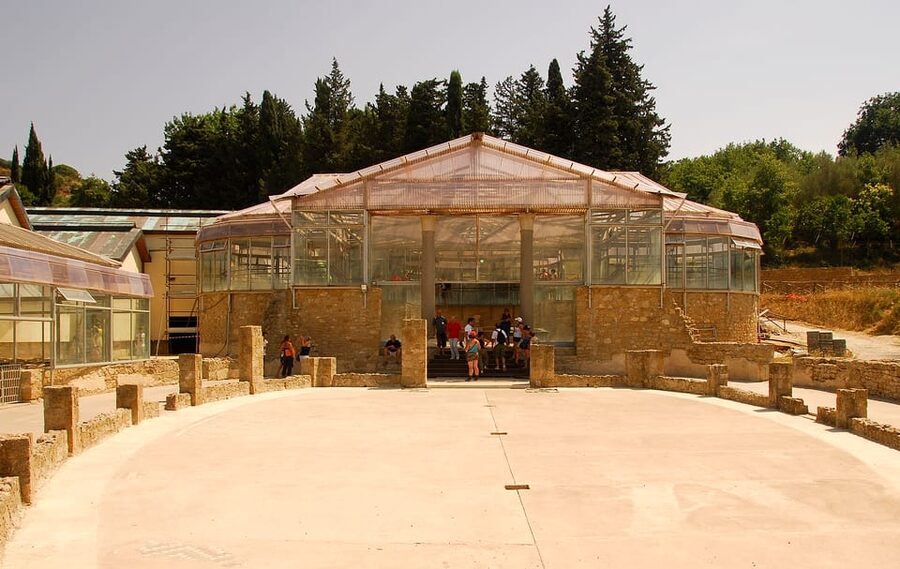
Reviewed · VILLA ROMANA DEL CASALE TOURS
Piazza Armerina: Private Villa Romana del Casale Guided Tour
The finest thing about Villa Romana del Casale is under your feet. Room after room is covered with detailed 4th-century mosaics showing chariot races, hunters, banquets, wild animals, and the daily routines of an elite Roman household. This is not a ruin you simply walk past. The floors tell the story.
I like the private format, since your guide can explain small details and answer questions instead of following a fixed script. I also like the clear route through the thermal baths, guest apartments, public halls, and private rooms, which helps you understand how this enormous home worked.
The main caution is cost. The price is $283.21 for a group of up to 15, and that covers the guide, not admission. One reported visit lasted about 1 hour and 40 minutes rather than two hours, so the value is best for a larger group that will make good use of the private guide.
In This Review
- Key points to know before you book
- Why the villa is worth your time
- Meeting your guide at the ticket booth
- The thermal baths: start with Roman comfort
- Guest apartments and the Little Hunt mosaic
- Orpheus, banquets, and the dining rooms
- The public halls and the Great Hunt
- The private rooms of the domina and dominus
- What the private guide adds
- Is $283.21 a fair price?
- Who will enjoy this tour most?
- Booking flexibility and practical details
- Should you book Villa Romana del Casale with a private guide?
- FAQ
- How much does the private Villa Romana del Casale tour cost?
- How long does the tour last?
- Where do I meet the guide?
- Are entrance tickets included?
- Which languages are available?
- Is hotel pickup included?
- Can I cancel or pay later?
Key points to know before you book
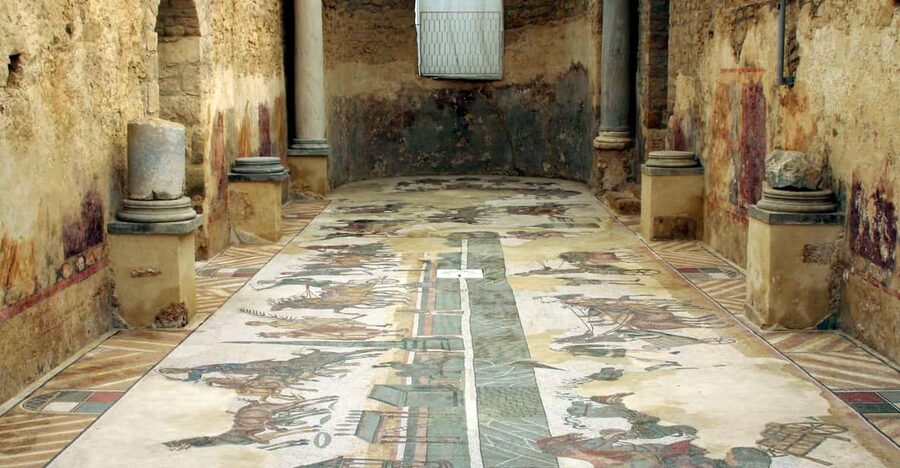
- The mosaics are the main event: You will see one of the largest surviving Roman mosaic collections, including the famous Great Hunt.
- The tour covers more than the floors: Your guide explains the baths, guest apartments, dining rooms, public reception areas, and private quarters.
- You meet at the ticket booth: Hotel pickup and drop-off are not included, and you must buy the entrance ticket separately.
- The group price works best with several people: The fee covers up to 15 people, so the per-person cost drops as your group grows.
- The guide may speak five languages: Tours are offered in English, French, Italian, Spanish, and German.
- Allow for a possible shorter visit: The advertised duration is two hours, though one French-language visit finished after about 1 hour and 40 minutes.
Why the villa is worth your time
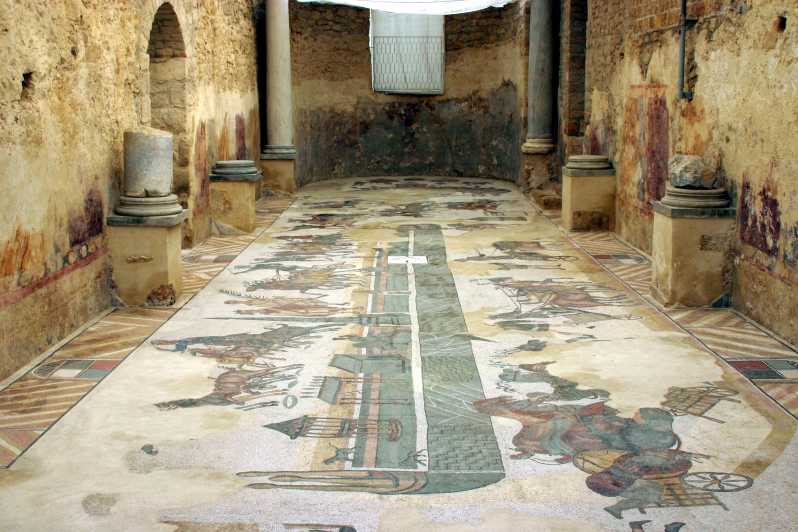
Villa Romana del Casale gives you a rare look at private life during the late Roman Empire. Its owner was wealthy enough to build a country residence with thermal baths, reception halls, servant areas, guest apartments, dining rooms, and private spaces for the household heads.
The exact identity of the owner is not certain, and that makes the guide especially useful. Instead of seeing a pile of old walls, you can ask how the villa may have operated, who used each room, and why certain scenes were placed where they were.
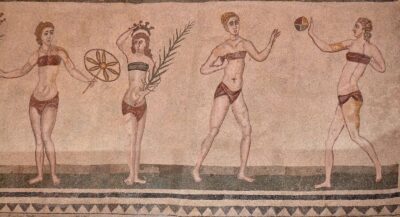
The mosaics are the star attraction. They are unusually extensive and cover much of the villa’s interior with scenes from work, sport, mythology, travel, hunting, and entertainment. The workmanship gives you a close look at Roman art, but the pictures also offer clues about food, clothing, animals, architecture, and social rank.
I recommend taking the tour early in your visit to Piazza Armerina. A guide can give you a framework for the villa, and you can then revisit favorite scenes on your own if time and admission arrangements allow.
More Villa Romana del Casale mosaic tours near Sicily:
- From Palermo: Villa Romana and Valley of the Temples Trip
★ 4.6 · 294 reviews - From Catania: Agrigento and Piazza Armerina Full-Day Trip
★ 4.7 · 140 reviews - Valley of the Temples and Villa Romana del Casale Day Trip from Taormina
★ 4.0 · 137 reviews
Meeting your guide at the ticket booth
The tour begins outside the villa, in front of the ticket booth. This is a simple meeting point, but do not expect transportation from your hotel. You need to arrange your own way to Villa Romana del Casale and handle the admission fee separately.
Your private certified guide leads the visit for about two hours. Since the group can include up to 15 people, the format is useful for families and small groups who want one explanation shared by everyone. It is less attractive for a solo visitor or couple if you are paying the full group rate.
The available languages are English, French, Italian, Spanish, and German. Two guides named in the tour information are Rafaello, who gave a particularly animated French-language visit, and Stephania, who also led a French-language tour. Guide assignments can vary, so do not book on the assumption that one particular person will lead your visit.
The tour ends back at the meeting point. Food, drinks, hotel transfers, and entrance tickets are not part of the guiding fee, so budget for those separately.
The thermal baths: start with Roman comfort
The first area is the villa’s thermal bath complex. This is a smart beginning because Roman bathing was not a minor household chore. It was a social ritual, a place to exercise, meet people, and spend time in carefully controlled heat and water.
You see the caldarium, the hot room, and the frigidarium, the cold room. The cold section was fed by the Gela River, a detail that helps you picture the engineering behind the comfort. The villa was not simply decorated lavishly. It was built with systems to move water and manage heat.
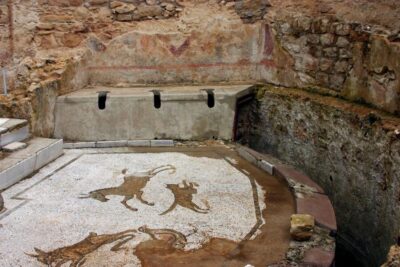
A guide can connect the rooms to the mosaics underfoot. The baths include scenes linked to sport and entertainment, including a quadriga race with four-horse chariots. As you look at the figures and movement in the floor design, the building feels less like a silent ruin and more like a place where people gathered, watched contests, and talked.
This is also where a guide earns the fee. Without explanation, the names of the rooms and their functions can blur together. With a private guide, you can ask how the bathing sequence worked and how the rooms fit into the larger household.
Guest apartments and the Little Hunt mosaic
From the baths, the route continues toward the guest apartment. Here, the pictures shift toward everyday activities such as fishing, hunting, and banquets.
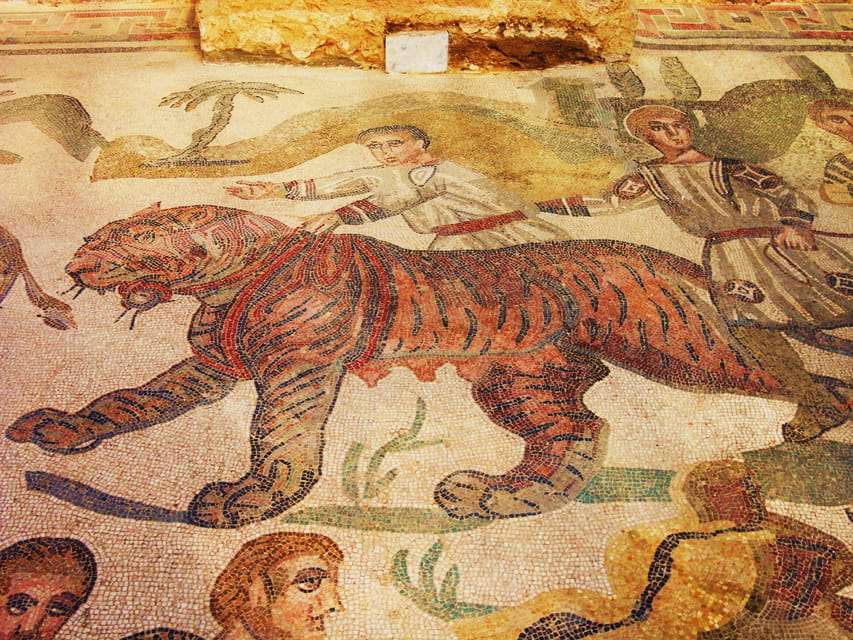
The Little Hunt mosaic is one of the most engaging sections. It captures the tension before the action, with hunters preparing and waiting. Look for the small details rather than rushing toward the biggest panel. The scene gives you a glimpse of elite leisure, but it also shows how hunting served as a display of wealth, skill, and status.
The guest quarters help explain how the villa functioned as more than a private family retreat. Important visitors could be received, entertained, and housed on the property. A private guide can point out the difference between rooms meant for guests and those reserved for the owners.
You may find this section more approachable than the grand public halls because the subject matter is familiar. People are eating, fishing, hunting, and socializing. The mosaics turn those ordinary actions into a record of how the upper class wanted its life to be seen.
A few more Sicily tours and experiences worth weighing up
- Mount Etna: Guided Volcano Summit Hiking Tour with Cable Car
★ 4.7 · 3,784 reviews - Taormina: Ancient Theater Skip-the-Line Ticket & Audio Guide
★ 4.5 · 1,701 reviews - Palermo: Teatro Massimo Opera House Guided Tour
★ 4.5 · 1,573 reviews - Etna Volcano: South Side Guided Summit Hike
★ 4.7 · 1,545 reviews
Orpheus, banquets, and the dining rooms
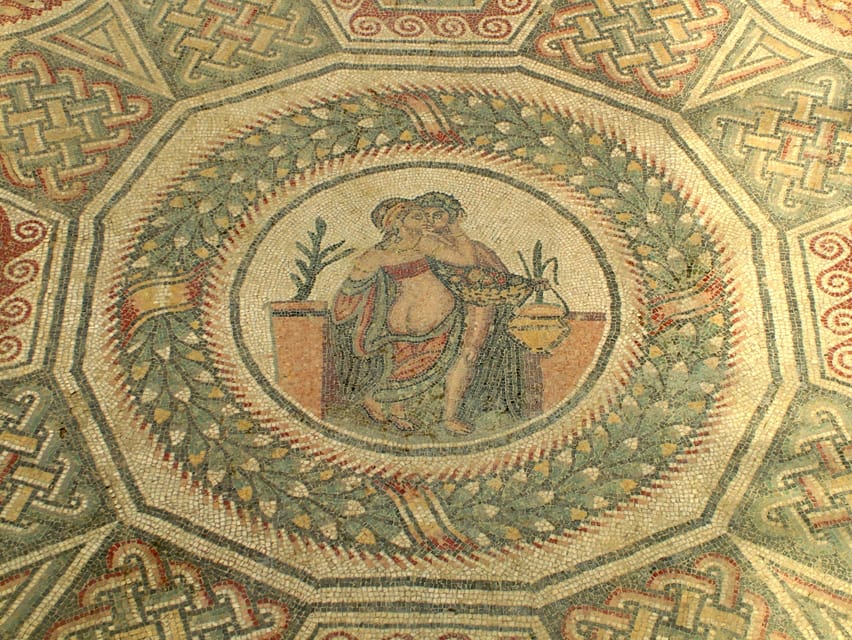
The dining area brings in mythology and performance. One mosaic shows Orpheus playing his lyre while animals gather around him. It is a graceful image, but it also reflects the kind of cultural world the villa’s owners wanted to present.
Roman dining was a public display of taste and status. The food mattered, but so did the room, the entertainment, the furnishings, and the stories told through art. In this setting, Orpheus becomes part of the atmosphere of an elite banquet.
I like this part of the visit because it links the villa’s art to its social purpose. The mosaics were not placed in a modern gallery, separated from daily life. They decorated spaces used for meals, meetings, bathing, and reception.
Your guide can help you read the scenes as more than pretty patterns. Mythological images, animals, athletic contests, and hunting scenes all helped communicate ideas about power, education, refinement, and control over the natural world.
The public halls and the Great Hunt
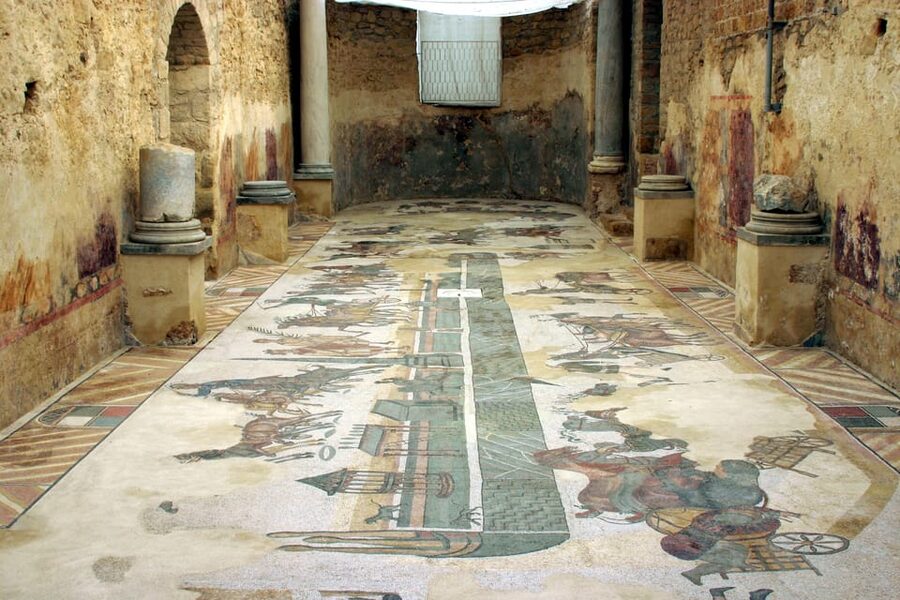
The grand public halls are among the most memorable parts of the villa. These were reception areas where the owner welcomed clients, meaning dependents and associates who came to pay their respects or seek support.
The Great Hunt mosaic is the major showpiece. It presents a wide-ranging scene of animals being captured and transported across the Roman world. You can see a lioness attacking a hunter, an elephant being loaded onto a ship, and a vessel moving across the waves.
The mosaic is often described as a monumental map of the Roman Empire. It is not a modern map with neat borders, but it gives you a sense of the empire’s reach and the movement of animals, people, and goods across great distances.
This is the point where the villa’s private luxury connects with imperial power. Exotic animals did not simply appear in a country house by chance. Their presence suggests trade networks, organized transport, money, and access to the far corners of Roman territory.
Give yourself time here. Large mosaics can be tiring to study, especially when the route is busy or the light is uneven. A guide helps by selecting the details that matter most, but you should still pause and look at the smaller figures around the edges.
The private rooms of the domina and dominus
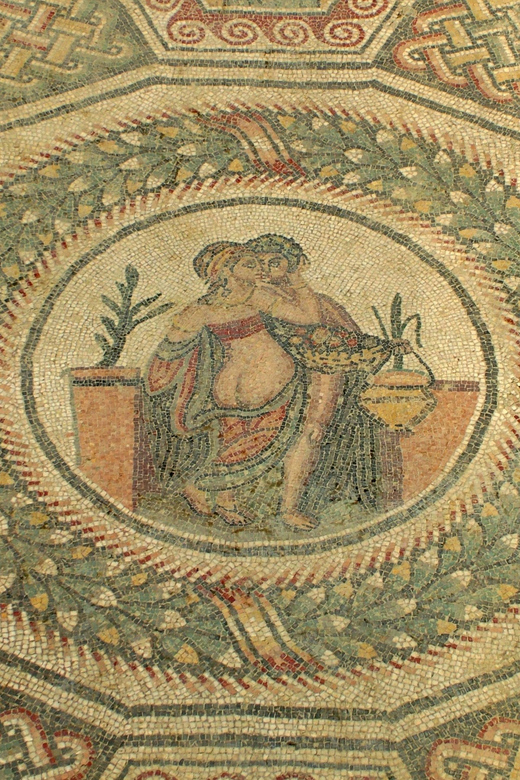
The final section takes you into the private rooms of the villa’s domina and dominus, the woman and man who headed the household. These spaces offer a more personal end to the tour after the public spectacle of the Great Hunt.
You learn where the owners slept, ate, and handled daily business. The arrangement shows how privacy worked in an elite Roman residence, where family life, administration, entertainment, and formal reception all took place within one large complex.
The contrast between the private rooms and the public halls is important. The owners wanted to impress visitors, but they also needed rooms for rest, household management, and routine decisions. The villa was both a home and a statement of rank.
Your guide also discusses who may have owned the property. Since the owner remains uncertain, this part should be treated as informed interpretation rather than a firm answer. That uncertainty does not weaken the site. It gives you a useful reminder that archaeology often provides strong evidence without solving every question.
What the private guide adds
A self-guided visit lets you see the mosaics, but a private tour gives them order and meaning. You move through the villa in a logical sequence, from bathing and guest areas to public halls and private rooms.
The best guides make the scenes feel active. Rafaello was praised for speaking very good French, giving precise and detailed explanations, adding lively anecdotes, and placing the villa within the wider story of its period. Stephania was also described as pleasant, clear in French, and willing to answer questions.
That kind of presentation matters at Villa Romana del Casale. There is a lot to see, and many scenes can look similar after an hour. A guide can keep your attention on the strongest details, explain cultural references, and help you notice how the architecture and mosaics worked together.
The private arrangement also lets you ask about what interests you. If your group cares about Roman engineering, you can spend more time on the baths. If you prefer daily life, you can focus on the guest apartments, dining scenes, and private rooms.
Is $283.21 a fair price?
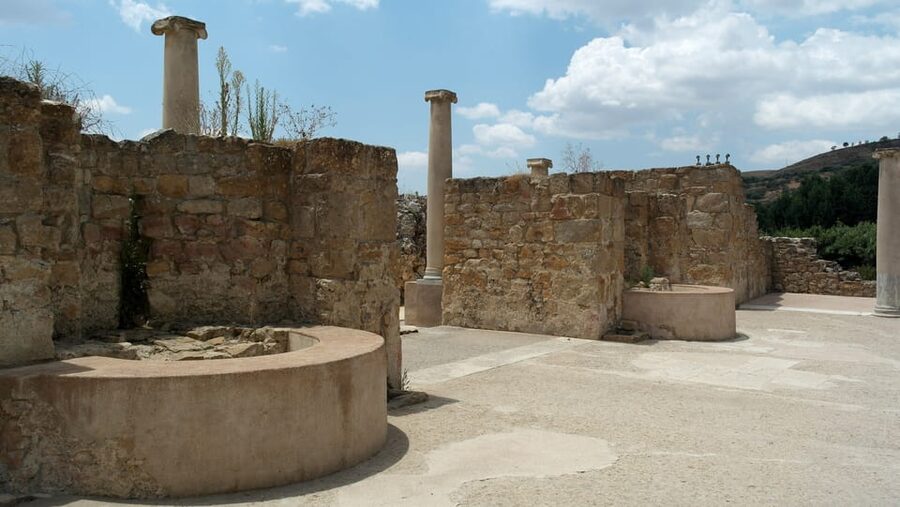
The listed price is $283.21 per group of up to 15 people. That is a guide fee, not an all-in admission price. You must add the entrance tickets, and the tour does not include transportation, food, or drinks.
For a group of 10 to 15, the guide cost can be reasonable because the fee is spread across many people. For four people, the price is much harder to justify, especially after adding admission. One French-speaking group paid about 250 euros for four people and felt the 1-hour-40-minute visit was too short for the total cost, even while considering the villa essential.
That is the central value question. The villa itself is a must-see for anyone interested in Roman art, architecture, or daily life, but you are paying for private attention rather than entry. If your group wants a detailed explanation and can split the charge, the arrangement makes more sense.
If you are on a tight budget, compare the guide fee with the cost of visiting independently. If you prefer context, questions, and a well-paced route, the extra cost may be worthwhile. Just remember that the advertised two hours should be treated as an approximate duration.
Who will enjoy this tour most?
I would recommend it to families, friend groups, and history-minded visitors who want to share one guide. It is especially useful if some members of your group are not comfortable reading long labels or if you want explanations in English, French, Italian, Spanish, or German.
It also suits first-time visitors to the villa. The building is large, and its rooms make more sense when you understand how baths, guest quarters, reception spaces, dining rooms, and private apartments were connected.
Couples and solo visitors should think carefully about the price. Since the fee is per group, you may pay nearly the same as a larger party. The experience can still be worthwhile, but the cost per person rises quickly.
Families with pets should note that animals are not allowed. Anyone booking should also remember that the entrance ticket is separate from the private guide.
Booking flexibility and practical details
You can cancel up to 24 hours before the tour for a full refund. The reserve-now-and-pay-later option also keeps your plans flexible, since you do not pay at the time of booking.
Starting times vary, so you need to check availability for your date. Plan to meet your guide at the ticket booth, not at a hotel or another point in Piazza Armerina.
The tour is listed as a two-hour walking visit. Wear comfortable shoes and allow enough time around the scheduled start for your admission arrangements, since the guide fee does not include entry.
Should you book Villa Romana del Casale with a private guide?
Book this tour if you are visiting with a group and want the mosaics explained by a live guide in your language. The baths, Little Hunt, Orpheus, Great Hunt, and private rooms form a strong two-hour route, and the best guides add context that is difficult to get from the floors alone.
Think twice if you are traveling alone or as a couple on a strict budget. Admission costs extra, the group fee is substantial, and one visit ran short of the advertised duration.
For a group of several people, I see good value in the private format, especially if you want to ask questions and understand how this lavish Roman home worked. For a very small group, compare the total cost first, then book only if personal guidance matters more to you than keeping the visit inexpensive.
FAQ
How much does the private Villa Romana del Casale tour cost?
The price is $283.21 per private group of up to 15 people. Entrance tickets are not included and must be paid for separately.
How long does the tour last?
The scheduled duration is two hours. One reported visit lasted about 1 hour and 40 minutes, so the actual length may be slightly shorter.
Where do I meet the guide?
Meet your guide in front of the ticket booth at Villa Romana del Casale. The tour ends back at the same meeting point.
Are entrance tickets included?
No. The entrance ticket is not included in the private guiding fee.
Which languages are available?
The live guide service is available in English, French, Italian, Spanish, and German.
Is hotel pickup included?
No. Hotel pickup and drop-off are not included. You must make your own way to Villa Romana del Casale.
Can I cancel or pay later?
You can cancel up to 24 hours in advance for a full refund. A reserve-now-and-pay-later option is available, so you do not need to pay at the time of booking.
Just added around Sicily
- Anti-Mafia Heroes (Cool Hours) Morning Walking Tour★ 5.0 · 3 reviews
- Nicolosi: Excursion Etna Craters at 3000 mt.★ 4.2 · 3 reviews
- DISCOVER THE SECRET OF PALERMO Walking Tour Combining Art and best street food★ 5.0 · 3 reviews
- The art of the Italian Aperitivo with a local: Learn & Enjoy in Palermo★ 5.0 · 3 reviews
- Taormina PRIVATE EAST COAST EXCURSIONS 2 Exclusive Days with Guide Driver★ 5.0 · 3 reviews
- Monti Rossi Adventure Park Entry Ticket Full★ 5.0 · 3 reviews
- Guided kayak tour inside the Stagnone of Marsala★ 5.0 · 3 reviews
- Catania : Diving for patented divers★ 5.0 · 3 reviews
Villa Romana del Casale Tours, compared.
Valley of the Temples and Villa Romana del Casale Day Trip from Taormina
Read our review →
Valley of the Temples & Piazza Armerina with Snack
Read our review →
Agrigento Valley of the Temples and Villa Romana del Casale Tour from Palermo
Read our review →
Agrigento and Piazza Armerina: Valley of the Temples and Villa Romana del Casale
Read our review →
Browse the lists this tour appears in