
Reviewed · MOUNT ETNA TOURS
Etna Volcano: South Side Guided Summit Hike
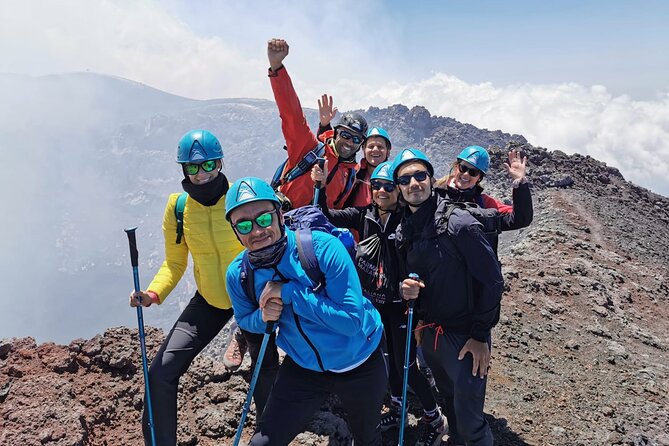
Etna’s summit is not a gentle mountain walk. After the cable car carries you to 2,500 meters, you climb through loose volcanic sand, lava flows, and gas-stained ground toward the highest volcano in Europe. The reward is a close look at summit craters, smoking vents, volcanic bombs, and wide views across Sicily. I like the serious mountain setting and the way a trained guide turns strange rocks and sulfur colors into a readable story. I also like that boots, helmets, and walking sticks are available, which saves you from packing bulky gear.
The main catch is simple: Etna is active, and the advertised summit may be off-limits on the day you visit. You could finish below the Central Crater, as some groups have, though guides usually replace the closed section with another route. The hike is medium to high difficulty, not a scenic stroll, and the cable car costs an extra €52 per person in cash.
In This Review
- Key points to know before you book
- Starting at Rifugio Sapienza on Etna’s south side
- The cable car ride to 2,500 meters
- Walking through Etna’s lunar terrain
- Reaching the Central Crater viewpoint
- A break beside one of Europe’s active volcanoes
- Descending toward the Barbagallo craters
- Crossing a lava channel before the return ride
- What the $67.97 price really buys you
- How to prepare for six hours above Etna’s tree line
- Who will enjoy this Etna hike most
- Should you book the South Side summit hike?
- FAQ
- How long does the Etna summit hike take?
- Where does the tour start and finish?
- Is the cable car included in the tour price?
- How difficult is the hike?
- Is reaching the summit guaranteed?
- What languages are available?
- What equipment is provided?
- What should I bring?
Key points to know before you book
- The hike begins at 2,500 meters: The cable car removes much of the lower climb, but the air is thin and the remaining ascent is demanding.
- Summit access is never guaranteed: Volcanic activity, wind, weather, or safety rules can change the route at any time.
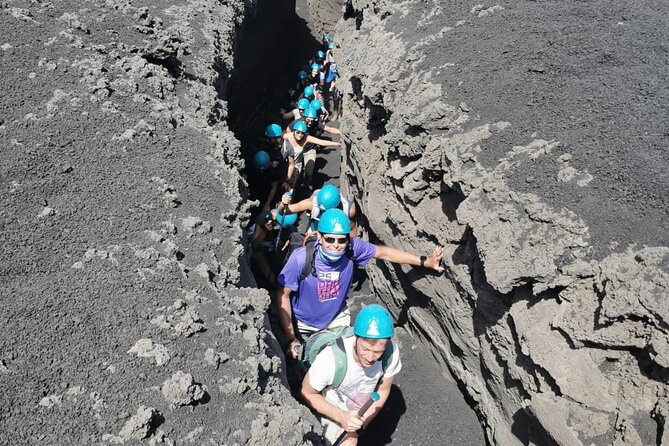
- The terrain is loose and uneven: Expect sandy slopes, lava rock, steep sections, and a lava channel on the descent.
- The guides are the heart of the experience: Guides such as Antonio, Giovanni, Marco, Massimo, and Nello have been praised for pacing, safety, and clear explanations.
- The listed price is not the final price: Add €52 for the return cable car, paid on the spot, cash only according to the tour information.
- Pack for cold, exposed weather: Bring layers, a face covering, water, food, sunglasses, and a small daypack.
Starting at Rifugio Sapienza on Etna’s south side
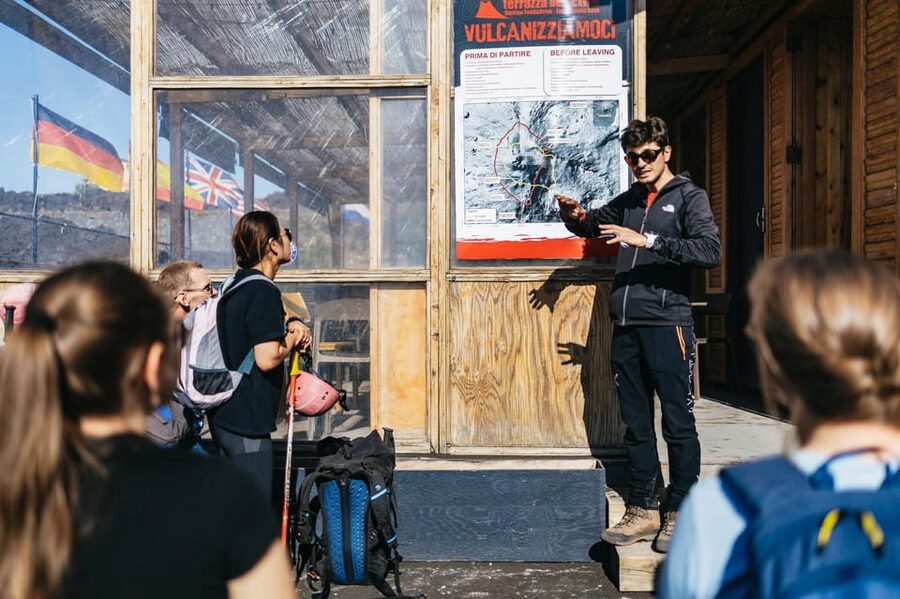
You meet the Ashàra Etna & Stromboli Guides team at their information point near Rifugio Sapienza, close to the Terrazza dell’Etna restaurant. This is the Etna South base, and the activity ends at the same place.
Allow a little patience at the start. The group may need to collect boots, helmets, and walking sticks before heading to the cable car. One large group spent a long time being fitted out, followed by another wait while tickets were arranged. Smaller groups should move more quickly, but the opening can feel less polished than the hike itself.
The meeting area is useful for last-minute food. You can buy sandwiches nearby, but I would still arrive with water, snacks, and a packed lunch. The tour lasts six hours, and once you are on the upper slopes, choices are limited.
Your guide leads in English, French, or Italian. The best part of the briefing is not just learning where to walk. You get a safety explanation, a sense of the day’s conditions, and an early indication of how far the group may be allowed to go.
More ways up Etna and around the craters:
- Catania: Mount Etna Morning or Sunset Day Trip with Tasting
★ 4.8 · 4,028 reviews - Mount Etna: Guided Volcano Summit Hiking Tour with Cable Car
★ 4.7 · 3,784 reviews - Catania: Sunset Jeep Tour of Mount Etna and Lava Flow Caves
★ 4.8 · 2,113 reviews
The cable car ride to 2,500 meters
The cable car takes about 25 minutes and gives you a fast change of scenery. At Rifugio Sapienza, you are in a developed mountain base. At the upper station, you are in a harsher volcanic world of black rock, ash, open slopes, and broad views.
This ride is included in the plan but not in the advertised price. The €52 ticket is payable on the spot, listed as cash only, so bring enough euros. The cost is significant when added to the $67.97 tour price, but it also replaces a long lower-altitude climb and makes the summit route possible within six hours.
The upper station is not the end of the climb. It is the point where the real hiking begins. If you are sensitive to altitude, cold, or strong wind, take the first part slowly. The hike can feel harder than the distance suggests because you are walking uphill on loose volcanic material.
Walking through Etna’s lunar terrain
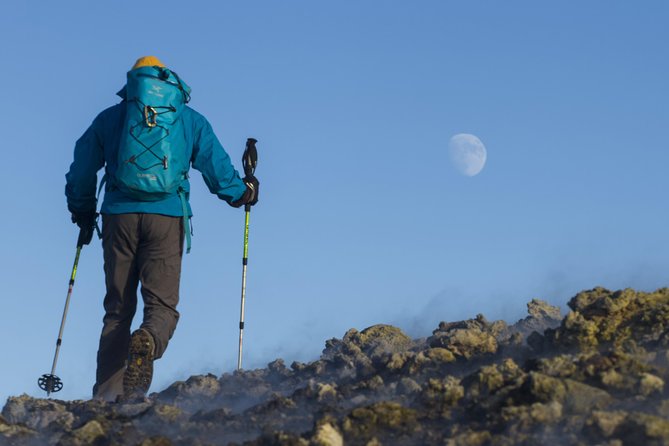
The route from the cable car includes roughly two hours of uphill hiking toward the summit craters, with breaks and photo stops along the way. The ground shifts from lava flows to loose black sand and rough rock. A walking stick helps with balance, especially on slopes where your feet slide backward with every step.
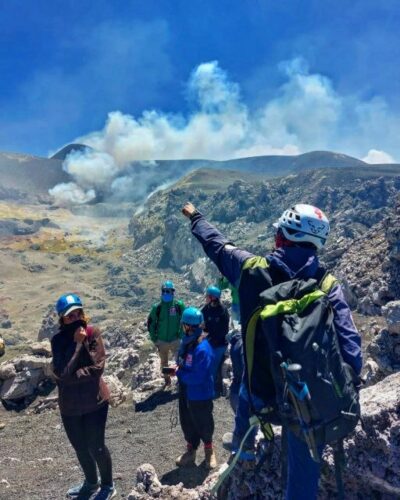
This is where the guide adds real value. A solo walk can show you dramatic scenery, but a guide can explain why one lava flow looks different from another, how volcanic bombs formed, and why patches of ground sparkle with sulfur and other minerals.
Expect an exposed route. The sun can feel strong, but the temperature may drop sharply with altitude. Wind is a serious factor. One late spring group encountered snow and cold headwinds, while another group found Etna active enough to restrict access. A warm jacket, extra shirt, long trousers, thick socks, and a face covering are sensible choices.
The face covering is especially useful when volcanic sand blows across the trail. I would also wear sunglasses even on a cloudy day. They protect your eyes from sun, ash, and wind.
Reaching the Central Crater viewpoint
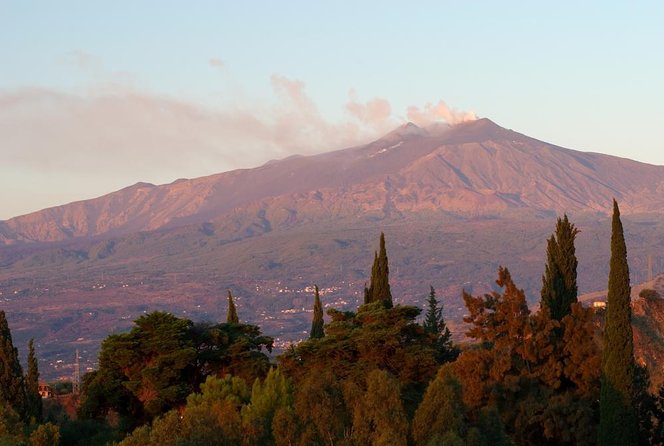
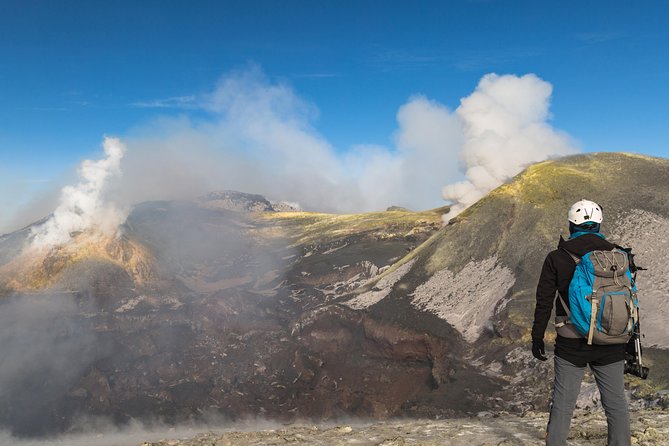
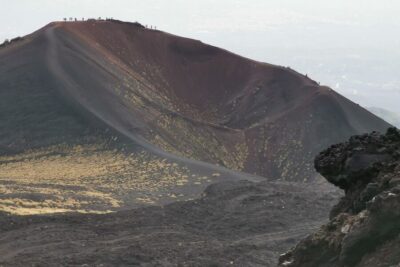
At the summit area, the route aims for the rim of Etna’s Central Crater, with views toward the Northeast Crater and the Southeast Crater. The Southeast Crater has produced some of Etna’s most dramatic recent eruptions, so seeing its profile gives the hike a direct connection to the volcano’s continuing activity.
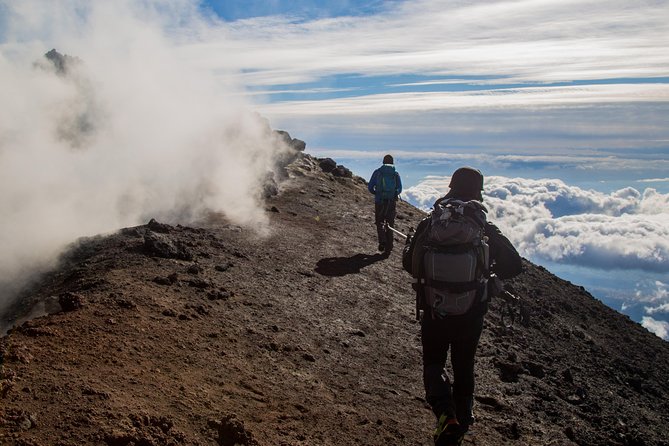
The scenery here is stark rather than pretty in the usual mountain sense. You see gas emissions, dark ridges, colored mineral deposits, and steep crater walls. The ground may show yellow sulfur tones or other bright patches created as volcanic gases cool and minerals collect.
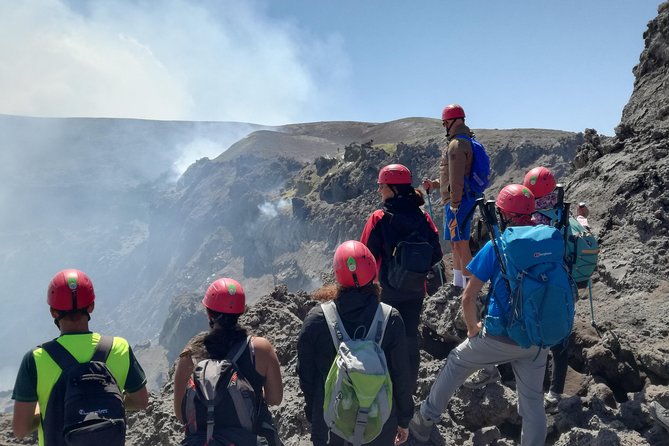
If conditions allow, the group spends time near the summit craters for photographs and explanations. Guides have been praised for making this section more than a quick photo stop. They explain the eruption cycles, crater shapes, calderas, lava flows, and the forces still working below your feet.
Do not treat access to the rim as a promise. Etna can close sections with little notice. Strong volcanic activity may limit the maximum altitude, and the guide has the final say if a route becomes unsafe. On several outings, the group reached around 3,000 meters but could not continue toward the summit at roughly 3,340 meters.
That is not a failed tour. It is the normal reality of an active volcano. A responsible guide will substitute safer viewpoints and craters rather than push for a better photograph.
More walks and treks around Mount Etna:
- Mount Etna: Trek to 3000m with cable car and jeep
★ 4.7 · 1,978 reviews - Mount Etna: Summit Crater Trek with Cable Car
★ 4.8 · 1,875 reviews - Catania: Mount Etna Trekking Trip off the Tourist Path
★ 4.9 · 1,351 reviews - From Taormina: Etna Tour with Hiking, Cave Visit, & Tastings
★ 4.7 · 518 reviews
A break beside one of Europe’s active volcanoes
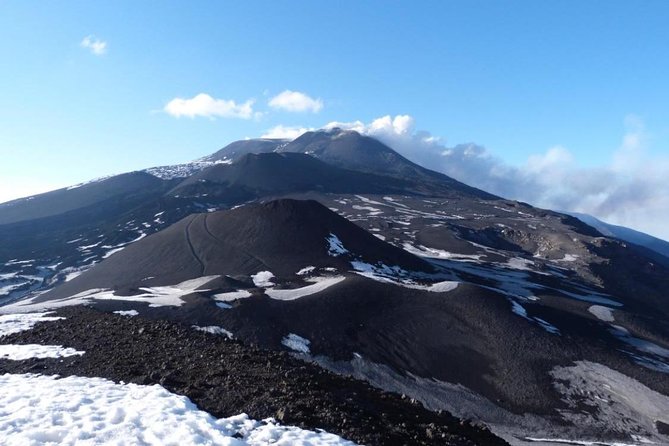
The scheduled Mount Etna section includes a break, a guided visit, and time for photographs. This pause matters because the uphill walking is tiring. Use it to eat, drink, adjust layers, and look around rather than rushing to the next point.
Bring your own food and water. Neither is included. The recommendation to carry a 10 to 20 liter daypack is sensible, since you need room for a jacket, extra shirt, lunch, snacks, and water without carrying a large bag.
You may see smoke or steam from the summit area. Do not expect flowing lava. Some outings take place after an eruption or during increased activity, but visible lava is not part of the guaranteed experience. The more reliable spectacle is the volcanic terrain itself, with fresh-looking flows, crater rims, gas vents, and unusual mineral colors.
The guides also keep an eye on pace and group condition. Antonio, Giovanni, Marco, Massimo, and Nello are among the guides singled out for patient pacing, clear explanations, and calm handling of difficult conditions. That matters when one person is strong on steep ground and another needs regular breaks.
Descending toward the Barbagallo craters
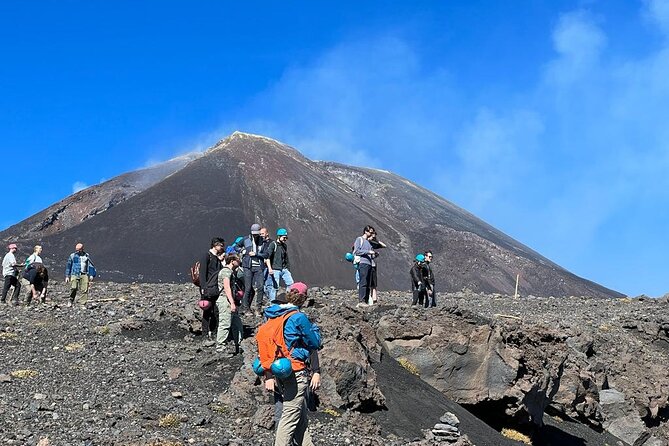
The descent visits the Barbagallo craters and heads toward the Valle del Bove area. These smaller craters give you another view of Etna’s activity and show how an eruption can create new cones and channels across the mountain.
Downhill walking sounds easy until you reach loose ash. It can be slippery, tiring, and hard on the knees. Trekking poles are useful here, and the supplied walking sticks are worth taking even if you rarely use them at home.
The Valle del Bove section adds variety after the summit slopes. Instead of only looking into one major crater, you cross a broader volcanic setting shaped by past eruptions and collapsing terrain. Your guide can point out the different textures of lava and explain how the volcano has altered the mountain over time.
The route is not a paved nature walk. You need to feel comfortable on sandy or uneven ground and able to manage a medium-high difficulty hike. The tour is not suitable for children under nine, pregnant women, wheelchair users, or people with back, heart, respiratory, or blood pressure problems. It is also unsuitable if vertigo makes exposed slopes uncomfortable.
Crossing a lava channel before the return ride
One of the more unusual parts of the route is crossing a lava flow channel. This is a good example of why a guided hike is useful. The channel is not just a dramatic shape for photographs. It helps you see how molten rock moved, cooled, and left a permanent scar across the mountain.
After the Barbagallo craters and lava channel, the route returns to the cable car at 2,500 meters. The ride back takes about 25 minutes. From there, you walk or return to the Ashàra meeting point, finishing where you started.
The itinerary can change at any stage. Weather, environmental conditions, seismic activity, or volcanic risk may alter the route. If the summit is closed, the guide takes you as high as the authorities allow and chooses other craters or viewpoints. If the minimum group size of four is not reached, the excursion may be canceled.
What the $67.97 price really buys you
The advertised price is $67.97 per person, but you need to add the €52 cable car ticket. That makes the real cost notably higher, especially for a family or group.
The tour price does include the guided hike, a multilingual volcano or Alpine guide, hiking boots, a rock helmet, walking sticks, and accident insurance. If you do not have suitable footwear, the included boots remove one common obstacle. The helmet is basic but important around volcanic rock and unstable ground.
I see good value here for someone who wants to understand Etna, not simply stand at a high viewpoint. The cable car and guide together give you access to terrain that would be difficult to manage alone. You are also paying for route judgment on an active volcano, where conditions can change faster than a fixed sightseeing plan can handle.
The value is weaker if you only want a guaranteed summit photograph. No operator can promise that, and the extra cable car charge remains payable even when volcanic conditions shorten the route. Book this for the guided experience and the mountain itself, not for a specific crater.
Free cancellation up to 24 hours before the start and the reserve-now, pay-later option make the booking easier to fit around a changing Sicily schedule. Still, check the weather and activity notices close to the day of your hike.
How to prepare for six hours above Etna’s tree line
I would pack more clothing than you think you need. Etna can be warm at the base and bitterly cold higher up, particularly when wind hits an exposed slope.
Bring:
- Sunglasses and a sun hat
- Sunscreen
- A warm jacket and an extra shirt
- Long trousers and warm socks
- Water, snacks, and a packed lunch
- A 10 to 20 liter daypack
- A face covering for windblown ash and sand
Do not wear shorts or sleeveless shirts. Pets, strollers, luggage, and large bags are not allowed. Good hiking boots are supplied, but you may prefer to wear your own if you have them and know they fit well.
Train for uphill walking before you arrive. You do not need to be an expert mountaineer, but you should be comfortable walking on loose, uneven ground for several hours. The guides can adjust the pace and stop the outing if safety or physical condition becomes a concern, but you still need a reasonable fitness base.
Who will enjoy this Etna hike most
I would choose this experience if you like geology, dramatic scenery, and active outdoor days. It suits someone who wants the physical feel of a volcano rather than a short coach stop and a souvenir photograph.
It is also a good fit if you are unsure about navigating Etna alone. The route is not always obvious, and volcanic terrain can look deceptively simple from a distance. A guide can select a safer path, explain what you are seeing, and alter the plan when the mountain changes its rules.
I would think twice if you dislike cold, wind, loose sand, or uncertain plans. The tour is not ideal for anyone with the listed medical restrictions, vertigo, or limited hiking ability. Children under nine cannot join, and there is no wheelchair access.
Group size may vary. Some outings have felt small and personal, while one group of about 25 lost time during equipment fitting and cable car arrangements. If you care strongly about a quiet, fast start, ask about the expected group size before booking.
Should you book the South Side summit hike?
Book it if you want a serious, well-guided introduction to Etna and accept that the volcano controls the final route. The strongest parts are the guide-led explanations, the unusual upper-mountain terrain, the cable car access, and the chance to walk near summit craters when conditions permit.
Go in prepared for cold weather, tiring sand, an extra €52 cable car charge, and the possibility of stopping below the summit. In return, you get a memorable six-hour outing that can still feel worthwhile when safety rules keep you away from the Central Crater. For an active visitor who values insight over a guaranteed checklist, this is a solid way to meet Etna on its own terms.
FAQ
How long does the Etna summit hike take?
The full activity lasts about six hours, including the cable car rides, hiking, guided stops, breaks, and return to Rifugio Sapienza.
Where does the tour start and finish?
You meet at the Ashàra information point at Rifugio Sapienza on Etna South, near the Terrazza dell’Etna restaurant. The activity ends back at the same meeting point.
Is the cable car included in the tour price?
No. The cable car ticket costs €52 per person and is paid on the spot. The tour information specifies cash payment.
How difficult is the hike?
It is rated medium to high difficulty. You should be comfortable walking on sandy, uneven terrain and handling uphill sections at high altitude.
Is reaching the summit guaranteed?
No. Weather, environmental conditions, seismic activity, and volcanic risk can change the route. If the summit craters are closed, the guide takes the group to the maximum safe altitude and adjusts the itinerary.
What languages are available?
The live guide service is available in English, French, and Italian.
What equipment is provided?
The tour includes hiking boots, a rock helmet, and walking sticks. It also includes accident insurance and the services of a volcano or Alpine guide.
What should I bring?
Bring sunglasses, a sun hat, sunscreen, water, food, snacks, a jacket, an extra T-shirt, long trousers, warm socks, and a 10 to 20 liter daypack. A face covering is useful in cold wind and blowing volcanic sand.
Just added around Mount Etna
- Nicolosi: Excursion Etna Craters at 3000 mt.★ 4.2 · 3 reviews
- Monti Rossi Adventure Park Entry Ticket Full★ 5.0 · 3 reviews
- Full circuit of Etna by MTB small group★ 5.0 · 3 reviews
- Etna & Snorkeling Jeep Tour★ 4.5 · 3 reviews
- From Messina: Mount Etna and Taormina Trip with Tastings★ 5.0 · 3 reviews
- From Catania/Taormina: Mount Etna Private Wine Tasting Tour★ 4.7 · 3 reviews
- Etna Summit Craters in 4×4 and Trekking★ 5.0 · 3 reviews
- Catania: Summit Craters from North Etna with 4×4 vehicles★ 5.0 · 3 reviews
Mount Etna Tours, compared.
Mount Etna Morning or Sunset Day Trip with Tasting
Read our review →
Guided Volcano Summit Hiking Tour with Cable Car
Read our review →
Sunset Jeep Tour of Mount Etna and Lava Flow Caves
Read our review →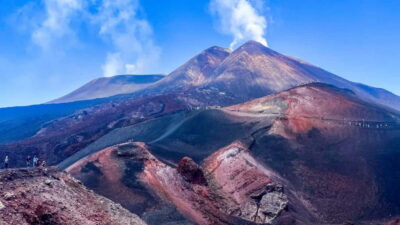
Etna and Alcantara Gorges Full-Day Tour with Lunch
Read our review →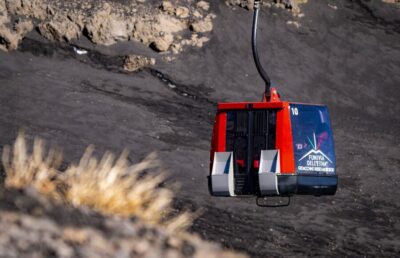
Mount Etna Trekking Trip off the Tourist Path
Read our review →Browse the lists this tour appears in