
Reviewed · ORTIGIA TOURS
Ortigia: Syracuse’s Ancient Town Center Private Walking Tour
Syracuse is easiest to understand on foot, where Greek columns, Roman layers, Arab street plans, and baroque churches all appear within a few minutes of one another. This two-hour private walk through Ortigia begins at the Temple of Apollo and links the island’s key sights without making you decode a map.
I like the personal format, since only your group takes part, and I like the way the guides connect grand monuments with ordinary life in the markets and narrow lanes. Guides including Eva, Ava, Valeria, and Carmine have been praised for clear English and for adjusting the walk to suit questions and interests.
The main limitation is time. Two hours gives you a strong introduction, but not a slow, museum-style visit to every church. You will also need to pay €2 per person to enter Syracuse Cathedral, and church interiors can be closed during Mass or weddings.
In This Review
- Key points to know before you book
- Why Ortigia works so well as a walking tour
- Starting beside the Temple of Apollo
- Piazza Archimede and the Diana Fountain
- Via Cavour and the Collegio dei Gesuiti
- Piazza Duomo, Ortigia’s grandest square
- Inside Syracuse Cathedral, built over a Greek temple
- Santa Lucia alla Badia and Caravaggio
- The myth and papyrus of Fonte Aretusa
- Narrow lanes through Ortigia and the Giudecca
- What the guides add to the experience
- Is $107.53 per person good value?
- Practical details that affect your day
- Who should book this Ortigia walk?
- Should you book it?
- FAQ
- How long does the Ortigia walking tour last?
- Where does the tour begin?
- Where does the tour end?
- Is this a private tour?
- Is the tour offered in English?
- Is the Syracuse Cathedral entrance included?
- What should I wear to enter the cathedral?
- Can I visit the cathedral interior during Mass or a wedding?
- Is Santa Lucia alla Badia open every day?
- Can I cancel for a full refund?
Key points to know before you book
- Greek temple to baroque cathedral: The route shows how Syracuse kept building over earlier civilizations rather than replacing them completely.
- Private, guide-led format: Your own group participates, so you can ask questions and request more detail without following a large crowd.
- A useful first look at Ortigia: The walk covers the Apollo Temple, Piazza Archimede, Piazza Duomo, Arethusa Spring, and the Giudecca district.
- Strong local guides: Eva, Ava, Valeria, and Carmine are specifically praised for their English, warmth, and command of Syracuse’s past.
- Extra church costs and restrictions: Cathedral entry is optional and costs €2 per person. Shoulders must be covered, and shorts are not allowed.
- Good value for history-minded visitors: At $107.53 per person, the price is easier to justify for a private group than for a solo booking.
Why Ortigia works so well as a walking tour
Ortigia is Syracuse’s old town center, set on an island joined to the main city. Its scale makes it well suited to a guided walk. You move from a Greek temple to a Renaissance or baroque façade, then turn down a narrow lane where the shape of the medieval Jewish quarter still survives.
That layering is the central idea of the tour. Greek settlers built Syracuse into one of the major cities of the ancient Mediterranean. Romans later used and altered what they found. Arab rulers shaped streets and customs, and Christian builders placed churches over older foundations. Your guide’s job is to help you see those layers instead of treating each building as an isolated stop.
I especially like this approach for a first visit. You get the main landmarks, but you also gain a simple mental map of the island. Afterward, you can return to the cathedral, shop in the market area, or wander the Giudecca district without feeling lost.
The route is conducted in English and lasts about two hours. It begins and ends at Via dell’Apollonion, near the Apollo Temple. Since this is a private activity, only your group takes part, though the exact group size is not specified.
More Ortigia walks in Sicily:
- Syracuse: Boat Trip of Ortigia Island and Sea Caves
★ 4.7 · 937 reviews - Tour of the island of Ortigia and exploration of sea caves with baths.
★ 5.0 · 668 reviews - Siracusa: Ortigia Boat Tour with Marine Grotto
★ 4.7 · 617 reviews
Starting beside the Temple of Apollo
The first stop is the Temple of Apollo, where you meet your guide. Admission is free, and the visit lasts about 10 minutes.
This is not a polished temple complex with every column standing upright. Its appeal is more immediate: it is an ancient Greek stone building in the middle of a living city. The temple is described as the oldest stone temple built by Greeks in Sicily, giving the tour a strong starting point.
Your guide explains what you are looking at and places the remains within Syracuse’s larger story. This matters because the monument can be easy to pass quickly if you do not know its importance. A short explanation turns a weathered ruin into the first chapter of the city’s development.
You will not spend a long time here, and that is sensible. The tour is designed to keep moving through Ortigia rather than linger at one archaeological site. If ancient monuments are your main interest, you may want a separate visit to Syracuse’s archaeological park as well.
Piazza Archimede and the Diana Fountain
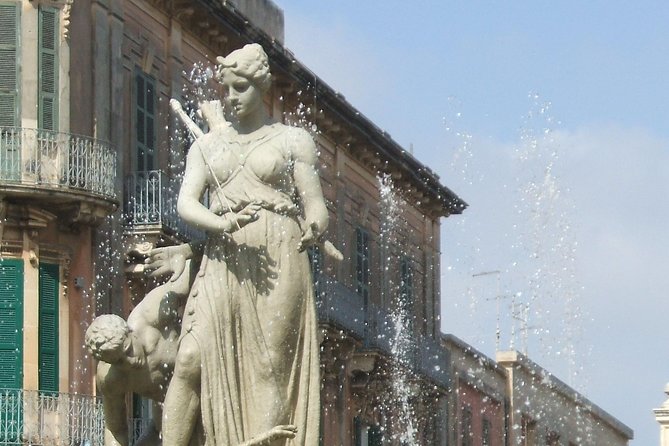
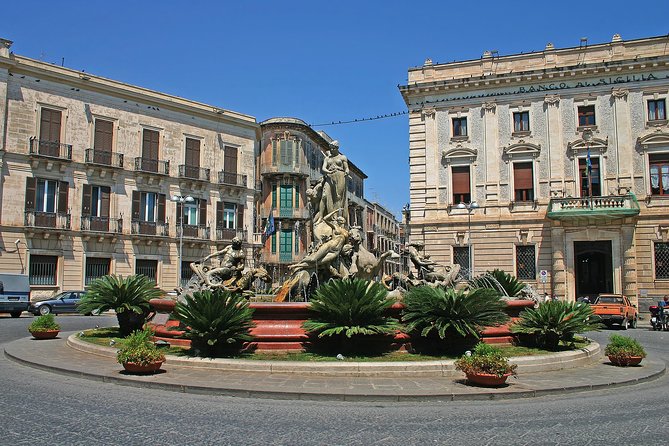
The next stop is Piazza Archimede, about a 10-minute visit. The square is known for the neoclassical Fountain of Diana and for its surrounding buildings, which show several architectural styles.
This is a useful contrast with the Apollo Temple. Instead of looking at a single ancient structure, you read the city through a public square. The façades help show how Syracuse changed over time, while the fountain gives the space a clear visual center.
A good guide will encourage you to look upward and around rather than focus only on the fountain. The square’s value is in the combination of civic design, decorative detail, and changing architectural periods. The stop is brief, but it helps you see that Ortigia is not simply an archaeological site. It is a functioning town with layers of history still in daily use.
Via Cavour and the Collegio dei Gesuiti
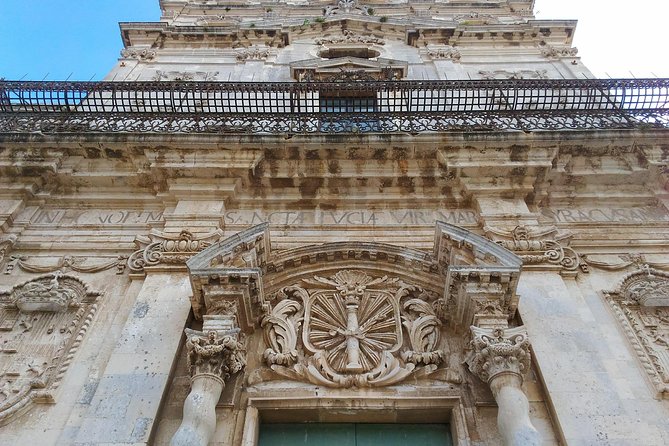
From Piazza Archimede, the route continues along picturesque Via Cavour, passing near the former Jesuit College. This section is less about one formal monument and more about how Ortigia feels at street level.
The narrow route gives you a chance to notice the details that are easy to miss when you walk alone: the proportions of old buildings, doorways, balconies, and the way the streets open toward larger squares. The nearby Collegio dei Gesuiti adds another piece to the city’s religious and educational past.
This is also where a private tour can feel more useful than a fixed audio guide. You can stop to ask why a street looks the way it does, or ask your guide to explain a building that catches your eye. Eva, in particular, is praised for tailoring explanations to specific interests, while Ava is described as easy to understand and generous with historical detail.
More walking tours in Sicily:
- Palermo: NO Mafia Walking Tour
★ 4.8 · 2,431 reviews - Palermo Original Street Food Walking Tour by Streaty
★ 5.0 · 2,105 reviews - Palermo: Street Food and History Walking Tour
★ 4.9 · 1,294 reviews - Palermo No Mafia walking tour: discover the Anti-mafia culture in Sicily
★ 5.0 · 1,011 reviews
Piazza Duomo, Ortigia’s grandest square
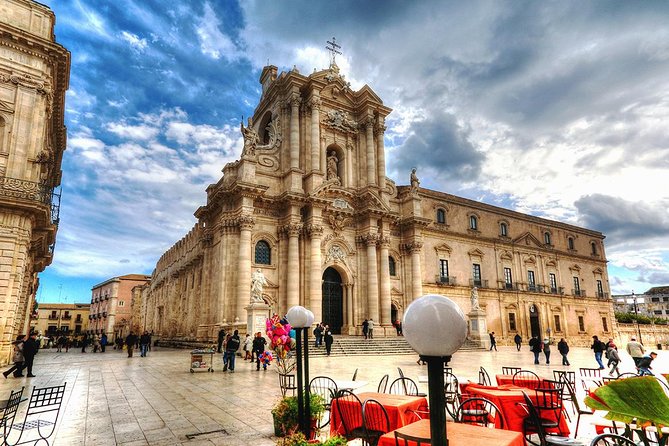
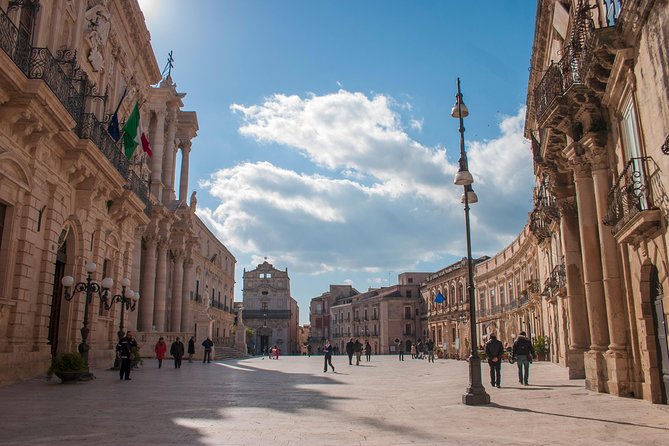
The tour then reaches Piazza Duomo, with about 15 minutes devoted to the square and its main buildings. This is the architectural high point of the walk.
Your guide introduces the cathedral, Palazzo Vermexio, the archbishop’s palace, and Palazzo Beneventano del Bosco. Together, these buildings frame one of Sicily’s most impressive civic spaces. The square is broad, pale, and formal, a marked change from the tight lanes you have just followed.
The important thing here is to compare the buildings rather than view them one by one. Their different roles tell you how religious, civic, and aristocratic power shaped the center of Syracuse. The guide also helps explain how the square changed after the earthquake and later rebuilding that gave much of Ortigia its baroque character, though the exact amount of detail can depend on your guide and questions.
You should allow yourself a moment to look beyond the scheduled explanation. Piazza Duomo is one of those places where the setting does part of the work. Even with a short stop, you get a strong sense of why this is the island’s symbolic center.
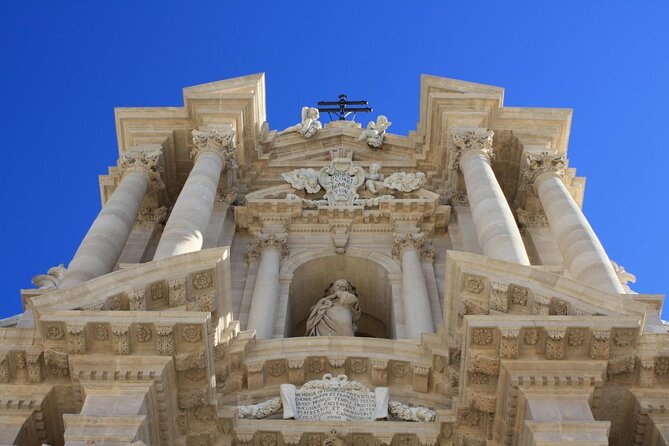
Inside Syracuse Cathedral, built over a Greek temple
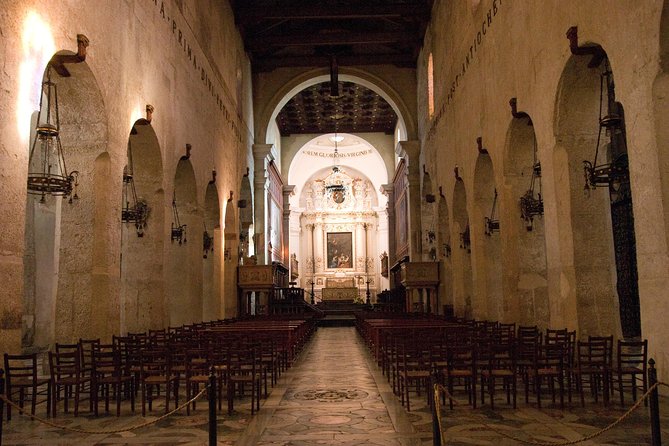
The cathedral interior is scheduled for about 25 minutes, the longest single stop on the walk. Entry is optional and costs €2 per person, which is not included in the tour price.
The church is especially important because it was built into an ancient Greek temple. Inside, you can see how Christian worship took over and adapted an older sacred structure. This is one of the clearest examples on the route of Syracuse’s habit of building on top of what came before.
I consider the small entrance fee worthwhile if the interior is open. The visit adds depth to the exterior discussion and gives you a close look at the combination of ancient columns, church decoration, and baroque design. It also helps explain why Ortigia can feel like several historical periods occupying the same room.
Dress carefully. Shorts and sleeveless tops are not allowed, and shoulders must be covered for both men and women. Entry may be refused if you do not meet the dress rules.
The interior cannot be visited during Holy Mass or a wedding. In that case, your guide explains the church from outside instead. That is an important practical point if seeing the interior is a priority, since the schedule is not fully within the tour operator’s control.
Santa Lucia alla Badia and Caravaggio
The next church is Santa Lucia alla Badia, where the interior visit takes about 20 minutes. The church is closed on Mondays, so you cannot visit inside if you book the tour for that day.
This stop gives you another chance to see Ortigia’s religious art and baroque interiors, but it also has a special draw for art lovers. The church is associated with Caravaggio’s Burial of Saint Lucy, a major painting connected with Syracuse. The precise display arrangement can change, so you should ask your guide what is currently visible when you arrive.
The church’s link to Saint Lucy adds another local layer. The cathedral also contains a chapel associated with Saint Lucy’s relics, including her bone, according to the information supplied for the tour. If you are interested in saints, relics, or Sicilian religious traditions, tell your guide early so you can spend your limited time on the details that matter most to you.
Because this is a walking overview, you should not expect a long art lecture. Still, 20 minutes is enough to appreciate the building and decide if you want to return later for a closer look.
The myth and papyrus of Fonte Aretusa
The route continues to Fonte Aretusa, a spring famous for its papyrus plants and its connection with the myth of Alpheus and Arethusa. The stop lasts about 10 minutes.
This is a welcome change from churches and formal squares. The spring brings water, plants, and mythology into the city walk. Your guide explains the story of Arethusa and Alpheus, giving you one of those memorable local legends that makes a place easier to remember.
The papyrus is not just decorative. Its presence gives the spring a distinct character and helps connect the stop to Sicily’s long relationship with the Mediterranean world. You are looking at a small natural feature, but the story attached to it is much larger.
Do ask questions here. One guide was specifically praised for expanding on the comic and unusual parts of the mythology when prompted. A private tour gives you room to say, Tell me more about that story, rather than moving on at the pace of a large group.
Narrow lanes through Ortigia and the Giudecca
The final part of the walk moves through Ortigia’s narrow streets and into the Giudecca, the former Jewish district. About 20 minutes are set aside for Ortigia’s old lanes, followed by roughly 10 minutes along Via della Giudecca.
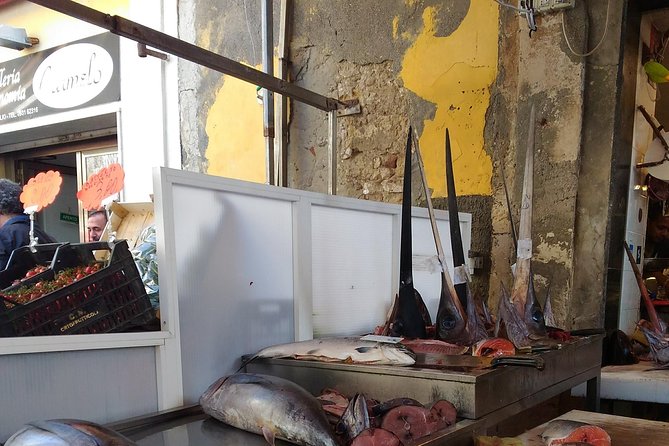
This is where the walk shifts from landmark collecting to understanding local urban life. You pass through streets shaped by centuries of use, near restaurants, churches, shops, and market activity. The route gives you a better feel for how the island operates today, not just how it looked in ancient times.
The Giudecca is especially worth including because it adds a social and cultural layer to the tour. Your guide can explain the area’s role as Syracuse’s historic Jewish quarter and point out details you might otherwise miss.
One particularly useful possibility is seeing an old mikveh, or ritual bath. Carmine has shown this kind of site during a walk, but it should not be treated as a guaranteed stop on every booking. Ask your guide if there is time and if it is open.
The final walk along Via della Giudecca brings you back to the human scale of Ortigia. After temples, palaces, and churches, you finish among lanes that are made for wandering. The tour ends back at the meeting point, so you can then retrace your steps or continue exploring independently.
What the guides add to the experience
The guide is the main reason to book this rather than simply download a map. The buildings are easy to find, but their connections are not always obvious.
Eva receives repeated praise for her English, warmth, and ability to explain both the past and present life of Ortigia. Ava is also described as personable, clear, and generous with facts. Valeria is praised for her passion for Syracuse, Ortigia, and Sicily, while Carmine is noted for showing an old mikveh and bringing attention to less obvious parts of the city.
Those names do not guarantee who will lead your booking. They do show the range of guide styles available. The strongest pattern is a guide who can answer questions, explain buildings in context, and adjust the route or detail to your interests.
I would arrive with two or three subjects in mind. You might care most about Greek architecture, Saint Lucy, Caravaggio, Jewish Syracuse, local food markets, or everyday life on the island. The tour already covers a lot, but your questions can make it feel more personal.
Is $107.53 per person good value?
The listed price is $107.53 per person, with group discounts available. That is a high price for a two-hour walk if you are booking alone or as a very small party. It becomes easier to justify when shared by a private group that wants an English-speaking guide and a tailored introduction to Syracuse.
The value comes from the route and the interpretation. You see major sights without handling navigation, and you get explanations at the exact places where the history happened. A guide can also point out churches, market areas, and side streets that are easy to overlook.
The cathedral’s €2 entrance fee is modest, but it is extra. Other listed stops are free. Since the tour is outdoors and depends on good weather, keep that in mind when comparing it with a self-guided plan.
If you are primarily interested in taking photographs or wandering at your own pace, the cost may not suit you. If you want a clear introduction on your first day in Syracuse, then use the rest of your stay to revisit favorite places, the private format has a stronger case.
Practical details that affect your day
You meet at Via dell’Apollonion, 96100 Siracusa, near the Temple of Apollo. The tour ends back at the meeting point, which makes it easy to continue from the center of Ortigia afterward.
Confirmation is provided at booking. The activity is near public transportation, and service animals are allowed. Most people can take part, though this is a walking tour through narrow streets and should be approached as an active two-hour outing.
Wear comfortable shoes and bring water, especially in hot weather. One walk took place under sweltering conditions, yet the guide adjusted well to the group. That does not remove the heat, so morning or late-day timing may feel more comfortable if those options are available.
The tour requires good weather. If poor weather causes cancellation, you are offered another date or a full refund. You can cancel for a full refund up to 24 hours before the start time, but late cancellations and changes within 24 hours are not accepted.
Who should book this Ortigia walk?
I would recommend it most strongly for a first visit to Syracuse, especially if you want history explained in plain English. It suits couples, families, and small private groups who prefer conversation to a large scheduled tour.
It is also a good fit for anyone who wants to understand the relationship between Greek, Roman, Arab, Jewish, and Christian Syracuse. The route does not treat the city as a single-period attraction. It shows how one layer was reused by the next.
Art and church lovers will appreciate the cathedral, Santa Lucia alla Badia, Saint Lucy connections, and Caravaggio reference. Mythology fans get the story of Arethusa and Alpheus. People who prefer local atmosphere to formal sightseeing get the lanes, markets, and Giudecca.
I would hesitate if you have only a short time and want long interior visits. The cathedral may be closed for worship, Santa Lucia alla Badia is closed on Mondays, and the entire route is an overview rather than a series of extended tours.
Should you book it?
Book this tour if you want a well-organized first look at Ortigia, a private guide, and a clear explanation of why Syracuse looks the way it does. The best part is not any single stop. It is the way the route links a Greek temple, a cathedral, a spring, churches, markets, and the old Jewish quarter into one understandable story.
At $107.53 per person, check the group discount and consider how many people will share the cost. For a private group with strong interest in history, the price can be fair. For one person or a couple seeking only a casual stroll, a self-guided visit may be better value.
If you book, dress properly for the churches, avoid Monday if Santa Lucia’s interior matters to you, and come ready with questions. That is how this short walk gives you more than a checklist of sights.
FAQ
How long does the Ortigia walking tour last?
The tour lasts approximately two hours.
Where does the tour begin?
It begins at Via dell’Apollonion, 96100 Siracusa SR, Italy, near the Temple of Apollo.
Where does the tour end?
The activity ends back at the meeting point.
Is this a private tour?
Yes. Only your group participates in the private walking tour.
Is the tour offered in English?
Yes. English is the listed tour language.
Is the Syracuse Cathedral entrance included?
No. Cathedral entry is optional and costs €2 per person.
What should I wear to enter the cathedral?
You must cover your shoulders, and shorts and sleeveless tops are not allowed for men or women.
Can I visit the cathedral interior during Mass or a wedding?
No. Interior access is not possible during Holy Mass or weddings. The guide explains the church from outside in that situation.
Is Santa Lucia alla Badia open every day?
No. The church is closed on Mondays, so the interior cannot be visited on a Monday booking.
Can I cancel for a full refund?
Yes, if you cancel at least 24 hours before the experience start time. Cancellations or changes made less than 24 hours in advance are not accepted for a refund.
Just added around Sicily
- Anti-Mafia Heroes (Cool Hours) Morning Walking Tour★ 5.0 · 3 reviews
- Nicolosi: Excursion Etna Craters at 3000 mt.★ 4.2 · 3 reviews
- DISCOVER THE SECRET OF PALERMO Walking Tour Combining Art and best street food★ 5.0 · 3 reviews
- The art of the Italian Aperitivo with a local: Learn & Enjoy in Palermo★ 5.0 · 3 reviews
- Taormina PRIVATE EAST COAST EXCURSIONS 2 Exclusive Days with Guide Driver★ 5.0 · 3 reviews
- Guided kayak tour inside the Stagnone of Marsala★ 5.0 · 3 reviews
- Monti Rossi Adventure Park Entry Ticket Full★ 5.0 · 3 reviews
- Catania : Diving for patented divers★ 5.0 · 3 reviews
Ortigia Tours, compared.
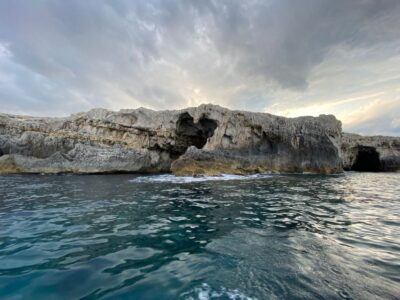
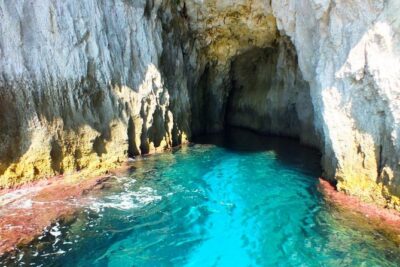
Tour of the island of Ortigia and exploration of sea caves with baths.
Read our review →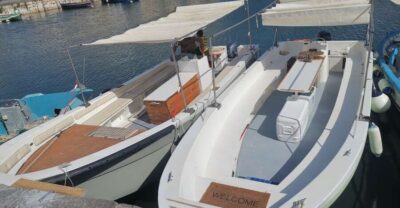

Ortigia & Sea Caves Speedboat Tour with Swim Stop
Read our review →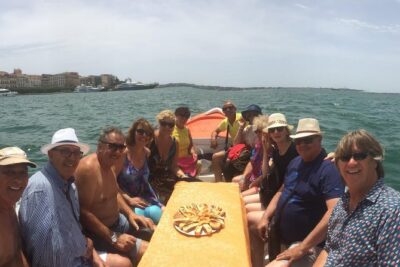

Ortigia Island and Sea Caves Boat Tour with Drinks
Read our review →Browse the lists this tour appears in