
Reviewed · WALKING TOURS
Catania Walking Tour with Audio and Written Guide by a Local
Catania’s best sights are spread across a compact historic center, and this self-guided walk links them with one useful thread: lava, earthquakes, Baroque rebuilding, legends, and daily Sicilian life. You begin at Ursino Castle and finish near the Benedictine Monastery, passing through the fish market and cathedral square along the way.
I like the go-at-your-own-pace format, especially for a city where you may want to pause for a pastry, a market scene, or a closer look at a carved church facade. I also like the low price, multilingual audio and text, and Google Maps connection, which make this a practical way to cover Catania without paying for a private guide.
The main drawback is simple: no person leads you. You need a smartphone with internet access, and the Roman amphitheater is viewed from outside unless you buy the separate €4 ticket. Start-point logistics can also be awkward if you are already near the Duomo.
In This Review
- Key points at a glance
- Why this route works for seeing Catania
- Ursino Castle and Catania’s volcanic setting
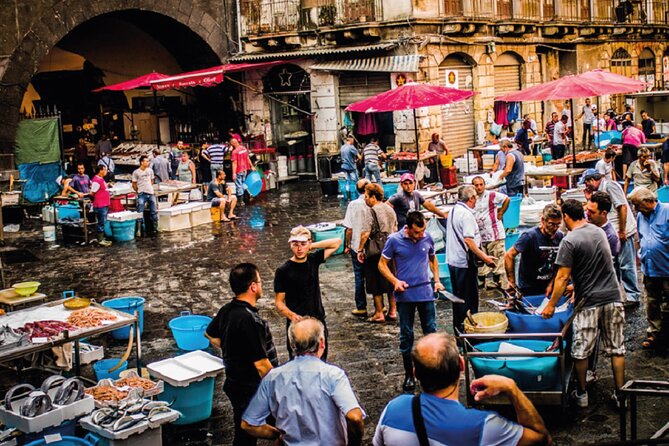
- A’ Piscaria, where the city gets practical
- Fontana dell’Amenano and Piazza del Duomo
- Cathedral of Sant’Agata and the Baroque center
- Piazza Università and four local legends
- The Roman amphitheater beneath Piazza Stesicoro
- Via dei Crociferi and Catania’s grand street
- Benedictine Monastery of San Nicolò l’Arena
- What you receive for $7.83
- Smartphone setup, timing, and comfort
- Who will appreciate this walk
- Should you book the Catania Walking Tour?
- FAQ
- How much does the Catania Walking Tour cost?
- How long does the walking tour take?
- Is a person leading the tour?
- What languages are available?
- Where does the route begin?
- Where does the route finish?
- Is admission included at the Roman amphitheater?
- What equipment do I need?
- Can I cancel the experience?
Key points at a glance

- Ursino Castle begins the route: See a medieval fortress that once stood close to the sea before lava and changes to the shoreline altered its setting.
- Catania’s daily life is part of the walk: The route includes A’ Piscaria, the city’s famous fish market, not just monuments.
- The digital guide is flexible: Pause, restart, change your pace, or leave the route briefly while staying connected to Google Maps.
- Nine historic stops fit into about three to four hours: The walk moves from medieval defenses to Roman remains and grand Baroque streets.
- The price is unusually modest: At about $7.83 per person, the cost is closer to a useful city orientation than a traditional guided excursion.
- You supply the equipment: Bring a charged smartphone, internet access, and headphones if you prefer not to use the phone’s speaker.
Why this route works for seeing Catania

This is not a lecture with a fixed meeting time and a flag-waving guide. It is a prepared walking program that lets you explore alone, with audio and written explanations available on your phone. That difference shapes the entire experience.
You can listen to a section before reaching a monument, stop the audio while crossing a busy street, and replay a point that catches your interest. You can also wander off for lunch and return later. One particularly useful approach is to listen to the material the night before, then use the walk as a loose plan for your day.
The route covers a strong selection of central Catania. It does not try to include every church, museum, or side street. Instead, it connects major landmarks in a logical line from Ursino Castle toward Piazza del Duomo, then onward through the university quarter and Via dei Crociferi to the Benedictine Monastery.
The suggested duration is three to four hours, but the digital format means you are not locked into that timetable. You could move quickly, linger at the market, enter the Roman amphitheater on your own, or split the route into two shorter outings.
More Walking Tours in Catania
- Catania: Heart of the City Guided Walking Tour
★ 4.6 · 708 reviews - Catania: City Highlights Walking Tour
★ 4.7 · 666 reviews - Catania: Street Food Guided Walking Tour
★ 4.9 · 326 reviews
Ursino Castle and Catania’s volcanic setting
The walk begins at Ursino Castle in Piazza Federico di Svevia. The castle is a useful first stop because it introduces two forces that shaped Catania: defense and Etna’s eruptions.
The fortress was originally much closer to the sea. A moat and defensive structures protected it, while its outer wall used carefully squared lava-stone blocks. The inner wall was built more irregularly, giving you a small but visible lesson in medieval construction.
The castle’s name has an uncertain origin, another detail that gives the opening stop a little mystery without requiring a long museum visit. You have about an hour here, though admission to the tour itself is free. The castle’s interior access is not listed as part of the experience, so treat this as a guided exterior and area visit unless you arrange any separate entry yourself.
Starting here has one practical downside. Ursino Castle is not the most central point in the historic core. If you have already walked from the station or are staying near Piazza del Duomo, you may find yourself covering part of the route before the official starting point. One person specifically found that starting farther out meant retracing much of the walk later.
A’ Piscaria, where the city gets practical

From the castle, the route heads toward A’ Piscaria, Catania’s historic fish market. Locally called Piscarìa, it sits near Piazza del Duomo and the Fontana dell’Amenano.
This is one of the most useful inclusions on the route. You are not only moving from one polished monument to another. You are also seeing a working part of the city center, with the market’s name and Sicilian dialect adding a little local texture.
The planned stop is only 20 minutes, which is enough for a look and a short explanation but not much time for a slow market exploration. If you enjoy street scenes, you may want to pause the guide and give yourself longer. The market’s atmosphere and activity can matter as much as the historical notes, so do not feel obliged to keep moving just because the audio has finished.
Admission is free. As with any market, conditions can vary by time and day, and the supplied information does not promise specific stalls, vendors, or opening patterns. The safe expectation is a brief visit to one of Catania’s best-known market areas.
Fontana dell’Amenano and Piazza del Duomo
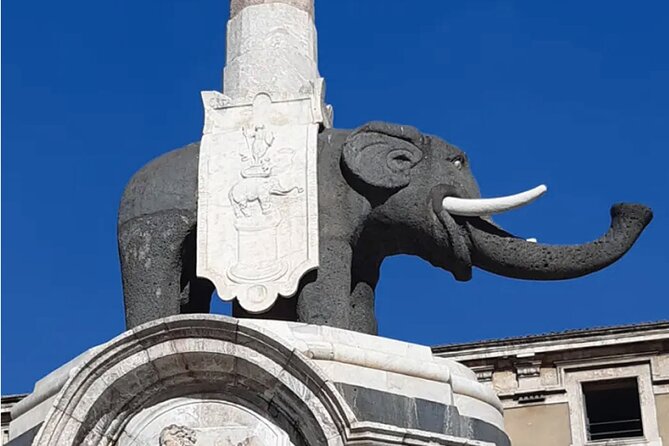
The Fontana dell’Amenano is a quick stop, planned for about 10 minutes. Created in 1867 by Neapolitan sculptor Tito Angelini in Carrara marble, it honors the Amenano, the underground river flowing beneath Catania.
The fountain matters because it connects the city you see above ground with the water and geological forces below it. Catania is a place where streets, buildings, lava, and buried features constantly overlap. This short explanation helps you read the city with more attention.
Next comes Piazza del Duomo, the city’s central square. Allow about 20 minutes for the square itself, though you may want longer if you plan to take photographs or examine the surrounding buildings. The piazza is home to the Cathedral of Sant’Agata and is the natural center of the historic district.
The route gives you the main context rather than a long architectural seminar. That suits the audio format. You can listen while looking around, then use the written notes if you want to review a name or historical point later.
A few more Catania tours and experiences worth weighing up
- From Catania: Inspector Montalbano Day Tour with Audio Guide
★ 3.5 · 6 reviews - Taormina: Ancient Theater Skip-the-Line Ticket & Audio Guide
★ 4.5 · 1,701 reviews - Agrigento: Valley of the Temples Entry Ticket & Audio Guide
★ 4.1 · 268 reviews - Siracusa Walking Tour with Audio and Written Guide by a Local
★ 5.0 · 59 reviews
Cathedral of Sant’Agata and the Baroque center

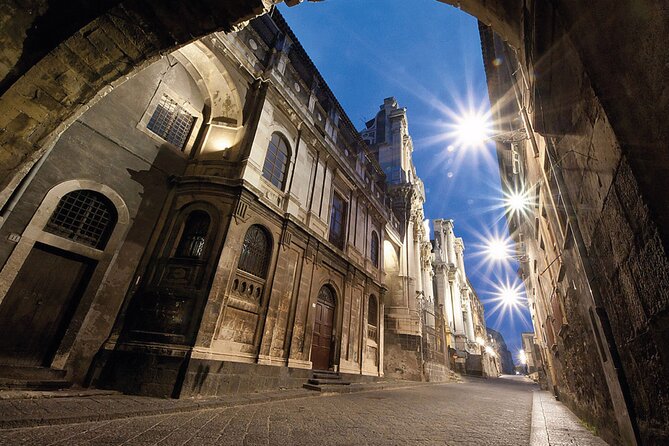
Catania Cathedral is dedicated to Sant’Agata, the city’s patron saint. The church was first built in 1090 over the remains of a Roman temple dedicated to Jupiter, then rebuilt after the earthquake of 1693 destroyed much of Catania.
That sequence is central to understanding the city. The cathedral is not simply an old church with a decorative facade. It reflects layers of Roman, medieval, seismic, volcanic, and Baroque Catania.
The stop is planned for 20 minutes, and admission is listed as free. You should think of this as a focused visit, not a full guided examination of every chapel and artwork. The audio can give you a clear framework, while your own pace lets you look longer at details that appeal to you.
The best part of a self-guided format here is control. If the square is crowded or you want a quiet moment inside, you can pause the narration. If you are primarily interested in architecture, you can continue after the main explanation without waiting for anyone else.
Piazza Università and four local legends
Piazza Università is a short 10-minute stop, but it adds a welcome change of focus. The square takes its name from Palazzo degli Studi, also called Palazzo Università.
Its most distinctive details are the four bronze lampposts at the corners. Each represents a figure from Catania’s popular legends: Gammazita, Cola Pesce, the brothers Anfinomo and Anapia, and the paladin Uzeta.
This is the kind of detail that is easy to miss when you explore only with a map. The square may look like a grand urban space at first glance, but the lampposts give it stories and local character. The guide’s combination of audio, text, and curiosity notes is especially useful for small features like these.
Ten minutes is enough for the basic explanation and a look at the lamps. You can easily extend the stop if you want to study the buildings around the square or take photographs.
The Roman amphitheater beneath Piazza Stesicoro
The Roman amphitheater is one of the route’s more unusual sights because much of it lies beneath the modern city. The remains date to the first century BC and were covered over the centuries by eruptions of Etna and seismic events.
The planned visit lasts about 25 minutes, but the digital tour does not include admission. You view the site from outside unless you choose to enter independently, with a listed ticket price of €4.
This is an important distinction when comparing the experience with a traditional guided tour. You receive the historical explanation and a location-based stop, but the ticket is extra and entry is your responsibility. If seeing the interior matters to you, plan for the additional cost and time.
The amphitheater also shows why Catania rewards a guided route. The modern streets do not always reveal what lies beneath them. Without context, you might walk across Piazza Stesicoro and miss the Roman scale of the place entirely.
Via dei Crociferi and Catania’s grand street

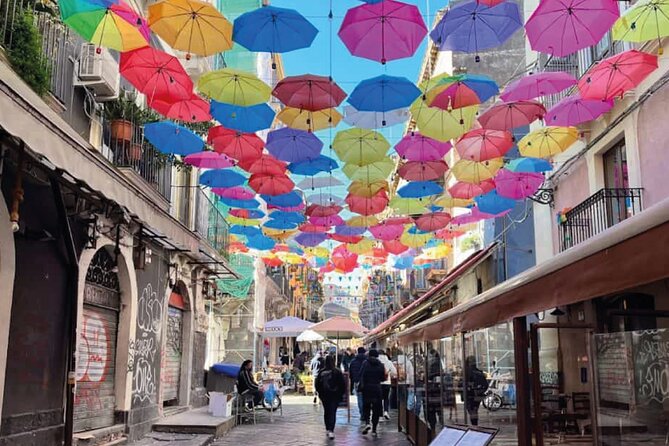
Via dei Crociferi receives a short 10-minute stop, yet it may become one of the most memorable stretches of the walk. It is one of the oldest and most atmospheric streets in Catania’s historic center, known for its striking appearance and use as a film setting.
The guide gives you a reason to slow down and notice the street as a complete scene rather than rushing between separate buildings. Its appeal comes from the arrangement of churches, facades, steps, and long views through the historic district.
The supplied timing is brief, so treat the 10 minutes as an introduction. You may want to pause the audio and walk a little more slowly. This is also a natural spot to make a short detour, provided you remember that the digital route is flexible and does not require you to keep to a rigid group schedule.
Benedictine Monastery of San Nicolò l’Arena
The route ends at the Benedictine Monastery of San Nicolò l’Arena in Piazza Dante. The planned stop lasts about 30 minutes.
The monastery became an important center in Catania, especially during the eighteenth century. Its large scale, elaborate rooms, and the noble background of its monks help explain why it has such a major place in the city’s story.
This is a fitting final stop because it brings together the route’s main themes: religious power, architecture, rebuilding, and the changing fortunes of Catania. The official endpoint is useful if you want a clear finish, but the product is digital, so you can choose another ending point. You are not required to complete the route in one sitting.
The supplied information lists the monastery as the final destination, but it does not promise a separate interior tour or admission arrangement. Check the site itself if entering the building is a priority.
What you receive for $7.83
At roughly $7.83 per person, this is a low-cost way to get structure and context in Catania. You are paying for a digital guide, not for a person’s time, transport, skip-the-line access, or included monument tickets.
The value is strongest if you want an introduction to the historic center and prefer independence. The route covers nine stops, and every listed stop is free except the Roman amphitheater, where entry costs €4 if you decide to go inside.
The audio and written material are available in English, Spanish, Italian, German, and French. That choice is useful if you prefer reading along or if audio is hard to hear in a market or square.
The guide connects with Google Maps, which adds a practical layer. You can return to your starting point, leave the route for food or shopping, or decide to stop early. One especially sensible tactic is to use the guide as a framework rather than a command. Catania is better when you leave room for a spontaneous turn.
Smartphone setup, timing, and comfort
You need a smartphone with an internet connection. Activation details are provided in the voucher, so read them carefully before arriving. The provider, Walking Cap, also sends activation information at booking and again before the activity, and support may contact you on the day if activation is incomplete.
That setup is the one point where a little preparation pays off. Download or open the guide before you leave, check that your phone has enough battery, and bring headphones if you want private listening. Headphones are not included, and you can listen through the phone’s speakers if you prefer.
The experience is available every day during the listed activity period, from December 9, 2024, through July 2, 2027. The stated operating window is 12:00 AM to 11:30 PM, but individual monuments and the market may follow their own hours. Do not assume that a listed stop will be open simply because the digital guide is available.
The advertised duration is three to four hours. Most people will find that enough for the core route, but your actual time depends on pauses, photographs, market interest, and whether you enter the amphitheater.
Who will appreciate this walk
I would choose this experience if you like making your own decisions. It suits independent sightseers, budget-conscious visitors, couples who dislike keeping up with a group, and anyone who wants to stop and start without explanation.
It is also a good fit for a first look at Catania. The route gives you enough background to understand the city’s Roman remains, medieval defenses, Baroque rebuilding, religious sites, legends, and markets before you decide where to spend more time.
You may prefer a person-led tour if you want live questions answered, local conversation throughout the walk, or help interpreting unexpected details. The digital guide cannot adjust its narration to your interests in the way a good human guide can.
The maximum capacity is listed as 104 people, but that number has less practical importance here than it would on a conventional group excursion. You are using the guide by yourself, so the real issue is phone access and your comfort navigating independently.
Should you book the Catania Walking Tour?
Book it if you want a cheap, flexible introduction to central Catania and you are comfortable using your phone. The strongest reasons are the practical route, the mix of major monuments and everyday market life, the multilingual audio and text, and the freedom to move at your own speed.
Skip it if you need a live guide, guaranteed interior access, or a start point close to Piazza del Duomo. If Ursino Castle is inconvenient from your hotel, begin the content elsewhere and use the route in reverse or select only the stops that suit your day.
For the price, this is an efficient city orientation rather than a full guided excursion. Bring internet access, headphones, and a little patience with the setup. If you prepare your phone in advance, you get a useful historical spine for exploring Catania on your own terms.
FAQ
How much does the Catania Walking Tour cost?
The listed price is $7.83 per person. Group discounts are available.
How long does the walking tour take?
The expected duration is approximately three to four hours. You can take longer or finish sooner because the guide is self-guided.
Is a person leading the tour?
No. This is a digital experience with audio and written information. You explore independently using your smartphone.
What languages are available?
The audio guide and written text are available in English, Spanish, Italian, German, and French.
Where does the route begin?
The route begins at Ursino Castle, Piazza Federico di Svevia 21, Catania.
Where does the route finish?
The listed final destination is the Benedictine Monastery of San Nicolò l’Arena at Piazza Dante Alighieri 32. Since the guide is digital, you can choose to finish elsewhere.
Is admission included at the Roman amphitheater?
No. The tour does not include entry to the Roman amphitheater. The listed admission price is €4, and you can visit it independently if you wish.
What equipment do I need?
You need a smartphone with an internet connection. Headphones are not included, so bring your own if you want to listen privately. You can also use your phone’s speakers.
Can I cancel the experience?
Yes. You can receive a full refund if you cancel at least 24 hours before the local start time. Cancellations or changes made within 24 hours are not refunded or accepted.
More Self-Guided Tours in Catania
- Agrigento: Valley of the Temples Ticket & App Audioguide
★ 4.3 · 1,160 reviews - Selinunte: Archeological Park Entry Ticket & App Audioguide
★ 4.4 · 66 reviews - Agrigento – Valley of the Temples – audio guide
★ 3.9 · 43 reviews - Segesta: Archeological Park Entry Ticket and App Audioguide
★ 3.9 · 42 reviews
Just added around Catania
- Catania AIRPORT transfer From / To Taormina★ 5.0 · 3 reviews
- Catania : Diving for patented divers★ 5.0 · 3 reviews
- Transfer Catania / Agrigento Airport★ 5.0 · 3 reviews
- Taormina: exclusive tour with food, drinks, and sunset, pick-up from Catania★ 5.0 · 3 reviews
- From Catania/Taormina: Mount Etna Private Wine Tasting Tour★ 4.7 · 3 reviews
- From Catania: Day Trip to Giardini Naxos and Taormina★ 5.0 · 3 reviews
- Catania: Summit Craters from North Etna with 4×4 vehicles★ 5.0 · 3 reviews
- Catania: Guided Street Food Tour with Tastings★ 5.0 · 3 reviews
Walking Tours, compared.


Palermo Original Street Food Walking Tour by Streaty
Read our review →

Palermo No Mafia walking tour: discover the Anti-mafia culture in Sicily
Read our review →


Street Food Walking Tour with Local Guide & Tasting
Read our review →
Browse the lists this tour appears in