
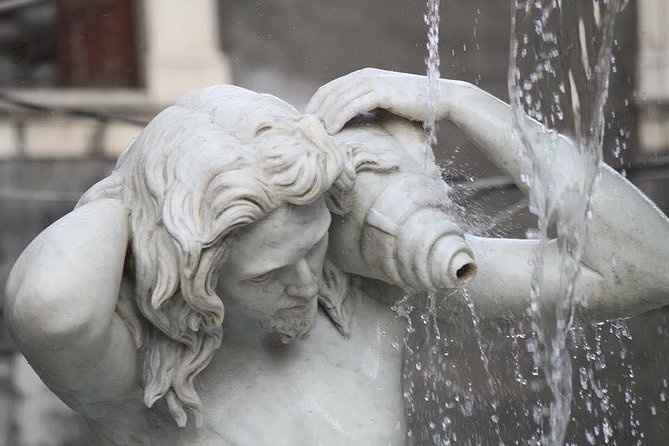
Reviewed · SICILY
Underground Catania
Catania has a second city below street level. Under the cathedral, restaurants, churches, and busy squares are Roman baths, lava-cut chambers, old burial spaces, and a river forced underground by centuries of eruptions and rebuilding. This tour connects those scattered places into one clear story, showing how volcanic eruptions, earthquakes, and human construction shaped the city you see today.
I like two things right away. First, the route reaches places you would have a hard time finding alone, including the Amenano River and a church built into living rock. Second, the archaeology guides, including Oreste, Maria, and Matilde, bring useful context rather than simply pointing at old stones. You learn why Catania has its present shape, not just what each ruin is called.
The main drawback is value. At $96.79 per person, this is not a cheap walk, especially if your party is combined with other people. The experience is capped at eight, and the private-tour wording should be clarified before booking, since a small group may include several separate bookings. Some people also find the walking pace slower than expected.
In This Review
- Key points at a glance
- Why Catania makes sense from below
- Terme Achilliane: Roman rooms beneath the cathedral
- Sant’Agata Cathedral: the city’s sacred center
- A Putia dell’Ostello and the Amenano River
- San Gaetano alle Grotte: a church carved into rock
- The guides make the difference
- Is $96.79 a fair price?
- Who should book this experience?
- Final call: book it for the city beneath the city
- FAQ
- Where does the Underground Catania tour begin?
- Where does the tour end?
- How long does the tour last?
- What language is the tour offered in?
- How many people can join the tour?
- Is the tour private?
- What sites are included?
- Are admission tickets included?
- Can I cancel for a full refund?
Key points at a glance
- Roman baths beneath Piazza Duomo: Begin below Catania’s cathedral in the surviving section of the large Terme Achilliane complex.
- A river under a restaurant: Visit a cave where a branch of the Amenano still flows below the historic center.
- A church inside a lava cave: San Gaetano alle Grotte combines volcanic rock, Greek reuse, Roman burial history, and Christian tradition.
- Guides who explain the whole city: Oreste, Maria, and Matilde are praised for connecting the underground sites with Mount Etna, the 17th-century eruption, and the earthquake that followed.
- A cool break from Catania’s heat: The underground rooms offer relief on hot afternoons, though surfaces can be uneven and damp.
- A compact city walk: The tour lasts about two to three hours, begins at Piazza del Duomo, and finishes near Piazza Stesicoro.
Why Catania makes sense from below
Catania can seem like a city built in layers, and that is exactly what it is. Lava, water, Roman construction, medieval rebuilding, earthquakes, and Baroque design all overlap here. A normal stroll through the center shows the grand result. This tour helps you see the buried stages beneath it.
The story is especially useful because Catania has been repeatedly damaged and rebuilt. Ancient rooms disappeared under new streets. Watercourses changed. Lava covered earlier structures. Churches were repaired or reconstructed. Your guide uses the underground sites to explain those changes, making the city above easier to read afterward.
I would take this tour early in a Catania stay, not at the very end. The route starts at Piazza del Duomo, one of the city’s central landmarks, and ends at Piazza Stesicoro. Along the way, the guide provides historical context and local observations that can help you understand other streets and monuments during the rest of your visit.
The tour is offered in English and normally takes two to three hours. That is long enough to cover several distinct sites without turning into a full-day commitment. It is a walking experience, with stairs and underground surfaces, so wear shoes that you trust on stone and potentially damp ground.
Other Sicily trips travellers book alongside this one:
- Catania: Mount Etna Morning or Sunset Day Trip with Tasting
★ 4.8 · 4,028 reviews - Mount Etna: Guided Volcano Summit Hiking Tour with Cable Car
★ 4.7 · 3,784 reviews - Palermo: NO Mafia Walking Tour
★ 4.8 · 2,431 reviews
Terme Achilliane: Roman rooms beneath the cathedral
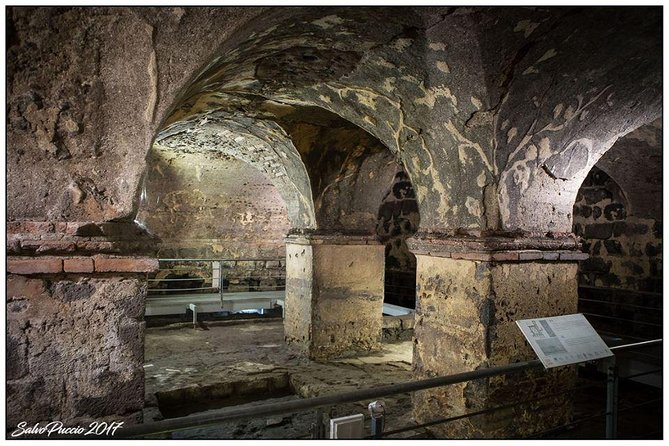
The first stop is Terme Achilliane, a large thermal complex dating from the third or fourth century AD. The baths once extended into the area now occupied by Piazza Duomo. Only part of the original complex remains accessible, and that surviving section sits below the cathedral.
This is a strong opening because it immediately changes your sense of scale. Above you is the cathedral and the open piazza. Below you are rooms tied to Roman public life, built at a time when the city had a very different layout and purpose.
Your guide explains how the thermal plant was arranged and how much of it has been lost or covered. The visit lasts about 20 minutes, which is enough to understand the site without getting bogged down in architectural detail.
Do not expect a vast Roman bath complex with every room intact. The accessible portion is only part of a much larger installation. Its appeal lies in the contrast between the ordinary city square overhead and the ancient structure beneath it.
This stop also sets up one of the tour’s main ideas: Catania is not simply old, it is layered. The city’s present streets often conceal earlier buildings, waterways, and lava formations.
Sant’Agata Cathedral: the city’s sacred center
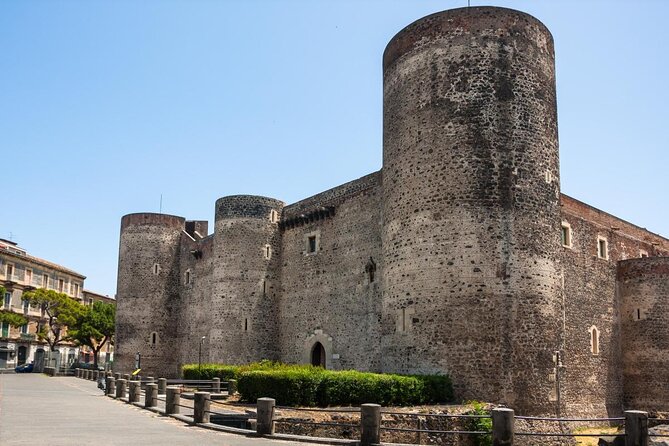
The next stop is the Basilica Cattedrale di Sant’Agata, the heart of Catania. Unlike the other stops, the cathedral itself is not an underground site, but it gives the tour an important above-ground link.
The cathedral reflects the city’s repeated destruction and rebuilding. Its story moves from the Norman-era church, sometimes described as an ecclesia munita, to the Baroque building you see today. That change was not a matter of taste alone. It was shaped by disaster, repair, religious devotion, and the city’s determination to rebuild.
The visit is listed at about 20 minutes, with no separate admission charge. Your guide places the cathedral between the city’s major symbols, including the Liotru elephant and Saint Agatha, whose presence is central to Catania’s identity.
This stop may feel less unusual than entering a cave or catacomb, but it prevents the underground visits from becoming disconnected curiosities. You see how the sacred center above relates to the buried Roman spaces below. The cathedral is part of the same story of destruction, reconstruction, and civic memory.
If you have already spent a long time inside the cathedral, the guide’s role here is especially valuable. You can focus on the changes over time rather than trying to inspect every chapel or decoration.
A Putia dell’Ostello and the Amenano River
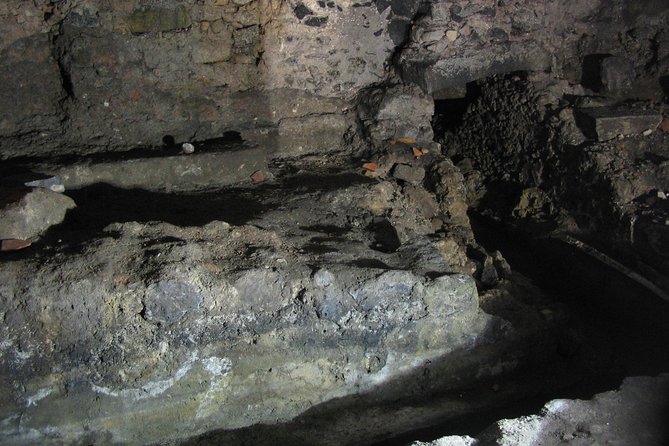
At A Putia dell’Ostello, the tour reaches one of its most unusual settings. The Amenano is an underground river running beneath Catania’s historic center. Long ago, it reached the surface and fed Lake Nicito. Eruptions, earthquakes, war, and later construction changed the waterway and the city around it.
You enter a sliding cave where a branch of the river still flows. The visit lasts about 10 minutes, so this is a short stop, but it delivers a memorable shift in perspective. Catania is not only built over earlier streets and buildings. It also sits above moving water.
The setting is part of a restaurant, which makes the location feel especially unexpected. You might be eating or walking through the historic center without realizing that basalt rock and a surviving river channel are directly below.
This is also where the guide can connect natural and human history. Lava altered the ground. Construction covered the water. Earthquakes changed buildings and routes. The result is an urban center whose surface hides both archaeological remains and natural features.
Because this stop is brief, listen closely to the explanation and take your time looking at the rock and water. It is not a long cave walk. Its value comes from the setting and the story behind it.
Same island, a completely different day out:
- Palermo: Hop-on Hop-off Bus Tour 24-hour Ticket
★ 3.9 · 2,410 reviews - From Trapani: Cruise to Favignana and Levanzo with lunch
★ 4.2 · 2,286 reviews - Catania: Sunset Jeep Tour of Mount Etna and Lava Flow Caves
★ 4.8 · 2,113 reviews - Palermo Original Street Food Walking Tour by Streaty
★ 5.0 · 2,105 reviews
San Gaetano alle Grotte: a church carved into rock
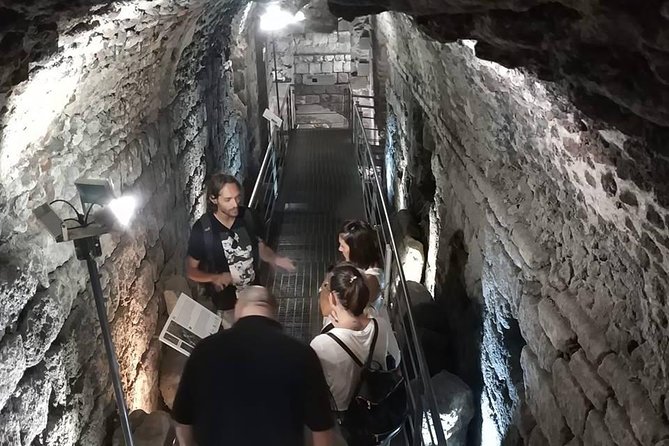
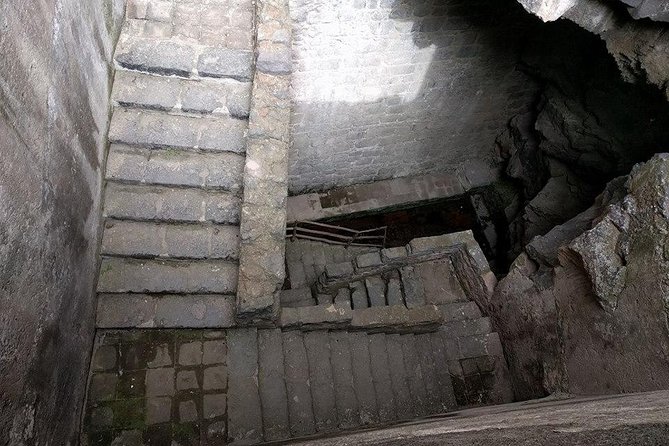
Chiesa di San Gaetano alle Grotte is likely to be the most layered stop on the route. The site is an ancient lava-flow cave that was reused in Greek times as a cistern. Later, Romans used it as a catacomb tomb. Christian tradition connects the place with the first burial of Saint Agatha, and a small church was built here as early as 262.
The crypt still preserves traces of old frescoes and decorations cut directly into the rock. This is not a polished museum room. The power of the place comes from seeing the raw volcanic material alongside signs of worship, burial, and reuse.
The site shows how one underground chamber can serve many purposes over centuries. A natural lava formation becomes a water container, then a burial space, then a Christian place of worship. That sequence gives you a practical lesson in Catania’s past: buildings and caves were adapted again and again because the city was always rebuilding on limited ground.
The visit lasts about 20 minutes. That may sound short for such a complicated site, but a focused explanation helps. You will want to look at the rock surface, the remaining decoration, and the shape of the chamber while hearing how the place changed over time.
The cave can also be a welcome respite on a hot day. Several people who took the tour in summer appreciated the cooler underground rooms. Do not confuse cool with comfortable in every respect, though. Stone floors, narrow areas, and damp conditions can make the route less suitable for anyone who struggles with uneven footing.
The guides make the difference
This tour depends heavily on the person leading it. The sites are small and scattered, and a weak guide could make them feel like a string of dark rooms. A good guide turns them into a connected account of Catania.
Oreste is praised for his command of archaeology and for answering detailed questions about the city. Maria is described as passionate about Catania and especially good at introducing lesser-known places. Matilde, also referred to as Mathilde, receives high marks for her warmth, preparation, and ability to explain the eruption, earthquake, and city changes in a way that makes sense.
That range matters because you are not only looking at Roman remains. You are also learning about Sicily, Mount Etna, Saint Agatha, the Amenano, and the disasters that repeatedly altered Catania. The best part of the guiding is the connection between each subject.
You can also ask questions and request more time at a particular feature. The experience is not presented as a rigid lecture. One guide adjusted the timing to suit the group, and another was patient when the group wanted to examine something longer.
The pace can be slow for some people. If you like to move quickly from site to site, tell the guide at the start. The small maximum group size makes that sort of conversation easier than it would be on a large coach tour.
Is $96.79 a fair price?
At $96.79 per person, this is a premium walking tour. You are paying for an expert archaeology guide, access to several paid underground sites, and the convenience of joining the places into one route.
The value is strongest if you care about archaeology, geology, religious history, or the way cities respond to disasters. It is also useful if you have limited time in Catania and want a structured introduction to the city rather than researching each location separately.
The value is weaker if you mainly want famous sights, a fast overview, or a large number of attractions. Four listed stops are covered in two to three hours, and some of the underground visits are brief. You are paying for access and interpretation, not for a long list of grand monuments.
Group size matters. The maximum is eight people, which is small enough for questions and a more personal feel. Still, the experience may not be private in the strict sense if several separate parties are grouped together. If exclusivity is important to you, confirm that point before paying.
Group discounts may improve the cost for larger parties. Free cancellation is available up to 24 hours before the start time, which gives you some flexibility if your Catania plans change.
Who should book this experience?
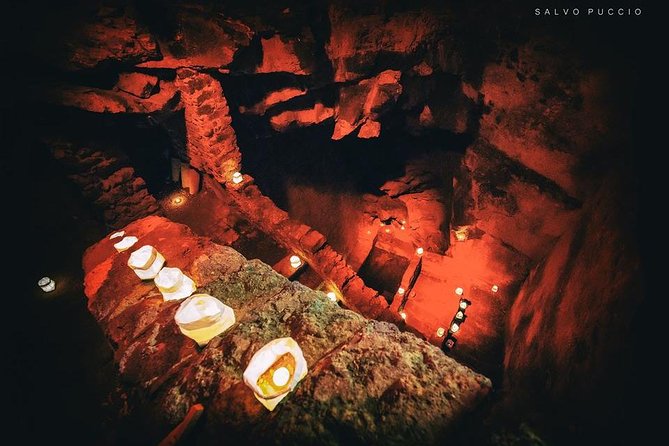
I would recommend it most strongly to people who want to understand how Catania was formed. History fans will get Roman baths, catacombs, a church tied to Saint Agatha, and a clear account of the city’s rebuilding. Anyone interested in geology will appreciate the lava caves and the effect of Mount Etna on the urban center.
It is also a good choice for a hot afternoon. The underground rooms provide a break from the sun, while the route remains tied to the city rather than sending you far outside town.
Families can take part, since most people can participate, but the experience is not designed as a children’s entertainment program. Younger children may need help with the slower pace and underground footing.
You should think twice if you dislike enclosed spaces, uneven ground, or historical explanation. The tour is built around stories and physical remains, not dramatic special effects. Also reconsider it if you want a private tour for only your own party unless that arrangement is confirmed clearly.
The meeting point is Piazza del Duomo, 7. The route ends at Piazza Stesicoro, so you finish in another central area rather than returning to the starting point. That is convenient if you plan to continue sightseeing, but you should allow for the walk back if your hotel is near the cathedral.
Final call: book it for the city beneath the city
Book Underground Catania if you want the parts of Catania that are easy to miss from the pavement. The Roman baths, underground river, lava cave, and grotto church each offer something different, and the guides tie them together with the story of a city repeatedly changed by nature and human rebuilding.
I would not book it simply because you want a cheap sightseeing walk. At $96.79, the price requires genuine interest in the subject. But if you value access to unusual sites and a guide who can explain what you are seeing, this is a thoughtful use of two to three hours in Catania.
FAQ
Where does the Underground Catania tour begin?
The tour begins at Piazza del Duomo, 7, in Catania.
Where does the tour end?
The tour ends at Piazza Stesicoro.
How long does the tour last?
The experience lasts approximately two to three hours.
What language is the tour offered in?
The tour is offered in English.
How many people can join the tour?
The activity has a maximum of eight participants.
Is the tour private?
It is described as an exclusive tour for your group, but the group size can include up to eight people. If you require a tour only for your own party, confirm the arrangement before booking.
What sites are included?
The route includes Terme Achilliane, the Basilica Cattedrale di Sant’Agata, A Putia dell’Ostello with its underground Amenano River cave, and Chiesa di San Gaetano alle Grotte.
Are admission tickets included?
Admission is included at Terme Achilliane, A Putia dell’Ostello, and Chiesa di San Gaetano alle Grotte. The cathedral stop has no separate admission charge.
Can I cancel for a full refund?
You can cancel up to 24 hours before the experience start time for a full refund. Cancellations or changes made less than 24 hours before the start time are not accepted for a refund.
Just added around Sicily
- Anti-Mafia Heroes (Cool Hours) Morning Walking Tour★ 5.0 · 3 reviews
- Nicolosi: Excursion Etna Craters at 3000 mt.★ 4.2 · 3 reviews
- DISCOVER THE SECRET OF PALERMO Walking Tour Combining Art and best street food★ 5.0 · 3 reviews
- The art of the Italian Aperitivo with a local: Learn & Enjoy in Palermo★ 5.0 · 3 reviews
- Taormina PRIVATE EAST COAST EXCURSIONS 2 Exclusive Days with Guide Driver★ 5.0 · 3 reviews
- Monti Rossi Adventure Park Entry Ticket Full★ 5.0 · 3 reviews
- Guided kayak tour inside the Stagnone of Marsala★ 5.0 · 3 reviews
- Catania : Diving for patented divers★ 5.0 · 3 reviews