Reviewed · PRIVATE
Private Tour of Syracuse in 6 hours with Enrica De Melio
Syracuse makes more sense when you see its ancient ruins and old island center together. This private tour with PhD archaeologist Enrica De Melio links the Greek and Roman remains at Neapolis with Ortigia’s temples, cathedral, piazzas, and seafront spring.
I like the chronological route through Neapolis, which helps you follow Syracuse from Greek theater to Roman arena. I also like the one-to-one format: your group of up to eight can ask questions and set the pace. The main drawback is cost, especially since the €17 archaeological park ticket, the €2 cathedral ticket, transport, and lunch are extra.
In This Review
- Key points at a glance
- Why this Syracuse tour works as a first look
- Starting with the Quarry of Paradise
- The Greek Theatre and Syracuse’s public life
- Hiero II’s altar and the Roman Amphitheater
- Crossing to Ortigia and the Temple of Apollo
- Piazza Duomo and the Temple of Athena
- Arethusa Spring and the end of the walk
- Enrica De Melio’s guiding style
- Is $361.11 good value for up to eight people?
- Timing, clothing, and practical planning
- Who should book this private Syracuse tour?
- FAQ
- How long does the Syracuse private tour last?
- What time does the tour start?
- Where does the tour begin?
- Where does the tour end?
- How many people can join the private tour?
- Is transportation included?
- Are entrance tickets included?
- Is lunch included?
- What fitness level is required?
- What happens if the weather is poor?
- Can I cancel for a full refund?
- Is this suitable for cruise ship visitors?
Key points at a glance
- See the Ear of Dionysius and Greek Theatre: The Neapolis visit covers the park’s most important ancient monuments in about 90 minutes.
- Connect Greek and Christian Syracuse: Ortigia’s Cathedral incorporates the ancient Temple of Athena into its structure.
- Walk with an archaeologist: Enrica De Melio brings formal archaeological training and a warm, personal manner to the tour.
- Plan for two walking areas: The tour starts at Neapolis and ends at Arethusa Spring in Ortigia, with transport between them not included.
- Best for history-minded visitors: You get context and interpretation rather than a quick checklist of sights.
- Budget for extra tickets: The park costs €17 per person, while the cathedral costs €2 per person.
Why this Syracuse tour works as a first look
Syracuse is not one compact sight. Its ancient core sits on the mainland at the Neapolis Archaeological Park, while its later civic and religious center occupies Ortigia, a small island linked to the city by bridges. Seeing both in one half-day gives you a useful frame for the city.
The tour begins at 9:30 a.m. at the entrance to Neapolis on Via Luigi Bernabò Brea. After the archaeological park, you make your own way to Ortigia, where the walking portion continues. The tour ends at Arethusa Spring, a practical spot for continuing into Ortigia on your own.
I like the structure because it moves from large ancient monuments to lived-in city streets. At Neapolis, you deal with scale, stone, theater, quarries, and empire. In Ortigia, you see how Greek foundations were reused and absorbed into later buildings.
The private setup matters here. A group of eight or fewer can stop when a question comes up, spend more time on a monument, or keep moving if the heat becomes tiring. Enrica’s background in archaeology suits a place where the most interesting details are often not obvious at first glance.
This is not a sightseeing bus or a tour built around photo stops. You should expect a guided walking experience with historical explanation at its center. A moderate level of fitness is advised, and smart-casual clothing is requested.
A few more Sicily tours and experiences worth weighing up
- Palermo: Private Custom Walking Tour with Local Guide
★ 4.7 · 661 reviews - Private 6-Hour Tour of Three Etna Wineries with food&wine tasting
★ 5.0 · 417 reviews - Private Tour explore Vulcano Island by Kayak & Coasteering
★ 5.0 · 338 reviews
Starting with the Quarry of Paradise
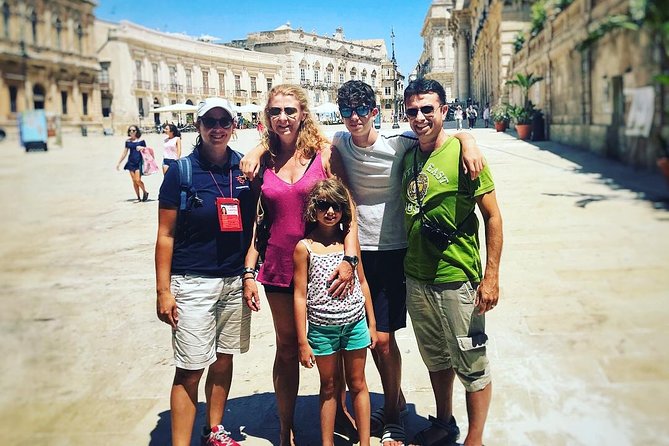
The first part of the Neapolis visit is the Quarry of Paradise, also called the Latomia del Paradiso. This former stone quarry is one of the park’s most memorable spaces, not because it looks polished, but because it shows how Syracuse used the rock beneath the city.
The best-known feature is the Ear of Dionysius, a tall, curved cavern cut into the limestone. Its shape and acoustics have made it famous, and the guide helps separate the monument’s physical reality from the stories that have gathered around it.
You will also see the Cave of the Rope-makers. Its name points to the labor once carried out in these excavated spaces. These quarries were not simply holes in the ground. They were tied to the city’s building program, military power, and difficult social history.
This is where having an archaeologist is especially useful. Without context, a quarry can feel like a dramatic but isolated cave. With explanation, it becomes part of Syracuse’s growth and the hard work that made its temples, theaters, and walls possible.
The quarry section lasts about 90 minutes as part of the wider park visit. Wear shoes that are comfortable for walking and bring protection from the sun, since the route is outdoors and the experience requires steady movement through a large archaeological area.
The Greek Theatre and Syracuse’s public life
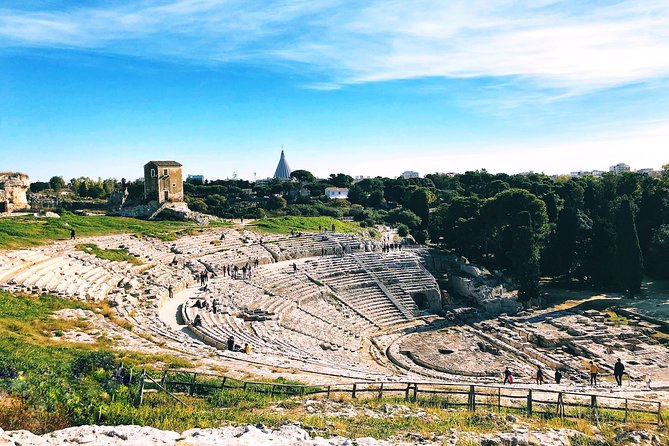
The Greek Theatre is the park’s great centerpiece. Carved into the hillside, it shows the importance of theater in the ancient Greek world and the ability of Syracuse to support major public works.
Your guide presents the theater as part of the city’s development, rather than treating it as a single photo stop. Look at its position, its seating, and the relationship between the stage area and the surrounding rock. The physical setting helps explain why ancient theaters were civic spaces as much as entertainment venues.
A private guide can make this part more responsive. If you are interested in ancient performance, engineering, or the political role of public gatherings, you can ask for more detail. If your group is focused on the basic story, Enrica can keep the explanation moving.
The theater is also one reason to avoid rushing through Neapolis. The park contains several major monuments, and a short visit without interpretation can leave you remembering shapes but not meaning. This tour gives the site a clear order and connects each stop to the next.
Keep in mind that the €17 admission to the archaeological park is not included. Visitors under 18 enter free, according to the tour information. That extra cost is easy to overlook when comparing the group price, so include it in your budget from the start.
Hiero II’s altar and the Roman Amphitheater
After the theater, the route continues to the Altar of Hiero II, described as the largest altar in the world. What remains is mainly the great base, but its size gives you a strong sense of the scale of ancient religious ceremony in Syracuse.
The altar is valuable as a lesson in power. A structure of this size required labor, planning, and resources on a huge scale. Enrica’s chronological approach helps you see it as part of the city’s Greek period, before the Roman Amphitheater introduces a later phase.
The Roman Amphitheater changes the feel of the visit. Its form points to Roman public spectacles and a different set of civic priorities. You can compare its construction and layout with the Greek Theatre and see how public architecture changed across periods.
I like that these sites are presented together. You are not just collecting ruins. You are watching Syracuse shift from Greek city to Roman city, with each monument offering a clue about the society that built it.
The route does not include transportation to or from the archaeological area. Since the meeting point is at Neapolis, you need to arrange your own arrival. Afterward, you also need to make your own way to Ortigia for the second walk. If you are arriving by cruise ship, build in a generous time margin. The tour does not refund missed visits caused by a late or non-arriving ship.
Same island, a completely different day out:
- Catania: Mount Etna Morning or Sunset Day Trip with Tasting
★ 4.8 · 4,028 reviews - Mount Etna: Guided Volcano Summit Hiking Tour with Cable Car
★ 4.7 · 3,784 reviews - Palermo: NO Mafia Walking Tour
★ 4.8 · 2,431 reviews - Palermo: Hop-on Hop-off Bus Tour 24-hour Ticket
★ 3.9 · 2,410 reviews
Crossing to Ortigia and the Temple of Apollo
Ortigia feels different from Neapolis almost at once. It is a smaller, denser urban area where ancient remains sit among streets, homes, churches, shops, and public squares. The walking tour begins with the Temple of Apollo, dated to the sixth century BC.
The temple is important because it is among the oldest Greek temples in Sicily. Even in its ruined state, it gives you a clear starting point for understanding Ortigia’s ancient identity.
The setting also shows how cities change without erasing everything that came before. The temple is part of the modern fabric, not a monument isolated in a park. That makes the explanation especially worthwhile. You can look at the stones and then continue through an active town built around them.
The Ortigia section is planned for about 90 minutes. That is enough for a guided introduction to the main sights, but not enough for every church, lane, museum, and food stop on the island. Think of it as a strong orientation, not a complete exploration of Ortigia.
Because the tour ends at Arethusa Spring, you have a natural chance to continue independently. You can linger in the area, find lunch, or return to places that caught your interest during the walk. Lunch is not included, so plan that as a separate part of your day.
Piazza Duomo and the Temple of Athena
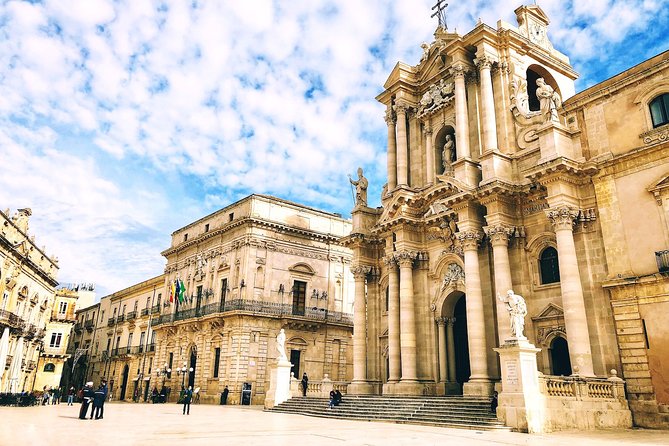
Piazza Duomo is Ortigia’s grand civic room. Baroque palaces frame the square, while the Cathedral of Syracuse occupies the site of an ancient Temple of Athena.
This layered building is one of the tour’s most rewarding stops. The cathedral is not simply a later church placed near Greek ruins. Its structure incorporates columns from the Temple of Athena, allowing you to see ancient Greek architecture within a Christian building.
That physical overlap captures Syracuse better than a list of dates can. Greek, Roman, Byzantine, Norman, and Baroque phases all left marks on the city, and the cathedral makes that process visible in one place.
The cathedral admission costs €2 per person and is not included. The tour information identifies cathedral access as part of the Ortigia visit, but you should still expect this small ticket charge. If you prefer to focus on the exterior, you can ask how the visit will be handled, though the tour’s main interest is seeing the site with explanation.
Piazza Duomo is also a good place to notice the contrast between Neapolis and Ortigia. The archaeological park gives you open space and monumental ruins. The square gives you architecture still tied to daily city life.
Arethusa Spring and the end of the walk
The walk ends at Arethusa Spring, one of Ortigia’s most recognizable natural features. The spring is linked with Greek mythology and gives the tour a gentler final stop after the heavier stonework of the archaeological park and cathedral.
Its location near the water helps explain Ortigia’s appeal. Ancient Syracuse was shaped by the sea, and this small freshwater source adds another layer to the island’s story. It is a fitting end point because you can pause here and then decide how to spend the rest of your day.
The tour does not include a return transfer. From Arethusa Spring, you are on your own, so check your onward plans before booking. If you need to return to a ship, hotel, or railway station at a fixed time, allow for the walk back and any local transport.
The listed stops add up to about three hours of guided walking, while the full experience is described as roughly five to six hours. The difference allows for the move between Neapolis and Ortigia, the pace of a private visit, and the practical time needed to cover two separate parts of Syracuse.
Enrica De Melio’s guiding style
Enrica De Melio is presented as a PhD archaeologist, and that qualification matters in Syracuse. The city demands more than dates and names. You need someone who can explain why a quarry, theater, altar, amphitheater, temple, and cathedral belong in the same story.
Her guiding style also appears to be personal and cheerful. Several written accounts describe her as warm, engaging, well prepared, and attentive to individual needs. One family also noted that she checked accessibility at the sites used on their wider touring day, which suggests that it is worth discussing mobility concerns with her before the visit.
You should not assume every part of Neapolis or Ortigia is easy for every person. The tour itself asks for moderate physical fitness, and the format is a walking tour. If someone in your group has a disability or needs a slower pace, contact the provider in advance and explain exactly what support is needed.
The private format gives Enrica room to adapt explanations. A couple interested in archaeology can ask detailed questions. A family can keep the history clear and lively. A group of friends can focus on the main monuments without being tied to strangers.
Is $361.11 good value for up to eight people?
The price is $361.11 per group, with up to eight people included. For a full group, that works out to about $45 per person before admission tickets and any transportation. For two people, the per-person cost is much higher.
The value depends on how you use the guide. If you want a quick introduction and are comfortable reading signs on your own, this may feel expensive. If you want a specialist to connect two major areas of Syracuse and answer questions as you go, the cost becomes easier to justify.
The tour covers the two places most visitors need to understand: Neapolis and Ortigia. A guide also saves you from treating the ancient sites as disconnected ruins. That interpretive value is the main reason to consider a private booking.
Add the €17 park ticket for each person, the €2 cathedral ticket for each person, transportation between areas, and lunch. There is no group transport included, so a full cost comparison should include those items.
This experience is strongest for a group of four to eight people who can share the private rate. Couples should compare the price with other guided options before booking, especially if they only want one section of the city.
Timing, clothing, and practical planning
The meeting time is 9:30 a.m. at Parco Archeologico della Neapolis, Via Luigi Bernabò Brea 14. The tour ends at Arethusa Spring in Largo Aretusa, Ortigia.
You need to plan your own transportation to the start and between the two areas. Both meeting points are near public transportation, but no specific transfer is supplied. A mobile ticket is used, and booking confirmation is provided at the time of purchase.
Wear smart-casual clothing and comfortable walking shoes. The moderate fitness requirement is important because the visit includes an archaeological park, streets, and two separate parts of the city. Service animals are allowed.
The tour requires good weather. If poor weather cancels it, you are offered another date or a full refund. You can cancel for a full refund up to 24 hours before the local start time. A late cancellation or change within 24 hours is not refunded.
Who should book this private Syracuse tour?
I would choose this tour if you want historical context, not just a route between famous sights. It is particularly well suited to a family, couple, or small group that wants to ask questions and keep the visit personal.
It is also a good match for anyone who finds ancient sites hard to read without help. The sequence from quarry to theater, altar, amphitheater, temple, cathedral, and spring gives Syracuse a clear shape.
I would hesitate if your group dislikes walking, needs included transport, or wants a relaxed food-focused morning. The tour is not cheap for one or two people, and the extra tickets and lunch costs need to be added.
FAQ
How long does the Syracuse private tour last?
The experience lasts approximately five to six hours. The guided visit at Neapolis is about 90 minutes, and the guided walk in Ortigia is also about 90 minutes.
What time does the tour start?
The tour starts at 9:30 a.m.
Where does the tour begin?
The meeting point is Parco Archeologico della Neapolis, Via Luigi Bernabò Brea 14, 96100 Siracusa.
Where does the tour end?
The tour ends at Arethusa Spring, Largo Aretusa, 96100 Siracusa.
How many people can join the private tour?
The price covers one private group of up to eight people.
Is transportation included?
No. Transportation to and from the attractions is not included. You must arrange your own transport between Neapolis and Ortigia.
Are entrance tickets included?
The €17 Neapolis Archaeological Area ticket is not included. Admission is free for people under 18. The Syracuse Cathedral ticket costs €2 per person and is also not included.
Is lunch included?
No. Lunch is not included in the tour price.
What fitness level is required?
A moderate level of physical fitness is recommended. The experience includes guided walking in the archaeological park and around Ortigia.
What happens if the weather is poor?
The experience requires good weather. If it is canceled because of poor weather, you will be offered a different date or a full refund.
Can I cancel for a full refund?
Yes. You can cancel at least 24 hours before the experience starts for a full refund. Cancellations or changes made less than 24 hours before the start are not refunded.
Is this suitable for cruise ship visitors?
You can book it if you can reach the meeting point on time, but there is no refund if you miss the tour because your cruise ship is late or does not arrive. Allow plenty of extra time.
Just added around Sicily
- Anti-Mafia Heroes (Cool Hours) Morning Walking Tour★ 5.0 · 3 reviews
- Nicolosi: Excursion Etna Craters at 3000 mt.★ 4.2 · 3 reviews
- DISCOVER THE SECRET OF PALERMO Walking Tour Combining Art and best street food★ 5.0 · 3 reviews
- Taormina PRIVATE EAST COAST EXCURSIONS 2 Exclusive Days with Guide Driver★ 5.0 · 3 reviews
- The art of the Italian Aperitivo with a local: Learn & Enjoy in Palermo★ 5.0 · 3 reviews
- Monti Rossi Adventure Park Entry Ticket Full★ 5.0 · 3 reviews
- Guided kayak tour inside the Stagnone of Marsala★ 5.0 · 3 reviews
- Catania : Diving for patented divers★ 5.0 · 3 reviews
Private, compared.

Private 6-Hour Tour of Three Etna Wineries with food&wine tasting
Read our review →
Private Tour explore Vulcano Island by Kayak & Coasteering
Read our review →
Godfather vs Mafia Tour & Pasta Lunch (Small Group or Private)
Read our review →
Private/Guided Godfather with appetizer and Pasta
Read our review →
Etna Countryside Food & Wine Lovers Tour (Small Group or Private)
Read our review →