Reviewed · TOURS
Half Day Tour of Syracuse
Syracuse packs an astonishing amount into a small area: a Greek theater cut into stone, an ancient quarry, a Roman amphitheater, and the elegant streets of Ortigia. This tour links the city’s two essential sights in about three hours, with guide Letizia bringing the old stones and modern Sicilian life into the same conversation.
I like the private format, since you can ask detailed questions and slow down in the heat. I also like the route itself: two hours in Neapolis, then one hour in Ortigia, ending at the fresh-water Arethusa Spring. The main drawback is that the $141.40 price is per person and does not include entrance tickets or transport.
In This Review
- Key points to know before booking
- Why this short Syracuse tour works
- The Greek theater and the scale of Neapolis
- Hieron II’s altar and the Roman amphitheater
- Crossing into Ortigia
- Ending at the Arethusa Spring
- Letizia’s guiding style
- What $141.40 per person really buys
- Timing, heat, and walking comfort
- Who should book this experience
- My verdict on the three-hour route
- FAQ
- How long is the Half Day Tour of Syracuse?
- What sights are included in Neapolis?
- What do you see in Ortigia?
- Is the tour private?
- Who is the guide?
- Are entrance tickets included?
- Where does the tour start and finish?
Key points to know before booking
- Syracuse’s biggest ancient sights fit into one morning or afternoon: You visit Neapolis and Ortigia without spending a full day on the city.
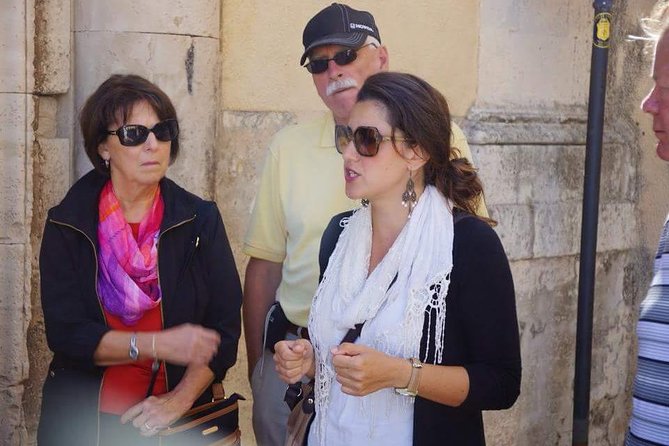
- Letizia leads a private tour in English: Her style is personable, patient, and flexible, with strong knowledge of Syracuse and its surrounding community.
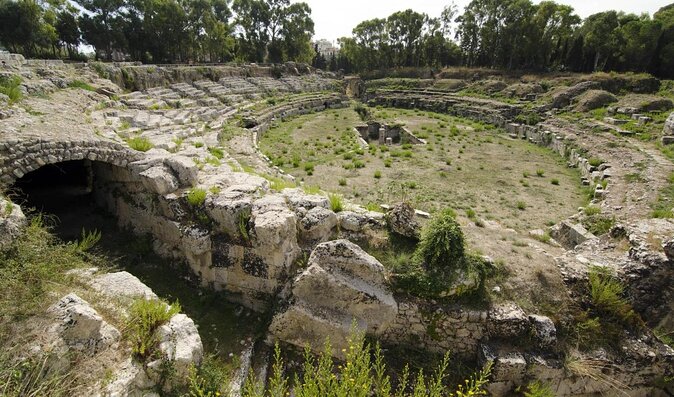
- The Greek theater is only part of Neapolis: You also see the stone quarries, Dionysius’ Grotto, Hieron II’s altar, and a Roman amphitheater.
- Ortigia ends at the Arethusa Spring: The final stop gives you an easy point from which to continue exploring the island on your own.
- Tickets are extra: Admission fees are not part of the tour price, so budget for them separately.
- The walking pace can be adjusted: This matters on a hot Sicilian day or if you prefer more time for questions and photographs.
Why this short Syracuse tour works
Syracuse can feel spread across different eras. Neapolis is an archaeological area with large, open ancient monuments. Ortigia is a compact old island where temples, churches, lanes, and daily life sit close together.
This tour makes the contrast easy to understand. You begin at Largo Anfiteatro, 2, near the archaeological park, and finish at Fonte Aretusa inside Ortigia. You are not simply looking at disconnected ruins. You are following Syracuse from Greek and Roman public life into the later layers of the city.
The private setup is the real advantage. Letizia can spend more time on the subjects that interest you, explain a detail again, or adjust the pace. Her English is described as excellent, and she also speaks Romance languages. That makes this a useful choice if you want more than dates and names.
The tour is scheduled for roughly three hours, with two hours at Neapolis and one hour in Ortigia. That is enough for an introduction, not enough for every museum, church interior, market stall, and side street. I would book it as a focused first look, then use the rest of your day to return to whichever part caught your attention.
Other Sicily trips travellers book alongside this one:
- Catania: Mount Etna Morning or Sunset Day Trip with Tasting
★ 4.8 · 4,028 reviews - Mount Etna: Guided Volcano Summit Hiking Tour with Cable Car
★ 4.7 · 3,784 reviews - Palermo: NO Mafia Walking Tour
★ 4.8 · 2,431 reviews
The Greek theater and the scale of Neapolis
The first two hours take place in Parco Archeologico della Neapolis. The centerpiece is the largest Greek theater in Sicily, a powerful reminder that Syracuse was a major Greek city, not a minor outpost.
The size of the theater helps explain why this park deserves serious time. From the seating area, you can better picture performances and public gatherings taking place on a scale that still feels impressive today. Letizia’s role is especially useful here because the stones do not explain themselves. You need context to understand how the theater fitted into the city and why its setting mattered.
The tour also includes the ancient stone quarries. These quarries were cut into the rock and later became associated with Dionysius’ Grotto, often called the Ear of Dionysius. The name has a dramatic ring, but the setting also gives you a practical sense of how Syracuse used the local stone.
Do not expect the park to feel like a quick succession of photo stops. The monuments are spread across an archaeological area, and the day’s heat can affect how much energy you have. One useful feature of a private tour is the ability to keep a slower pace. That flexibility mattered to one person who toured on a particularly hot day.
Hieron II’s altar and the Roman amphitheater
Neapolis is not only about Greek theater. You also see the sacrificial altar of Hieron II, an enormous ancient structure tied to public religious ceremonies. Its scale helps you grasp the resources and organization available to Syracuse’s rulers.
Then the route moves forward to the Roman amphitheater. Seeing Greek and Roman sites in the same park gives you a quick lesson in the city’s changing political and cultural world. The theater and amphitheater were built for different purposes, and their contrasting forms make the progression easier to follow.
I like this mix because it keeps the archaeological visit from becoming a single-monument tour. You see performance, religion, engineering, and public spectacle in one place. Letizia can also answer the small questions that often make a site memorable, such as how a quarry was used or how later cultures changed the city.
An open-air sculpture exhibition by Igor Mitoraj has also added another layer to the park at times. It is not listed as a guaranteed part of the tour, so treat it as a possible extra rather than a promised feature. If it is present during your visit, the modern sculptures can create an interesting contrast with the ancient stone.
Entrance tickets are not included. Check the current admission cost when you book or before you arrive, and remember that the tour price covers the guide rather than the site fees.
Crossing into Ortigia
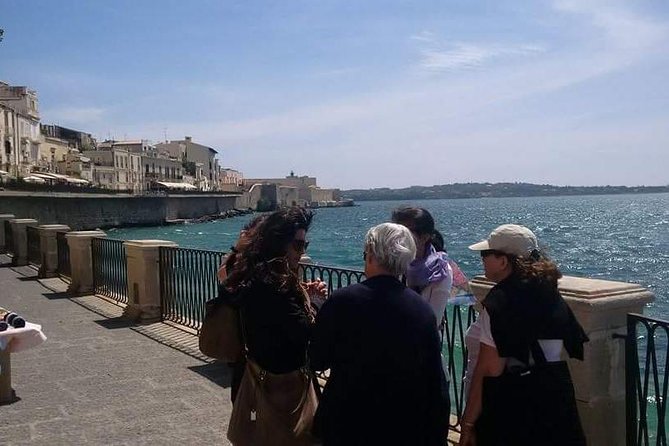
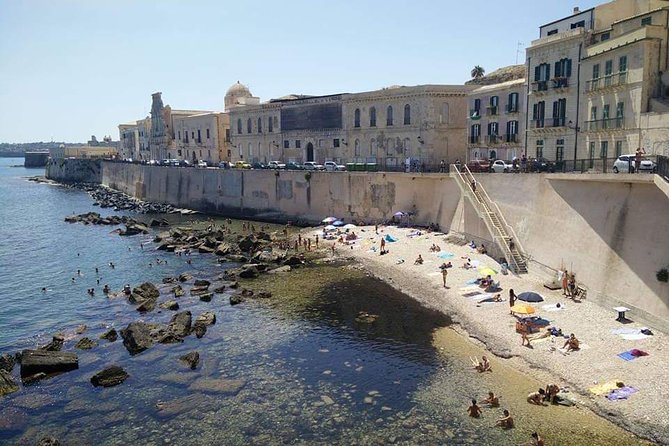
After Neapolis, the experience turns from large archaeological spaces to the close streets of Ortigia. This is the oldest part of Syracuse, set on an island and filled with buildings from different periods.
The one-hour Ortigia portion focuses on three major sights. You visit the oldest Temple of Sicily, the Cathedral, and the Arethusa Spring. The short time means you should expect an introduction to these places rather than a long interior study of every building.
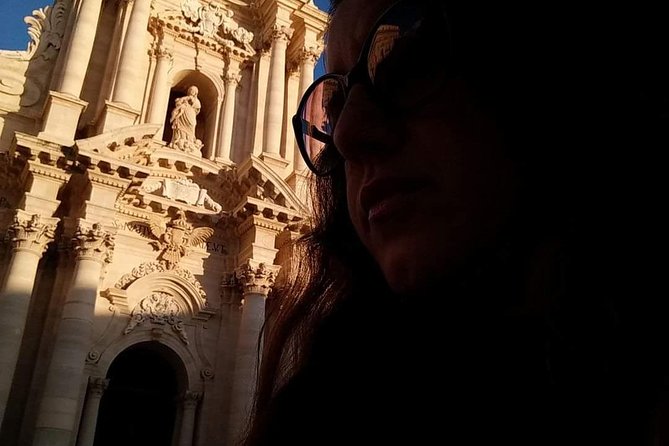
The Cathedral is especially rewarding for anyone interested in how cities change over time. Its design combines different architectural styles, so the building tells a story of Syracuse’s successive cultures. Letizia’s explanations help you read those layers instead of seeing only a beautiful church facade.
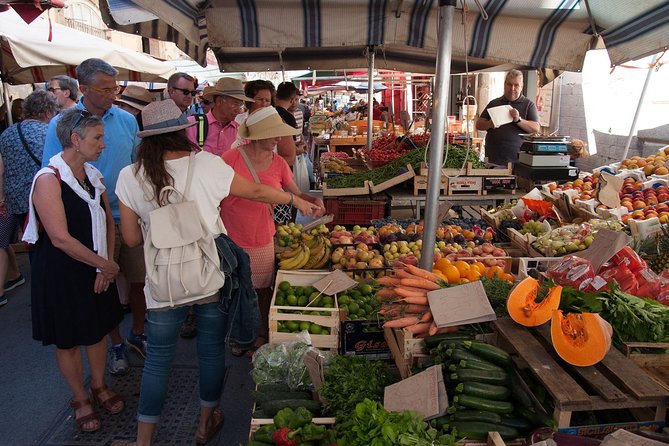
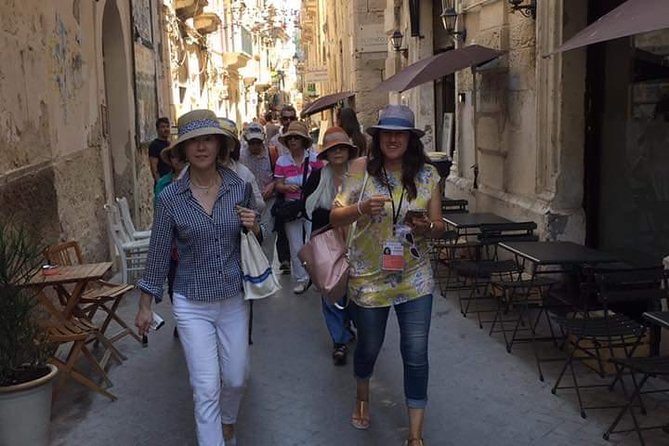
The route also includes the island’s narrow old streets. This is where the tour becomes less about grand monuments and more about how the city feels at street level. You may notice details that are easy to miss when walking alone, including local plants and wild spices. Letizia has a reputation for pointing out those small, everyday features, which can make the walk feel connected to present-day Sicily rather than locked in the past.
Same island, a completely different day out:
- Palermo: Hop-on Hop-off Bus Tour 24-hour Ticket
★ 3.9 · 2,410 reviews - From Trapani: Cruise to Favignana and Levanzo with lunch
★ 4.2 · 2,286 reviews - Catania: Sunset Jeep Tour of Mount Etna and Lava Flow Caves
★ 4.8 · 2,113 reviews - Palermo Original Street Food Walking Tour by Streaty
★ 5.0 · 2,105 reviews
Ending at the Arethusa Spring
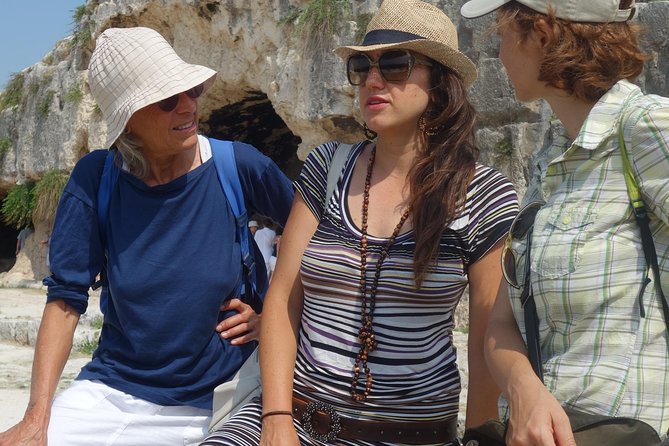
The tour finishes at Fonte Aretusa, the fresh-water spring that serves as one of Ortigia’s best-known symbols. Ending here is practical. You are already inside the old island, with time to continue toward lunch, the market, or another church after the guide says goodbye.
The spring also makes a fitting final stop because it links natural water with the story of the city. After two hours among theaters, quarries, and amphitheaters, this calmer setting gives the tour a different mood.
The endpoint is not the starting point, so plan your day around a one-way route. The tour does not provide private transportation. You need to make your own way to Largo Anfiteatro at the beginning, and you will be left at Fonte Aretusa at the end. The meeting point is near public transportation, which helps, but the activity itself is a walking tour.
Letizia’s guiding style
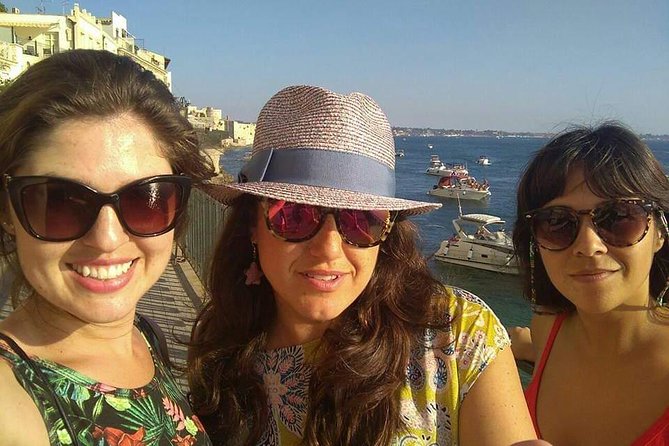
The guide can make or break a short city tour, and Letizia is the strongest part of this experience. Her approach combines site knowledge with a warm, easy manner. She is described as patient with detailed questions, comfortable adapting the tour to personal interests, and willing to keep the pace comfortable.
That flexibility is useful in Syracuse because people arrive with different goals. You may care most about Greek archaeology, while someone else in your group may prefer churches, food, or local customs. A private guide can shift the emphasis without making the whole group wait for a standard script.
Letizia also has a family background in guiding, and her work extends beyond sightseeing. She offers food tours and cooking classes, and she can provide restaurant suggestions. A market visit and lunch recommendation have been part of some Syracuse experiences with her, but you should not assume those are included in this specific three-hour itinerary. Ask about food stops if that is important to you.
Her interest in local plants and wild spices is another pleasant detail. It gives you something to notice between major monuments and adds a small connection to the island’s everyday culture.
What $141.40 per person really buys
At $141.40 per person, this is not a low-cost sightseeing walk. The price makes more sense if you are a small group that values private attention and wants to cover both Neapolis and Ortigia in one outing.
For two people, the guide’s time and flexibility can feel worthwhile, especially if you want to ask questions or adjust the pace. For a larger private group, the per-person cost may compare more favorably, though the supplied price is still quoted per person.
The price does not include entrance tickets, snacks, or private transportation. That matters because the archaeological park is the main paid sight on the route. You should set aside extra money for admission and handle drinks or food separately.
The tour’s value is less about the number of hours and more about what those hours accomplish. In three hours, you get a structured introduction to the two parts of Syracuse most people want to see. You also avoid spending time working out the route or trying to decode the archaeological park alone.
If you already have a strong command of Greek and Roman archaeology, you may prefer to visit independently and spend longer at each monument. If you want the city explained in clear English and prefer a private pace, the cost is easier to justify.
Timing, heat, and walking comfort
The stated operating hours are Monday through Saturday, from 10:00 a.m. to 4:00 p.m. The schedule is relatively narrow, so check the available start time before building your day around it.
Sicily can be hot, and much of Neapolis is outdoors. Wear comfortable walking shoes and bring water, even though snacks are not included. The guide can slow the pace, but the tour still covers a large archaeological area followed by walking in Ortigia.
The experience requires good weather. If poor weather causes a cancellation, you are offered another date or a full refund. You can also cancel for a full refund up to 24 hours before the start time. Changes or cancellations made less than 24 hours ahead are not accepted for a refund.
Most people can take part, and service animals are allowed. The activity is private, so only your group participates. That gives you more control over the pace, but it does not change the need to plan for outdoor walking.
Who should book this experience
I would choose this tour if you have only part of a day in Syracuse, especially if you want both ancient sites and Ortigia rather than one or the other.
It also suits you if:
- You want an English-speaking local guide.
- You prefer a private experience to a large group.
- You like asking questions about archaeology, culture, and local life.
- You want a relaxed pace that can respond to heat or personal interests.
- You are visiting Syracuse for the first time and want help organizing the essentials.
It is less suitable if you want a full-day archaeological study or long interior visits. Three hours moves at a sensible pace, but it cannot cover every corner of Neapolis and Ortigia. It is also not the best fit if you want all entrance fees, food, and transport bundled into one price.
My verdict on the three-hour route
I like this experience because it gives Syracuse a clear shape. You begin with the city’s Greek and Roman monuments, then move into Ortigia’s layered streets and finish at the Arethusa Spring. That progression is easy to follow and makes good use of limited time.
The guide is the reason to choose this private version rather than simply walking between the same sights on your own. Letizia brings patience, local detail, and the ability to adapt the tour to your interests. Her explanations can turn the Greek theater, quarry, altar, and amphitheater from impressive ruins into connected parts of Syracuse’s story.
Book it if you want an efficient first visit with personal guidance and do not mind paying extra for a private format. Skip it if you prefer to explore independently, need transportation included, or want to spend a full day inside the archaeological park. For most first-time visitors with three hours to spare, it is a strong introduction, provided you budget separately for admission and arrive ready for outdoor walking.
FAQ
How long is the Half Day Tour of Syracuse?
The tour lasts approximately three hours. About two hours are scheduled for Parco Archeologico della Neapolis, followed by about one hour in Ortigia.
What sights are included in Neapolis?
The route includes the largest Greek theater in Sicily, the stone quarries with Dionysius’ Grotto, the sacrificial altar of Hieron II, and a Roman amphitheater.
What do you see in Ortigia?
The Ortigia portion includes the oldest Temple of Sicily, the Cathedral with its mix of architectural styles, and the Arethusa Spring.
Is the tour private?
Yes. Only your group participates in the activity, and the private format allows the guide to adjust the pace and respond to your interests.
Who is the guide?
The tour is led by Letizia. The experience is offered in English, and Letizia also speaks Romance languages.
Are entrance tickets included?
No. Entrance tickets are not included in the $141.40 per-person price. Snacks and private transportation are also excluded.
Where does the tour start and finish?
The tour starts at Largo Anfiteatro, 2, in Syracuse. It ends at Fonte Aretusa inside Ortigia.
Just added around Sicily
- Anti-Mafia Heroes (Cool Hours) Morning Walking Tour★ 5.0 · 3 reviews
- Nicolosi: Excursion Etna Craters at 3000 mt.★ 4.2 · 3 reviews
- DISCOVER THE SECRET OF PALERMO Walking Tour Combining Art and best street food★ 5.0 · 3 reviews
- The art of the Italian Aperitivo with a local: Learn & Enjoy in Palermo★ 5.0 · 3 reviews
- Taormina PRIVATE EAST COAST EXCURSIONS 2 Exclusive Days with Guide Driver★ 5.0 · 3 reviews
- Guided kayak tour inside the Stagnone of Marsala★ 5.0 · 3 reviews
- Monti Rossi Adventure Park Entry Ticket Full★ 5.0 · 3 reviews
- Catania : Diving for patented divers★ 5.0 · 3 reviews
Tours, compared.
Guided Volcano Summit Hiking Tour with Cable Car
Read our review →
Sunset Jeep Tour of Mount Etna and Lava Flow Caves
Read our review →
Palermo Original Street Food Walking Tour by Streaty
Read our review →
Segesta, Erice and Salt Pans Full-Day Excursion from Palermo
Read our review →
Etna and Alcantara Gorges Full-Day Tour with Lunch
Read our review →