
Reviewed · SICILY
CATANIA 1943: Husky operation
Catania 1943: Husky Operation takes you beyond the usual Roman ruins and Baroque streets. It explains how Allied forces reached Sicily in 1943, then connects that military story to Catania’s bomb shelters, shattered churches, and memorials. The best part is the way Operation Husky and Operation Fustian are tied to real places you can still see in the city.
I like two things right away: the first two hours are spent in a serious, well-documented museum, and the tour then brings the war story outdoors, where bomb damage remains visible. I also like that guide Oreste has helped an older visitor by driving between stops when walking became difficult.
The main consideration is the price, $94.68 per person, for roughly three hours. That can be fair for a private tour with museum admission and an English-speaking guide, but it is a high cost if you only want a quick overview or prefer to explore Catania’s central sights on your own.
In This Review
- Key points about the Catania 1943 tour
- Why Operation Husky matters in Catania
- Two hours inside the Museo Storico dello Sbarco
- The Roman amphitheater and its wartime role
- Sant’Euplio on Via Sant’Euplio
- Ending in Piazza del Duomo
- A private tour changes the pace
- Is $94.68 a fair price?
- Who will get the most from this experience?
- Booking and cancellation details
- Should you book Catania 1943: Husky Operation?
- FAQ
- How long does the Catania 1943 tour last?
- What language is the tour offered in?
- Is museum admission included?
- Is this a private tour?
- Where does the tour begin?
- Where does the tour end?
- Can I cancel for a full refund?
Key points about the Catania 1943 tour
- Two hours at the Landing Museum: The tour gives most of its time to the Museo Storico dello Sbarco in Sicilia 1943, with special attention to the Allied invasion and the Battle of the Simeto.
- A private experience: Only your group takes part, allowing the pace and discussion to suit your interests.
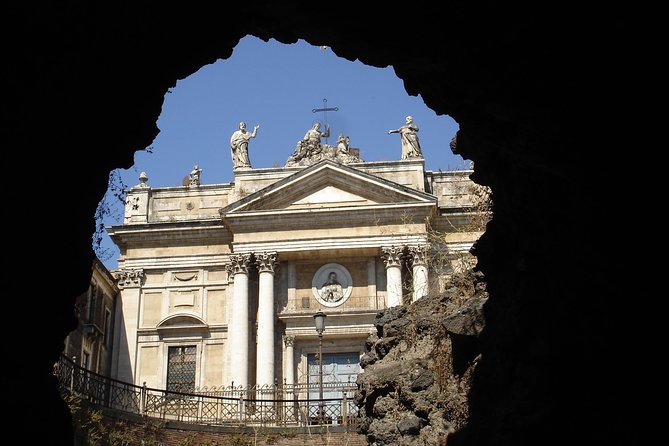
- Catania’s war scars remain visible: The Roman amphitheater, Sant’Euplio ruins, and a damaged altar in Piazza del Duomo connect military events to everyday life.
- Oreste may assist with transport: He has driven an older participant from the museum to the next stop, a useful option for anyone who finds city walking tiring.
- Access beyond the usual public route: The tour can include places in the city that are not normally open to the public.
- English and mobile ticketing: Confirmation arrives at booking, and the experience is offered in English with a mobile ticket.
Why Operation Husky matters in Catania
Many visitors first meet Sicily through Greek temples, Roman monuments, Norman churches, and food. World War II can feel like a separate subject, but in Catania the 1943 campaign is written into the city itself.
Operation Husky was the Allied invasion of Sicily. The campaign changed the course of the war and brought fighting directly into Sicilian towns and villages. This tour focuses not only on troop movements, but also on the effect of bombing and invasion on Catania’s people and buildings.
The Battle of the Simeto, connected with Operation Fustian, receives particular attention. That focus gives the museum visit a sharper purpose. You are not simply looking at old photographs and military objects. You are following a specific campaign and then seeing how the conflict affected the city.
I like this approach because it gives you a human scale. Maps and battle plans explain movement. The damaged church and air raid shelter show what war meant on the ground.
Other Sicily trips travellers book alongside this one:
- Catania: Mount Etna Morning or Sunset Day Trip with Tasting
★ 4.8 · 4,028 reviews - Mount Etna: Guided Volcano Summit Hiking Tour with Cable Car
★ 4.7 · 3,784 reviews - Palermo: NO Mafia Walking Tour
★ 4.8 · 2,431 reviews
Two hours inside the Museo Storico dello Sbarco
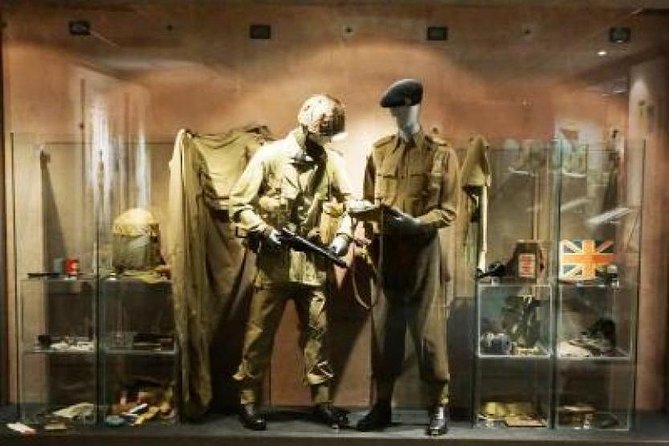
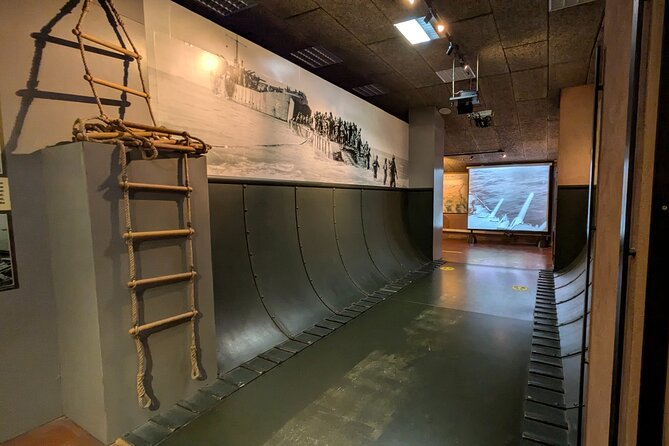
The tour begins at the Museo Storico dello Sbarco in Sicilia 1943, at Piazzale Rocco Chinnici. Plan on spending about two hours here, with admission included.
This is the main historical portion of the experience. The museum presents an in-depth account of the Allied landing in Sicily, with special attention to Operation Husky and Operation Fustian. Its documentation supports an accurate reconstruction of events, making it one of the more serious historical stops in Catania.
Your guide leads you through the material rather than leaving you to assemble the story alone. That matters in a military museum, where maps, dates, units, and shifting front lines can quickly become confusing. An English explanation also helps you connect the details to the places you will see later.
The museum is not a quick photo stop. Two hours is a substantial portion of a three-hour tour, so you should choose this experience only if wartime history genuinely interests you. If you want only a broad introduction, the time may feel long. If you want context, it is the reason to book.
Guide Oreste has been praised for explaining the war, the troops, and the effect on Sicilian people in a clear and considerate way. He has also adapted to the needs of an older participant, which is worth knowing if your group includes someone who cannot comfortably manage a full walking route.
The Roman amphitheater and its wartime role
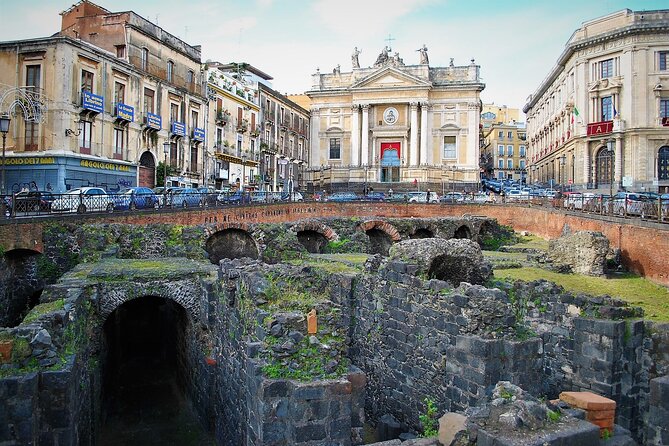
After the museum, the route moves to Catania’s Roman amphitheater in Piazza Stesicoro. This monument is usually introduced as a symbol of Roman Catania, but the tour adds another layer: during World War II, the amphitheater served as an air raid shelter.
That detail changes how you look at the monument. The structure is not only an ancient entertainment venue. In the 1940s, its enclosed spaces offered protection as bombs threatened the city.
You have about 30 minutes here, with admission included. That is enough time for a focused explanation, though not for a long archaeological visit. The stop works best as a link between the museum’s military account and the city’s civilian experience.
In the same square, you can see the remains of the church of Sant’Euplio, bombed on April 16, 1943. The ruined church has become a memorial for victims of war and persecution. Its presence near the amphitheater makes the stop especially direct: one site recalls ancient Catania, while the other carries the marks of a modern conflict.
Sant’Euplio on Via Sant’Euplio
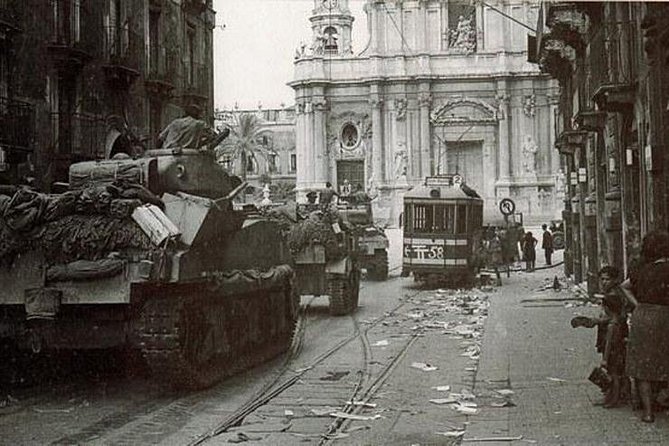
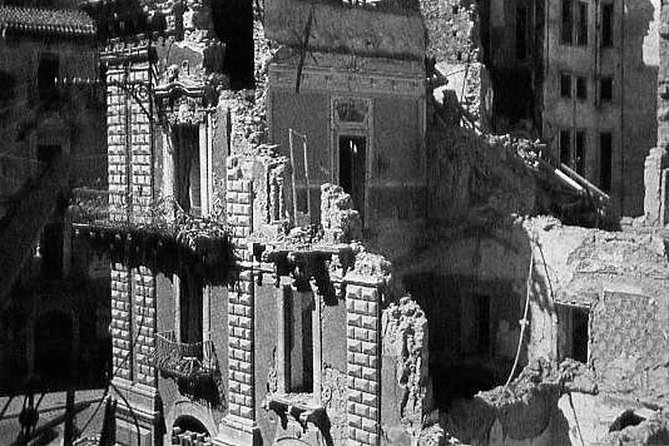
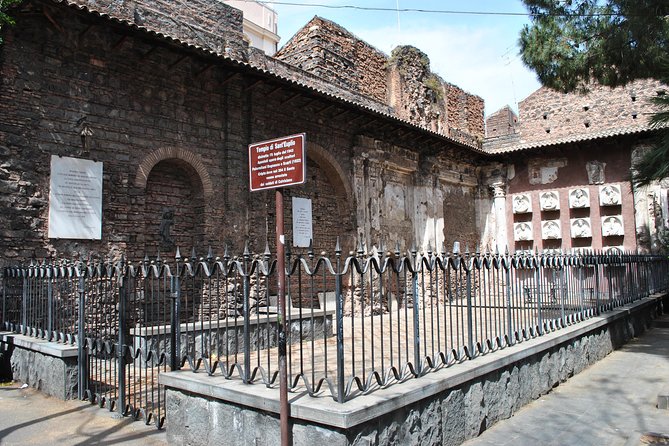
The next stop is a brief visit to Via Sant’Euplio, where the ruins of the ancient church dedicated to Catania’s patron saint still show damage from the July 1943 bombings.
You spend about 10 minutes here, and there is no separate admission charge. Do not expect a large museum or a lengthy monument visit. This is a compact, visual stop where the surviving walls and scars do the work.
The value lies in seeing more than one wartime mark across the city. The museum gives you documents and explanation. The Roman amphitheater shows how an ancient structure was used during the war. Via Sant’Euplio gives you another physical reminder of the bombing.
The short timing is sensible, but it also means the guide’s explanation is important. Without context, damaged masonry can be easy to pass without understanding what happened there.
Same island, a completely different day out:
- Palermo: Hop-on Hop-off Bus Tour 24-hour Ticket
★ 3.9 · 2,410 reviews - From Trapani: Cruise to Favignana and Levanzo with lunch
★ 4.2 · 2,286 reviews - Catania: Sunset Jeep Tour of Mount Etna and Lava Flow Caves
★ 4.8 · 2,113 reviews - Palermo Original Street Food Walking Tour by Streaty
★ 5.0 · 2,105 reviews
Ending in Piazza del Duomo
The tour is scheduled to end in Piazza del Duomo, the center of Catania, after about 15 minutes at the square. Here the wartime story meets the city’s much older religious and civic history.
Among the monuments of the square, you pause at an altar that still bears bombing marks. After the war, it became a place of prayer for peace. This is a quiet ending rather than a dramatic one, and that suits the subject.
Piazza del Duomo is also a practical finishing point for continuing your day in central Catania. The tour information separately gives the Roman amphitheater as the end meeting point, while the detailed route continues to Via Sant’Euplio and Piazza del Duomo. Because those details do not match perfectly, confirm the exact final drop-off when booking.
A private tour changes the pace
This is a private activity, so only your group participates. That is a useful advantage in a museum where you may want to ask about a particular battle, local family experience, or piece of evidence.
A private guide can also adjust the experience for physical needs. One participant with an elderly mother was able to ride in Oreste’s car from the museum to the next part of the tour. That does not guarantee private transport for every booking, so ask about it in advance, but it shows the kind of practical adjustment the format can allow.
The route includes several city locations, and most people can participate. The museum and stops are near public transportation. Service animals are allowed. Still, the published details do not provide a full accessibility breakdown for every entrance, stairway, or surface, so anyone with limited mobility should ask specific questions before booking.
The tour is offered in English. Confirmation is provided at booking, and a mobile ticket makes arrival simple.
Is $94.68 a fair price?
At $94.68 per person, this is not a bargain-priced city walk. The value depends on what you want from Catania.
You are paying for about three hours, museum admission, an English-speaking guide, a private group, and a carefully connected historical route. The museum receives two hours, which means the cost is not being spread across a rushed series of postcard stops. If your group cares about World War II history, the private format can make the price reasonable.
Group discounts may improve the value for larger parties. A private tour also avoids the drawbacks of a large group, such as waiting for strangers or limiting questions to fit a fixed script.
The price is harder to justify if you are mainly interested in ancient Catania. The Roman amphitheater is included, but only as part of a wartime story. You will not get a broad tour of all of Catania’s main sights.
I would compare this experience with the cost of museum admission and a private guide separately, but the deciding factor is not arithmetic alone. The museum, the local war sites, and the guide’s ability to explain how they connect are the product.
Who will get the most from this experience?
I would recommend this tour to you if you have a strong interest in World War II, military campaigns, civilian life during wartime, or the way historic cities carry damage into the present.
It also suits visitors who prefer focused history over a general sightseeing circuit. The route has a clear subject, and every stop supports it.
Families with older relatives may find the private format useful, especially if transport between locations can be arranged. Oreste’s willingness to help with an elderly participant is a positive sign, though you should discuss your group’s needs before the day.
This is less suitable if you want a relaxed stroll through Catania, a food-focused tour, or a full introduction to Sicilian architecture. The museum is the heart of the experience, and it asks for attention.
The schedule also matters. The stated operating hours are Tuesday through Sunday, from 10:00 AM to 1:00 PM, for the date range shown as September 5, 2019 through March 18, 2027. Since the experience lasts about three hours, the morning timing is important. Check the available date and start time before making other plans.
Booking and cancellation details
You can cancel for a full refund if you do so at least 24 hours before the local start time. Cancellations made less than 24 hours before the experience are not refunded, and changes within that period are not accepted.
The starting point is the Museo Storico dello Sbarco in Sicilia 1943 at Piazzale Rocco Chinnici, Catania. The supplied meeting information names the Roman Amphitheater of Catania in Piazza Stesicoro as the end point, while the route description places the final stop at Piazza del Duomo. Confirm that detail directly so your transport plans are correct.
Should you book Catania 1943: Husky Operation?
Book it if you want a serious, local account of Sicily in 1943 and appreciate a guide who can connect museum evidence with surviving city sites. The two-hour museum visit, the Battle of the Simeto material, and the bomb-damaged Sant’Euplio locations give this tour more substance than a standard historical walk.
I would skip it if you have little interest in World War II or want to see Catania’s main sights without a fixed theme. At $94.68 per person, the tour needs to match your interests.
For the right audience, this is a thoughtful way to understand Catania beyond its ancient stones and grand squares. It shows how the city’s past is not locked in one period. Some of it is still visible in shelter spaces, broken churches, and a simple altar dedicated to peace.
FAQ
How long does the Catania 1943 tour last?
The experience lasts approximately three hours. About two hours are scheduled at the Museo Storico dello Sbarco, followed by around 30 minutes at the Roman amphitheater, 10 minutes on Via Sant’Euplio, and 15 minutes in Piazza del Duomo.
What language is the tour offered in?
The tour is offered in English.
Is museum admission included?
Yes. Admission is included for the Museo Storico dello Sbarco and the Roman amphitheater.
Is this a private tour?
Yes. Only your group participates in the activity.
Where does the tour begin?
The tour begins at the Museo Storico dello Sbarco in Sicilia 1943, Piazzale Rocco Chinnici, 95129 Catania, Italy.
Where does the tour end?
The route description ends in Piazza del Duomo, while the meeting information names the Roman Amphitheater of Catania in Piazza Stesicoro as the end point. Confirm the exact final location when booking.
Can I cancel for a full refund?
Yes. You can receive a full refund if you cancel at least 24 hours before the experience’s local start time. Cancellations or changes made less than 24 hours before the start are not accepted or refunded.
Just added around Sicily
- Anti-Mafia Heroes (Cool Hours) Morning Walking Tour★ 5.0 · 3 reviews
- Nicolosi: Excursion Etna Craters at 3000 mt.★ 4.2 · 3 reviews
- DISCOVER THE SECRET OF PALERMO Walking Tour Combining Art and best street food★ 5.0 · 3 reviews
- The art of the Italian Aperitivo with a local: Learn & Enjoy in Palermo★ 5.0 · 3 reviews
- Taormina PRIVATE EAST COAST EXCURSIONS 2 Exclusive Days with Guide Driver★ 5.0 · 3 reviews
- Monti Rossi Adventure Park Entry Ticket Full★ 5.0 · 3 reviews
- Guided kayak tour inside the Stagnone of Marsala★ 5.0 · 3 reviews
- Catania : Diving for patented divers★ 5.0 · 3 reviews