
Reviewed · FOOD & DRINK
Catania: Private Tour with Arancino Tasting
Catania’s best sights line up in a compact two-hour walk, ending with one of Sicily’s most satisfying snacks: a hot arancino, eaten by hand from its bottom point. You move from Norman-Swabian stonework to Baroque churches, a lively fish market, and an opera house without needing a taxi or bus.
I like the private group format, which gives you room to ask questions, and I like the smart route through Catania’s historic center. Guide Silvia has a PhD and brings strong historical knowledge to the walk. The main caution is pace: two hours covers a lot, and the tour is not suitable for wheelchair users.
In This Review
- Key points to know before booking
- Catania in two focused hours
- Starting beside the elephant fountain
- Ursino Castle and Catania’s medieval edge
- Via Auteri, Roman baths, and the fish market
- Piazza del Duomo and the Baroque rebuild
- Sant’Agata Cathedral and Vincenzo Bellini
- The proper way to eat an arancino
- Bellini Theater and Catania’s musical side
- Via Vittorio Emanuele to San Nicolò
- What the $183.52 price really buys
- Who should choose this Catania walk
- Should you book it?
- FAQ
- Where does the Catania tour start?
- Where does the tour end?
- How long does the tour last?
- Is the arancino included?
- Which languages are available?
- Are entrance fees, transportation, and other food included?
Key points to know before booking
- Ursino Castle begins the story: See a 13th-century fortress built with an unusual mix of Eastern and Western design influences.
- The route connects major sights efficiently: The fish market, Piazza del Duomo, cathedral, Bellini Theater, and Benedictine monastery all fit into one central walk.
- The arancino is part of the experience: You receive a Sicilian rice snack filled with meat sauce, shaped like a drop and eaten with your hands.
- The guide matters here: Silvia is specifically noted for her PhD and strong command of the history behind the sites.
- The tour starts and ends at Piazza del Duomo: Meet beside the elephant fountain, with no hotel pickup or drop-off included.
- Plan for walking: Wear comfortable shoes and clothing, carry water and cash, and remember that Roman theater entry fees are extra.
Catania in two focused hours
Catania can feel broad and busy when you first arrive, but its central sights are close together. This tour makes good use of that layout. You do not spend your short outing crossing town. Instead, you follow a mostly sightseeing-focused route through the old center, with stops that show how Roman, Norman-Swabian, Baroque, royal, religious, and modern cultural threads overlap.
The experience is private, so the guide can set the tone for your group. You may want dates, architecture, and famous names explained in detail, or you may prefer a brisk orientation before exploring on your own. English and Italian are available.
The four-and-a-half-star rating is based on only four reviews, so I would not treat it as a broad statistical verdict. Still, the specific praise is useful. Silvia is singled out for her excellent command of the places visited, with her PhD adding depth to the explanations. That detail matters in Catania, where a quick look at a church or castle does not tell you why it is there.
At $183.52 per person, this is not a bargain walking tour. The price makes more sense for someone who values a private guide, a focused route, and a food sample rather than a large group and a lower rate. If two or more people share the experience, private touring may feel more worthwhile because you receive direct attention throughout the walk.
More food and wine trips in Catania:
- Catania: Mount Etna Morning or Sunset Day Trip with Tasting
★ 4.8 · 4,028 reviews - From Catania: Mount Etna Sunset Tour with Tasting and Cave
★ 4.7 · 1,119 reviews - Catania: Etna Morning Excursion with Tasting and Pickup
★ 4.8 · 820 reviews
Starting beside the elephant fountain
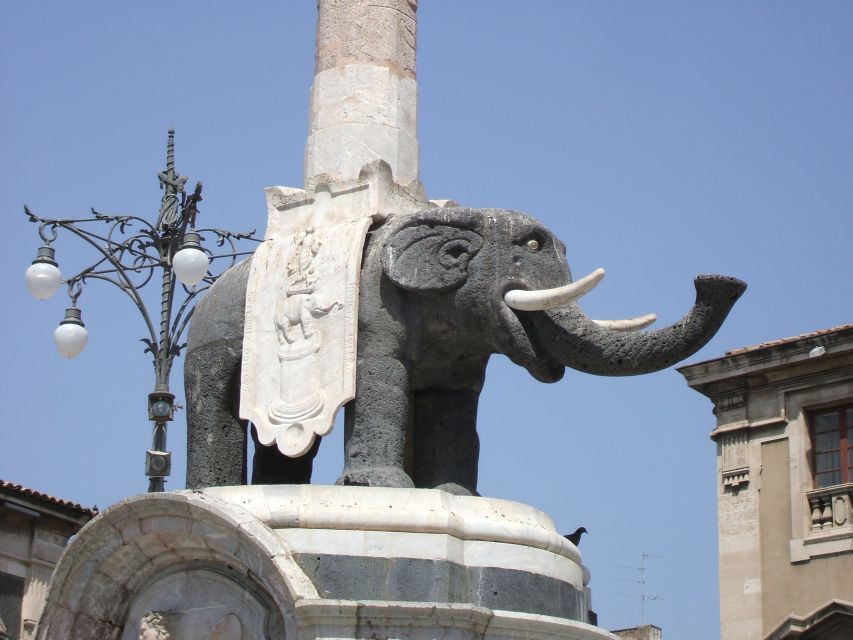
Your meeting point is Piazza del Duomo, right next to Catania’s elephant fountain. This is a practical start because the square is one of the city’s clearest landmarks. Arrive with enough time to locate the fountain and meet the guide without cutting into the two-hour visit.
The fountain features an elephant carrying an obelisk, and it gives the square an instantly recognizable center. From here, the tour connects several of Catania’s main sights. You should have your camera ready, but do not let photography take over the walk. The value is in seeing how the buildings relate to one another, not just collecting isolated pictures.
Because pickup and drop-off are not included, you must make your own way to Piazza del Duomo. The activity ends back at the same meeting point. That return is useful if you plan to continue sightseeing, shop, or stop for a meal nearby.
Ursino Castle and Catania’s medieval edge
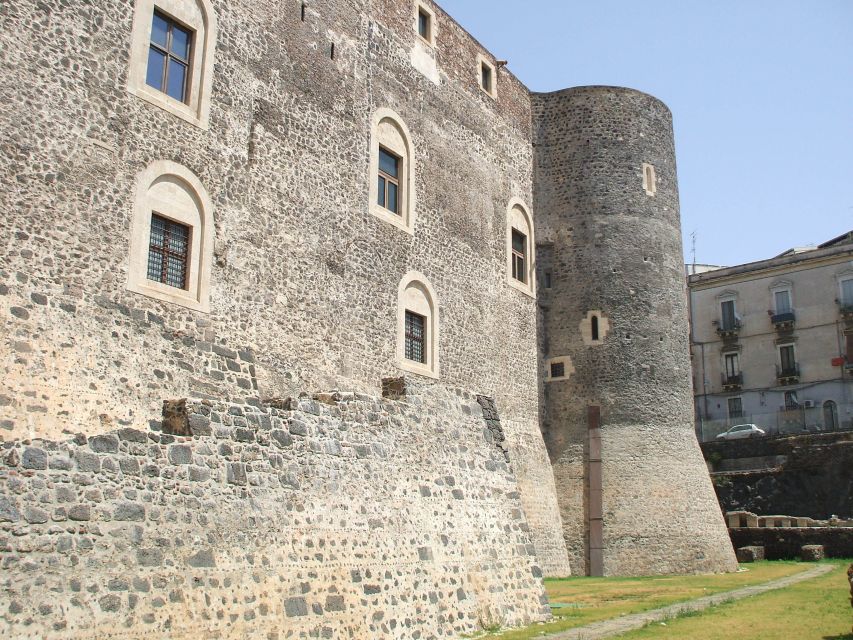
The walk begins at the 13th-century Ursino Castle. This Norman-Swabian fortress gives you a strong opening because it looks and feels different from the Baroque center that follows. Its architecture reflects Eastern and Western influences, a reminder that Sicily has long sat at a crossroads of cultures and rulers.
Take time to look at the castle’s heavy form and defensive character. The guide can help you read the building as more than an attractive backdrop. It was made to protect power, not simply to decorate the city. The castle also gives the tour a useful historical starting point before you move toward churches, public squares, and theaters.
The castle is one of the more substantial stops, but the tour is a walking route rather than an extended museum visit. If you want a long interior exploration or a full look at every collection connected with the castle, two hours will not provide that. Here, the emphasis is on orientation, architecture, and the place of the castle in Catania’s story.
Via Auteri, Roman baths, and the fish market
After Ursino Castle, the route passes along Via Auteri and by the Roman baths. These stops bring older layers of the city into view. Catania was not built in a single period, and the walk makes that clear by placing Roman remains near medieval stonework and later Baroque buildings.
The Roman baths are also a good example of why a guide can add value. Ruins can be easy to pass without understanding what you are looking at. The tour does not include Roman theater fees, so ask your guide what is included in the outdoor walk and what would require a separate ticket. Do not assume every Roman site along the route includes interior entry.
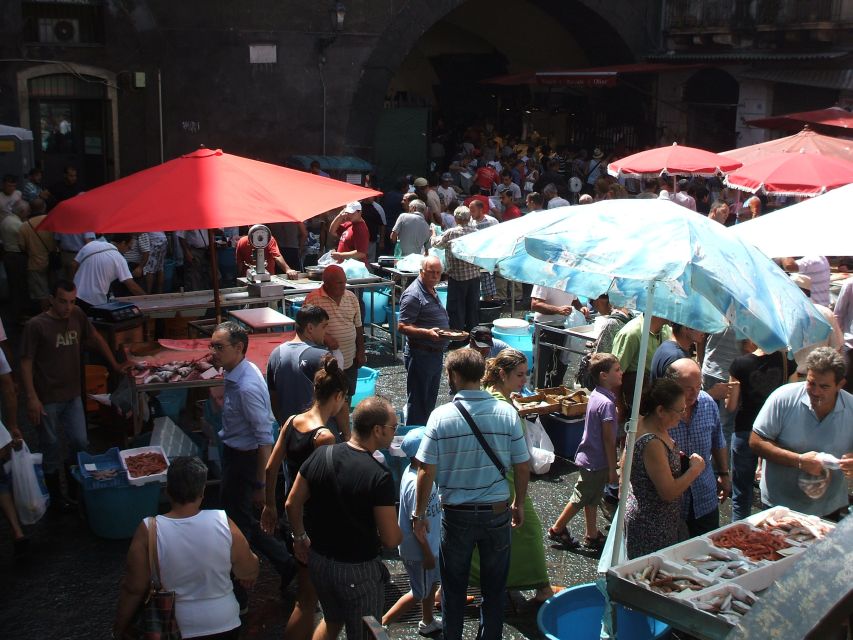
Next comes Catania’s fish market. This is one of the route’s more sensory stops, with displays of sea creatures and the activity of a working food market. It gives you a look at daily commerce, not just grand monuments. That contrast is important. A city is not only its cathedral and palaces. It is also the place where people buy food and go about ordinary business.
Market conditions can change from day to day, so keep your expectations practical. You are walking through a food market, not attending a staged tasting. Stay aware of the group and follow the guide’s lead as you move through the area.
A few more Catania tours and experiences worth weighing up
- From Taormina: Private Godfather Tour with Lunch
★ 4.9 · 128 reviews - Catania : Private Custom Walking Tour With A Guide (Private Tour)
★ 4.5 · 92 reviews - Catania: Private custom tour with a local guide
★ 4.7 · 78 reviews - From Taormina: Private 3 Etna Wineries with Food & Wine
★ 4.9 · 71 reviews
Piazza del Duomo and the Baroque rebuild
From the fish market, you reach Piazza del Duomo. This is the visual center of the tour, with Baroque buildings arranged around the elephant fountain. The square shows Catania after the earthquake of 1693, when much of the city was rebuilt.
The architectural style here is bold without being fussy. Look upward at the pale stone facades, then back toward the fountain and the cathedral. The square works as a complete scene, and the guide can help explain how the buildings fit into the city’s reconstruction.
I like this point in the route because it brings together several themes introduced earlier. You have seen the medieval castle and Roman remains, then watched the city shift toward its later Baroque identity. Catania’s architecture becomes easier to understand when you see those periods in sequence.
This is also a useful place for photographs. The elephant fountain and surrounding buildings are among the tour’s most recognizable views. Your camera is worth carrying, but comfortable shoes matter more. The walk includes several stops, and standing on hard streets for two hours can become tiring.
Sant’Agata Cathedral and Vincenzo Bellini
The Cathedral of Sant’Agata was built in 1090 above the Roman baths of Achille. That location gives the building a layered foundation, with Christian worship placed over an earlier Roman site. After the 1693 earthquake, the cathedral was completely rebuilt, so what you see today reflects both an older religious history and a later Baroque reconstruction.
Inside, you can see the tomb of composer Vincenzo Bellini and the graves of several Aragonese kings. Those details give the visit a human focus. The cathedral is not only an architectural stop. It connects Catania to music, royal power, and local devotion.
Bellini is one of several artists and thinkers associated with the city’s creative life. The tour also points toward Catania’s connection with figures such as Carmen Consoli, Giovanni Verga, and Ettore Majorana. You should not expect a full biography of each person during a two-hour walk, but their names help show how the city has inspired work in music, literature, and science.
The cathedral stop is especially worthwhile if you enjoy places where different eras overlap. Roman foundations, medieval origins, earthquake reconstruction, royal burials, and Bellini’s tomb all occupy the same location. You will get more from it if you listen for those connections rather than treating it as a quick photo stop.
The proper way to eat an arancino
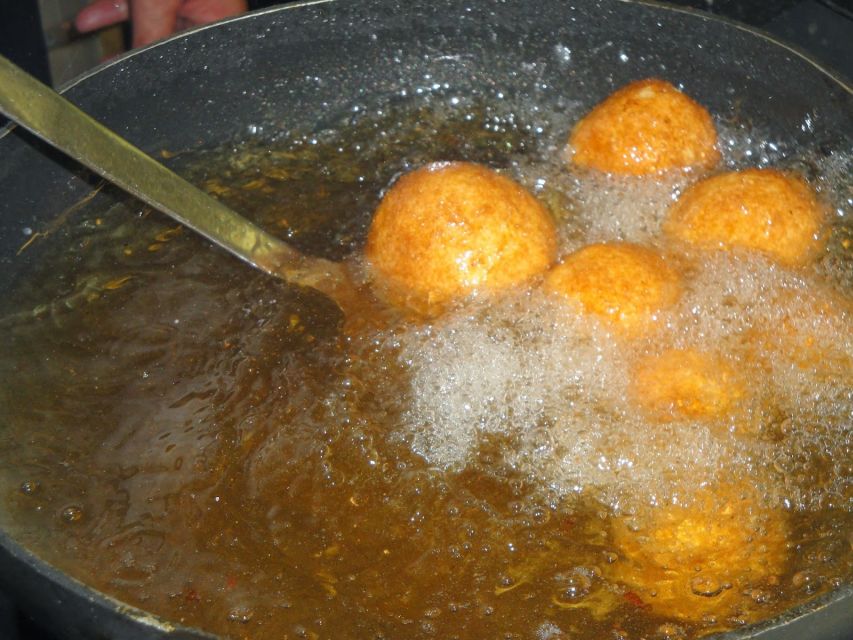
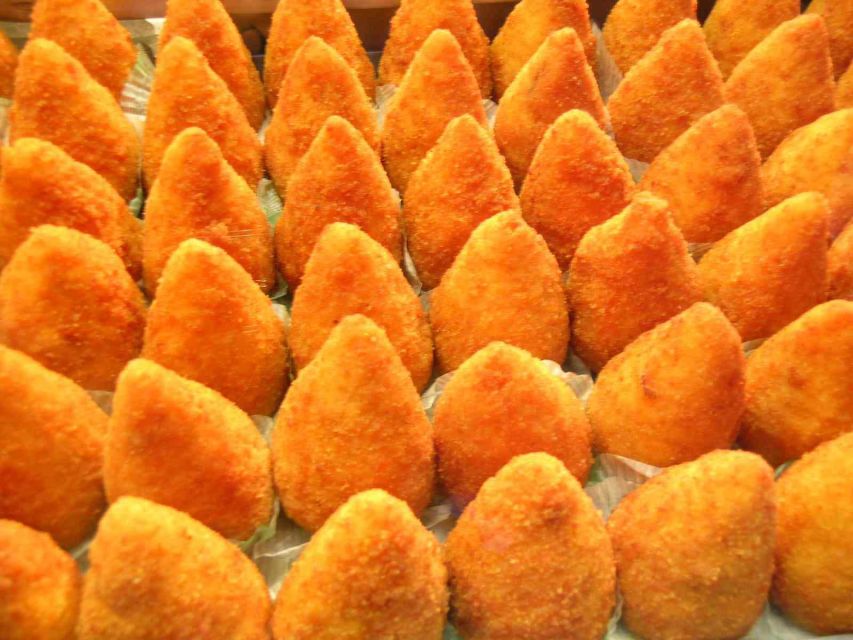
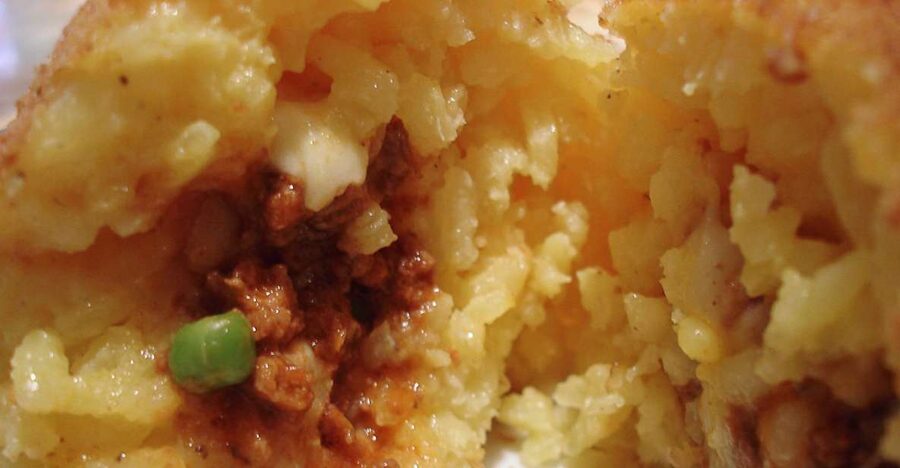
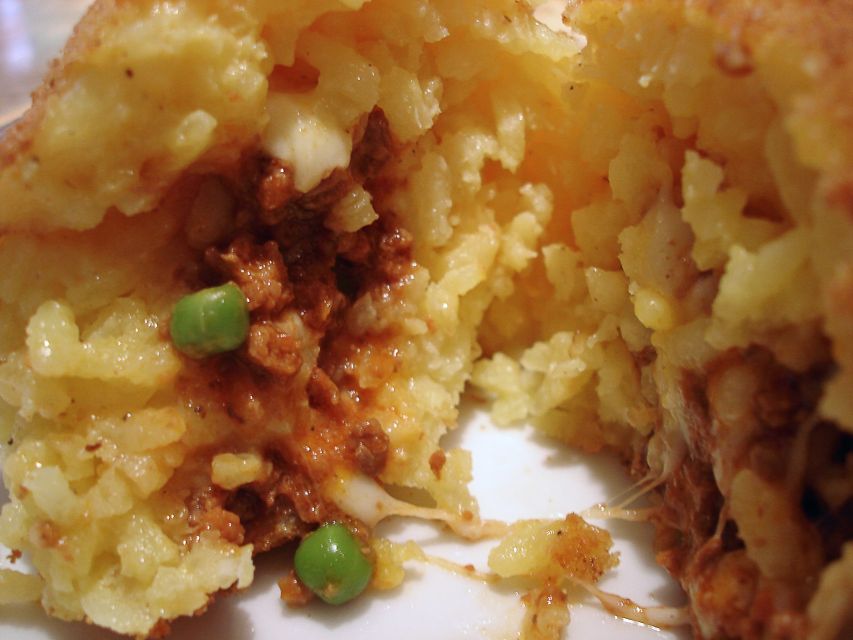
The food tasting is short, but it gives the tour a welcome change of pace. You receive a Sicilian arancino, a rice-based snack filled with meat sauce and shaped like a drop. The instructions are simple and delightfully firm: hold it by the bottom point and eat it with your hands.
This is not a formal meal, and the included tasting does not cover other food or drinks. Still, it is a useful introduction to one of Sicily’s best-known street foods. Rice, filling, and a crisp outer layer make an arancino more substantial than a small sample might suggest.
The food also adds a local touch to a route that could otherwise feel heavily focused on monuments. You have just seen a cathedral and a major square, then you pause for something people eat in everyday life. I like that balance.
Carry water, and bring cash and a credit card in case you want to buy additional food or drinks. The provided information does not specify the exact arancino filling beyond meat sauce, so do not book this as a full food tour. Think of it as one well-placed taste during a history walk.
Bellini Theater and Catania’s musical side
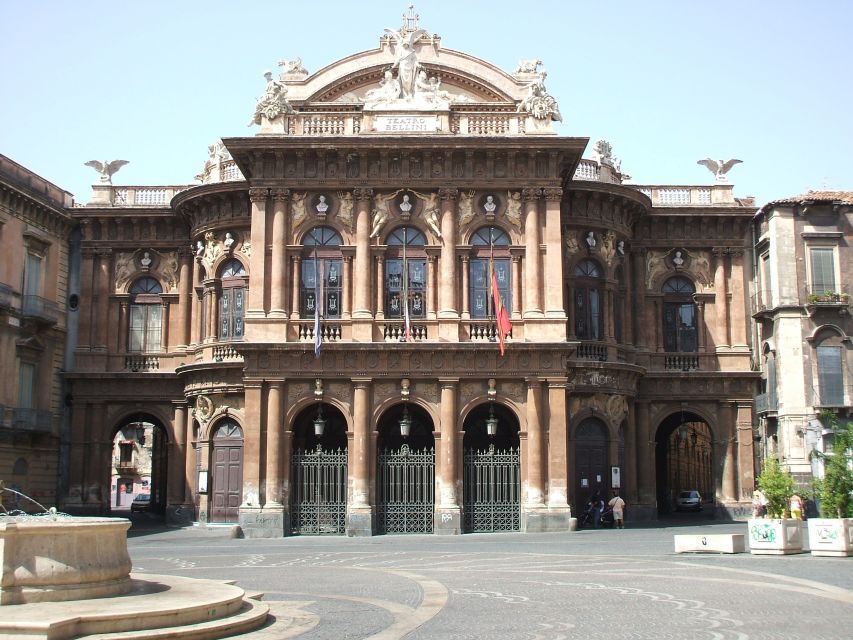
After the arancino, the route continues to the Bellini Theater, an impressive building associated with opera. It is described as the most famous theater in Italy, and the stop gives the tour a cultural counterpoint to the religious buildings and ancient remains.
The theater is especially relevant after visiting the cathedral tomb of Vincenzo Bellini. The composer’s name is part of the city’s identity, and the theater helps connect that identity to live performance. Even if you are not an opera fan, the building’s design gives you another strong exterior view and a chance to see how Catania presents its artistic life.
The stop is primarily a sightseeing visit. The tour information does not promise an opera performance or interior admission, so you should not expect to attend a show as part of the two-hour walk. Take photos, listen to the guide, and note the location if you want to return later for a performance.
Via Vittorio Emanuele to San Nicolò
The final stretch follows Via Vittorio Emanuele and ends at the Benedictine monastery and the Church of San Nicolò. By this point, the route has moved through a castle, Roman remains, a market, a grand square, a cathedral, and a theater. The last section adds another religious and architectural marker to the city center.
The Benedictine monastery and San Nicolò provide a quieter closing note after the market and Piazza del Duomo. The walk ends where it began, at the meeting point. That arrangement keeps your afternoon flexible. You can stay in the center, return to a sight for a longer visit, or continue on to another part of Catania.
Because the schedule is only two hours, the final stops may feel brisk if your group asks many questions earlier. That is not necessarily a flaw, but it is something to keep in mind. If you want extended interior visits at every church and archaeological site, book separate time for them.
What the $183.52 price really buys
At $183.52 per person, the main purchase is not transportation or a long list of admissions. It is private guiding over a compact historic route, plus the arancino tasting. The local guide, English or Italian language choice, and private group setup are the core value.
The price is easier to justify if you want personal explanations and do not enjoy large groups. Silvia’s academic background may be particularly useful if you care about architecture, history, and the people connected with Catania’s cultural life. A private setting also lets you ask about the sites that interest you most.
The value is weaker if you mainly want to see the exteriors quickly and can follow a map on your own. Roman theater fees, other food and drinks, and transportation are not included. You should also remember that the tour does not provide hotel pickup or drop-off.
Free cancellation is available up to 24 hours before the activity for a full refund, and you can reserve now and pay later. Those terms help if your schedule is still changing, but they do not change the basic calculation: this is a premium short walking tour, not an inexpensive group introduction.
Who should choose this Catania walk
I would recommend it to you if you have limited time in Catania and want a clear introduction to the central sights. It suits first-time visitors who prefer a guide to connect the castle, Roman remains, cathedral, theater, and Baroque center into one understandable route.
It is also a good fit for couples, families, or small private groups who want to ask questions without speaking over a large crowd. People interested in Vincenzo Bellini, opera, Sicilian architecture, or religious art will find several useful stops.
You should think twice if mobility is a concern. The activity is not suitable for wheelchair users, and the route requires walking and standing. Anyone looking for a full meal, a dedicated archaeological tour, or extended museum entry will also need a different plan.
Wear comfortable shoes and clothes, bring water and a camera, and carry both cash and a credit card. Check the available start times before booking, since the tour lasts two hours and timing may affect what you do before or after it.
Should you book it?
Book this tour if you want a private, academically informed introduction to Catania and like the idea of mixing major sights with a simple local food tasting. The route is well chosen, the meeting point is easy to identify, and the return to Piazza del Duomo keeps your day open.
Skip it if the price feels high for two hours, if you want substantial interior visits, or if you need a wheelchair-accessible route. For the right group, though, the combination of Ursino Castle, Sant’Agata Cathedral, Bellini Theater, the fish market, and a hand-held arancino makes a tidy and useful first look at Catania.
FAQ
Where does the Catania tour start?
Meet your guide at Piazza del Duomo, right next to the elephant fountain.
Where does the tour end?
The activity ends back at the meeting point in Piazza del Duomo.
How long does the tour last?
The tour lasts two hours. Available starting times are shown when you check the booking calendar.
Is the arancino included?
Yes. An arancino tasting is included. The snack is shaped like a drop, filled with rice and meat sauce, and eaten by hand from the bottom point.
Which languages are available?
The live tour guide is available in English and Italian.
Are entrance fees, transportation, and other food included?
Roman theater fees, additional food and drinks, hotel pickup, and drop-off are not included.
Just added around Catania
- Catania : Diving for patented divers★ 5.0 · 3 reviews
- Catania AIRPORT transfer From / To Taormina★ 5.0 · 3 reviews
- Transfer Catania / Agrigento Airport★ 5.0 · 3 reviews
- Taormina: exclusive tour with food, drinks, and sunset, pick-up from Catania★ 5.0 · 3 reviews
- From Catania/Taormina: Mount Etna Private Wine Tasting Tour★ 4.7 · 3 reviews
- From Catania: Day Trip to Giardini Naxos and Taormina★ 5.0 · 3 reviews
- Catania: Summit Craters from North Etna with 4×4 vehicles★ 5.0 · 3 reviews
- Catania: Guided Street Food Tour with Tastings★ 5.0 · 3 reviews
Food & Drink, compared.
Mount Etna Morning or Sunset Day Trip with Tasting
Read our review →
Palermo Original Street Food Walking Tour by Streaty
Read our review →

Street Food Walking Tour with Local Guide & Tasting
Read our review →
Browse the lists this tour appears in